



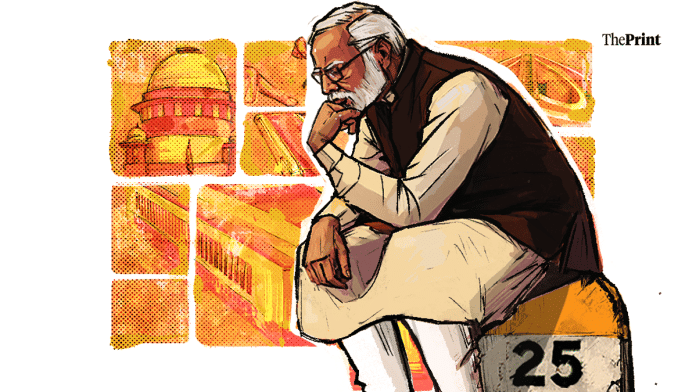
This is the season for looking at Narendra Modi’s 25 years in power, and beyond. His followers are celebrating. His Cabinet has passed a resolution praising him. Critics, of course, are dissecting his quarter century in public life, not with a scalpel but with a scythe.
It’s also the season for people, especially journalists, telling their ‘when I first met Modi’ stories. I’ll hold on to mine for another day. Let’s not risk diluting today’s serious argument.
Two weeks ago, we noted in a National Interest column that, for any incumbent in India, the third year of a term is the toughest. This is when challenges build up, fatigue sets in, aspiring successors sharpen the knives. We also said that the last of these doesn’t apply to Modi. Nobody in his party would even dare to whisper the ‘S’ word.
The third year of Modi’s third term, however, is beset with all of the other challenges. His tired and incomplete Cabinet is struggling. His chief ministers—barring Yogi Adityanath, Devendra Fadnavis and Himanta Biswa Sarma—aren’t up to the multiple challenges.
Having used the ancient editorial privilege of ‘tabooing’ a word, and listing the cliched “narrative” under it, I then can’t use it. The fact is, this market of popular opinion is rife with competing, contradictory notions. The Modi-BJP story is still the most significant. It just isn’t as dominant as before. Multiple headwinds make the turbulence Modi is battling as he steps into his 26th year in public office.
This has brought the classical, and so far all-conquering, three-point Modi proposition under the greatest pressure since 2014. The three points are: hard, Hinduised nationalism; ever-expanding welfare, distributed efficiently, with minimal friction or leakage; and visible construction of physical infrastructure. All of this without significant overhang of corruption.
The Modi proposition survives. It’s just that several other factors have now emerged. And we aren’t just talking about the rebellion of an irreverential, ageist, educated and mostly not-impoverished Gen-Z. What makes this period of crisis unprecedented in Modi’s prime ministership is the convergence of these factors. Like the Shakespearean “when sorrows come, they come not single spies, but in battalions”.
In isolation, each of these factors may look small. But they become formidable when the big picture comes together. As the great management guru late C.K. Prahalad used to say, ‘weak signals add up to a big change’. He elaborated this in his oft-quoted 1995 paper “Weak Signals Versus Strong Paradigms” (Sage Journals). Prahalad himself summarised it thus: “Taken one at a time, these signals don’t add up to much. But taken together, they present a picture of a country (or industry) in dramatic transformation.”
Is this what Modi is confronted with now? Let’s check out some facts.
Also Read: Let’s keep Pakistan, Bangladesh out of our politics. It undermines India’s strategic interests
I’m reducing these ‘battalions of sorrows’ to a dozen most significant.
- Dramatic damage to the credibility of the Election Commission of India (ECI), and thereby growing doubts over the integrity of the election process.
- A growing belief that the top judiciary either doesn’t dare look the executive in the eye, or gives wishy-washy orders. Worse, that it speaks with a forked tongue. Ironically, this view is shared on both sides.
- A solitary retired civil servant (Subhash Chandra Garg) was able to trigger a nationwide debate on the credibility of GDP figures.
- Inflation, as now forecast by the RBI, is set to rise to its highest level in nearly three years, and the rupee is struggling despite a highly successful, if expensive, round of global deposit-raising by Indian banks.
- Two of this establishment’s most trusted civil servants, the two Election Commissioners (ECs), protected their own backs by creating a paper trail to record their opposition to the CEC’s decisions.
- Ability of the Opposition, especially Rahul Gandhi, to lay siege to the Capital with English TV channels and Hindi newspapers, including the ones ‘most trusted’ by the establishment, giving it prominent airtime.
- Young people lampooning the Prime Minister with mere feckless pushback from his ‘Right-wing’ supporters and an overnight phenomenon like CJP setting the agenda, from NEET to the state of government schools.
- A small ally like Chirag Paswan taking a swipe at the Bihar government over law and order. And a way smaller ally Om Prakash Rajbhar going public with his purported conversation with the Prime Minister on Uttar Pradesh’s division into multiple states, which Yogi Adityanath firmly opposes.
- Contrary to the Modi government’s decisive image, we’ve seen festering indecisiveness on whether to press with delimitation, or what to do with a Parliament session that has not been prorogued even two months after its adjournment sine die. To the naked eye, it shows a lack of confidence in marshalling the numbers for constitutional amendments the BJP really wants.
- Inability, one can also say prolonged hesitation, in carrying out a Cabinet reshuffle, or at least filling the vacant slots. There are too many of them, including education.
- Continued value destruction in the stock market across Modi’s third term as all global peers, from the US to Europe, Japan, South Korea and China to even Pakistan, have boomed. The disinclination to acknowledge the challenge is a self-destructive cop-out when millions from the Middle Class have moved their savings into SIPs and are celebrated by the government for doing so. It also amounts to them having given the fleeing Foreign Portfolio Investors (FPI) a golden handshake.
- And finally, a global situation for India not seen in decades. Trump has narrowed India’s strategic space in many areas. He’s also challenging our claims to strategic autonomy, with a provocation a day. Beyond Trump, the war in Ukraine, smouldering West Asia, roiled energy markets, and a newly opened strategic-rentier window for Pakistan.
Also Read: 20% ethanol, 80% anger: BJP’s core voter is furious and looking for answers
All of these have come on top of a deficient monsoon. That’s beyond any government’s control. But these simmering discontents will play out in a below-average farming year. The larger issues, however, are rooted in the three most fundamental factors that have made India cohesive and stronger over the decades. These are: trust in the Constitution and the belief that nobody can take it away; fairness of the top judiciary; and independence of the Election Commission. All three are under strain now.
The BJP knows better than its opponents how badly it was damaged in 2024 by rumours fed by just the odd statement from its middling functionaries, and the Ayodhya candidate, that the party needed 400 seats to change the Constitution. Now, most Indians haven’t read the Constitution, or even the 106 amendments already carried out. But they see the Constitution almost like a deity or a scripture. Fair, secular, with a Bill of Rights they won’t let anybody take away. Constant talk of special Parliament sessions have brought back these suspicions.
The Supreme Court has, unfortunately, built a well-deserved reputation of flip-flops, cynical prevarications and talking more than writing. This also applies to its treatment of the SIR issue so far. It’s being watched closely now as it battles multiple challenges—from restoring the credibility of the ECI, to taking a view on the right to protest in the Capital.
And finally, the ECI. Through nearly eight decades, the institution has had good days and bad, some indifferent ones too. It was, however, never as broken as it is now. An ECI caught in an every-man-for-himself trap will struggle to win back popular confidence. It’s a national crisis.
These are the challenges Modi needs to address as he steps into his 26th unbroken year in public office. If he doesn’t, or fails to do so, C.K. Prahalad’s small signals theory shows that a dramatic crisis awaits Modi in the two and a half years until the summer of 2029.
Also Read: Guru RSS is cautioning shishya Modi govt. Bhagwat’s endorsement of Gen Z has an Indira lesson