



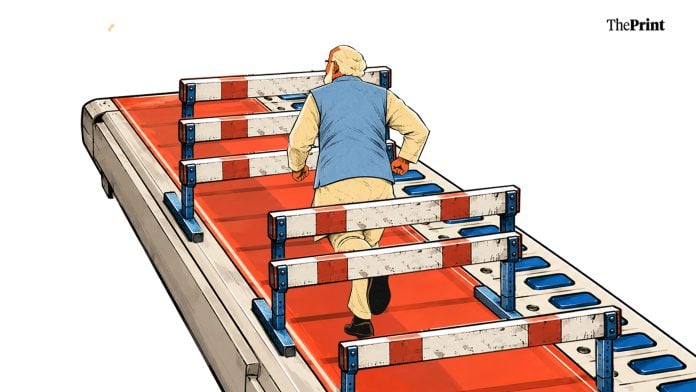
If you promise you won’t Google, I’ll ask you three questions.
One, how many Chief Election Commissioners (CECs) preceded Gyanesh Kumar in the Modi era?
Second, can you recall even one?
And third, how many CECs can you remember, beginning 1950?
The answer to the first is, eight. Eight CECs have served honourably and faded away in the Modi era, across which the BJP, as its own spokesperson acknowledged, “lost 20 elections” and was reduced to 240 seats in the Lok Sabha in 2024. You’d of course remember T.N. Seshan in the nineties for how he reinvented the institution. S.Y. Quraishi for being so active in civilised public debate. And probably, Manohar Singh Gill. That’s partly because he successfully took on Seshan’s ‘dictatorship’ along with fellow Election Commissioner G.V.G. Krishnamurty in 1993-95, paving the way for the principle of the ‘three members being equal’. Also, partly because Gill became a minister of state (MoS) in the Manmohan Singh Cabinet.
The remaining 22 CECs quietly retired, their reputations mostly intact. As for the great institution they led, many enhanced it. Hardly anybody hurt it.
Even I, having covered politics and elections for nearly 50 years now, can recall only a handful of names. Some whom I knew personally from before they became CEC, and others with whom I interacted with professionally.
The first one I spoke with was R.K. Trivedi (18 June, 1982 to 31 December, 1985). This was in the context of the disastrous election Indira Gandhi forced on Assam in the face of a violent mass boycott that consumed about 7,000 lives. Why did he railroad an election like this, I asked Trivedi. “I have to be practical,” was his short answer. It became a much-quoted line.
This long preamble wading 75 years back is to put in perspective the fact that Gyanesh Kumar has now become the second most unforgettable among our 26 CECs. He obviously didn’t seek this ‘fame’. But he can’t shake it off. Nor can the Modi government disown him. However, the indications are that they’d wish to do so. Hear the sharp criticism targeting him by many influential commentators, including noted TV anchor Rajat Sharma, whom nobody would mistake for an Opposition megaphone.
Gyanesh Kumar’s position is among the highest constitutionally-protected positions in the country. Nobody can fire him. With the new 2023 law, he can never be prosecuted for any action as CEC. The Opposition can threaten but don’t have the numbers to impeach him. If the government ‘persuades’ him to go, political consequences would be severe, with so many elections coming up, leading up to the big one in the summer of 2029. He can stay till his term ends on 26 January, 2029. It will just be a very long 27 months. The bind that the “system” is caught in, is classic Lady Macbeth.
Also Read: Let’s keep Pakistan, Bangladesh out of our politics. It undermines India’s strategic interests
For Modi government, this has come at a juncture that’s usually troublesome in India: the third year of the incumbent. Going back 60 years, to the Indira era beginning January 1966, every government has shown fatigue and drift in about its third year. Only those that reinvented their politics or government were able to fight their way out of this trap.
Mrs Gandhi did so by splitting her party in 1969, taking a hard Left turn and finding an ideological ally in the Communist Party of India (CPI) to match this. She won a big majority in 1971, but was in a downward spiral by 1974. Even after she returned in 1980, her government had lost direction by 1983. If Rajiv swept the elections after her assassination, it was mostly because of the nationalistic surge she had already built, especially in the Hindi heartland, with Operation Bluestar. Rajiv, despite his majority of 415 in a House of 545, also lost direction by 1987, and never recovered. As did P.V. Narasimha Rao. He had a rousing start with the 1991 reform. By 1993, his government was ‘dead man walking’, crippled by Ayodhya and Arjun Singh’s ‘secular’ rebellion.
How did Modi get over the third-year hump in his first two terms? In the first, the triple highs of Demonetisation, Uri/surgical strike and Pulwama/Balakot turned the tide. In his second term, he didn’t find such a dramatic turnaround and ultimately fell short of a majority in 2024. This is now the third year of his third term.
Even in football, or hockey, which is more familiar to us, especially in this week of the Asiad, coaches know the imperative of fresh legs. The best players tire, and you need substitutes rolling in and out. Historically, tired governments have responded with Cabinet reshuffles, to bring in fresh legs, and to change the headlines. This government has had a sameness to it for too long now.
Externally and internally, it’s facing piled-up challenges. The economy is growing, but jobs and wages aren’t. Too many lightweight chief ministers are drifting. The new big bets—semiconductors, private defence production, and critical minerals—have a long lead time.
Internationally, with Donald Trump, Xi Jinping and Vladimir Putin finding the classical big power modus vivendi, India has a very fraught maze to navigate. Note the clear indications from Washington that Putin is likely to be invited to this year’s G20 being hosted by the US. This opens opportunities for India. But it also complicates things, given critical dependencies on all three big powers.
Then, begins the flurry of elections. Uttar Pradesh first, Punjab, Gujarat, followed the next year by the bellwether Karnataka, Madhya Pradesh, Rajasthan, and Chhattisgarh. These are only the major states. Elections here will be held under the watch of a wounded EC, and the Opposition has its script. If it wins any state, it will say Modi government is on its way out. If it loses, it’ll insist the election has been stolen.
Also Read: 20% ethanol, 80% anger: BJP’s core voter is furious and looking for answers
On the positive side for Modi, politically, there’s no internal challenge. His party, allies and Cabinet are cohesive. As I wrote earlier, people might nurse ambitions, but nobody would even dare to whisper the ‘S’ word.
All of the three or four people within the BJP, who are looking at a future, know they can’t lead the party to a win in 2029. They need Modi to win a fourth term. Think Advani, Murli Manohar Joshi, Pramod Mahajan in 2003. They all wanted Vajpayee to win the 2004 election for them. Today’s seniors will rally around Modi even more strongly.
How to pull his third-term government out of its third-year trough, Modi would know best. Will it take change, or a shuffle of personnel, new ideas and projects, he would know. But the first priority must be to restore the respect for the EC as India’s most valuable institution.
There’s an exceptionalism to Indian democracy that 1.45 billion Indians so cherish—free elections, decade upon decade, even as leaders and ideologies come and go. Our democracy is a greater common good for the world, as Rahul Gandhi also acknowledged. And if it’s so, and the election process sits at its very heart, who should go out to defend it? It can’t be left to party spokespeople.
From Modi government and the EC’s point of view, the ideal thing would’ve been for the three ECs to sit together, answer questions, smile at cameras and tell the nation ‘all is well’. That it hasn’t happened underlines the magnitude of the challenge. Prime Minister Modi proudly calls India the ‘mother of democracy’. Shouldn’t he be the ideal person to come out and defend the sanctity and integrity of its election process? Who knows, it may even pull his government and party out of that third-year lassitude. Unconventional calls do sometimes work in politics.
Also Read: Guru RSS is cautioning shishya Modi govt. Bhagwat’s endorsement of Gen Z has an Indira lesson
Mr. Gupta, a highly disappointing column.
You write of happenings at the election commission without raising any serious questions or passing judgment.
For example, the 2023 law that puts the CEC above the law – just taken at face value.
The disagreements with the other two commissioners? Just mentioned and the reasons not delved into.
Is this AI slop masquerading as a Shekhar Gupta column?
Seriously man! Is this all just a ‘messaging problem’?
Poor writeup. No substantial input just hankering on past.
Dear Sekhar Gupta, what a good story it is! You are a great journey, but this article is just a story, not a media article. There is little fact here, it is just based on perception. In each and every office, private or government there will be differences of opinion, there will be objections. That is natural. But the CEC can have his opinion too. Why that does not matter. Why some objections of the ECs become more correct? Just because it is what helps the opposition parties? That is ridiculous and absurd. How many citizens have filed against SIR? That is what matters. The perceptions created by journos like you and the opposition matters little. Because you guys are misusing your positions in the democratic ladders and you guys doing for your selfish reasons. Please respect the public opinion with facts, not just perception.
The 2023 law has never been tested. A petition against the incumbent CEC has been filed in the Supreme Court, based on the investigations carried out by Indian Express.
What could be the rationale or wisdom of appointing feather light CMs for some very large states. For the average citizen, the state governments matters so much more than the central government. A wide range of services, something as basic as sending drinking water by tankers to villages.
M S Gill diminished the apolitical aura of the Election Commission by becoming a minister subsequently. Then there was Naveen Chawla, whose closeness to the family started during the Emergency itself. To be fair to history, all governments have played footsie. Some a little, some lots.
Retaining him would be a – grave – error of judgment. My second submission on Shri Vir Sanghvi’s outstanding column. Completely untenable now.
I remember Rajiv Kumar. With some forgettable Urdu couplets. There was another gentleman from Gujarat cadre. Then someone who had been Chairman CBDT, with extensions. Now part of an innocuous Lok Pal which the Editor had feared would become a monster when it was being discussed with Anna Hazare and his colleagues. A gradual decline, if one may say this respect.