



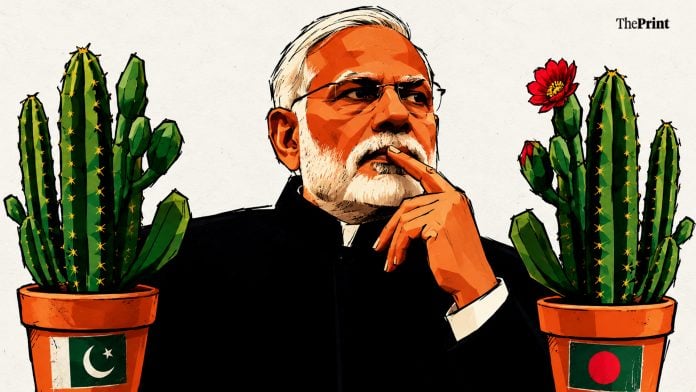
Compared to about two years ago, India’s immediate neighbourhood now looks more fraught. The important outcome for India is that these neighbourhood crises or broken relationships have also become central to our domestic politics. We’re arguing that it brings its pitfalls, and that this internalising of foreign (neighbourhood) affairs harms India’s national interest.
First, a stocktaking: ties have stabilised with Nepal, and greatly improved with Sri Lanka and the Maldives; with Bhutan, they remain solid as ever.
The situation with Pakistan has worsened with the rise of Asim Munir and his ideological view of religion, nationhood, history, politics, and geography. Bangladesh is a new challenge with the fall of Sheikh Hasina and rise of Tarique Rahman.
Rahman’s sweeping majority is riddled with withering contradictions. The biggest, is that it’s accompanied by the mainstreaming of Jamaat-e-Islami. It’s historically been pro-Pakistan. Marginalised so far, it walked into the Opposition space in what became a one-party election.
Here’s one way of looking at our two large, terrestrial neighbours. In each, a challenger won an election after disqualifying the previous incumbent. Shehbaz Sharif and Tarique Rahman won single-party elections. That lack of legitimacy undermines both. It matters more in Dhaka.
To that extent, both ‘elected’ governments are weak and under-confident. Pakistan, at the very least, has a clear power structure, such as it may be, with the army on top. Bangladesh is different.
That’s why Rahman constantly has to look sideways and backwards for the Jamaat. It’s a cruel irony, but he appears a weak prime minister despite his humongous majority.
This reflected in his hesitations so far in engaging with India, or visiting his most important neighbour. He knows that Hasina’s extradition is an impossibility. He isn’t willing to learn from the Chinese, who might protest each time the Dalai Lama speaks up but haven’t let his presence ruin their post-1988 engagement with India.
There are two important differences between the Dalai Lama and Sheikh Hasina situations. One, India gave the former asylum. Second, Hasina didn’t escape to India stealthily. She came on board a Bangladesh Air Force helicopter, helped along by the powers that be, on that day of tumult in Dhaka (5 August, 2024).
Also Read: Munir’s latest power grab is proof of his paranoia. Dictatorship and delusion go together
Look at the picture from Rahman’s vantage point. That he feels threatened by the Jamaat and the mood on ‘the streets’ is a reality. He can’t afford to suddenly declare normalcy with India, and definitely not when Hasina keeps making statements, even holding online press conferences attacking his regime. But, he can complain, with good reason, that India, especially its domestic politics, isn’t helping him. Elections in Assam and West Bengal were fought against “Bangladeshi infiltrators”. And this factor remains central to the BJP’s politics elsewhere in the country too.
On top of this, influential establishment-friendly voices on Indian social media treat Bangladesh as no less an adversary than Pakistan. The language used is also similar. If Pakistan is called “Bhikaristan” (a nation of beggars), Bangladesh is called “Kangladesh” (a nation of paupers).
Admittedly, it’s only social media. But nationalist public opinion lacks the patience to make that distinction. Combined with the ‘smaller neighbour syndrome’, it infuriates Dhaka. It’s also widely believed that this has larger political sanction in India, if not encouragement. Pakistan, we may not bother about for now. But, do we want Bangladesh in the same basket?
Compulsions of our domestic politics, or rather the choices we make in our constant electioneering, have resulted in hyphenating Bangladesh with Pakistan. However angry the public and the Indian establishment might be at Sheikh Hasina’s ouster, her return to power can’t dictate the normalisation of ties.
A regime change in Bangladesh isn’t on India’s agenda. The Modi government understands this. It shows in many of its moves, including the choice of Dinesh Trivedi, a consummate politician, as India’s High Commissioner to Dhaka. But, how does India reconcile this larger strategic wish of normalising ties with Dhaka while the (“illegal”) Bangladeshis remain at the heart of its domestic politics?
India is, therefore, caught in a trap of its own making. Pakistan has been central to BJP’s politics since the failure of Modi’s first outreach (2015). The BJP swept Uttar Pradesh in 2017, and later the 2019 general election riding on the anger post Uri surgical strikes and Pulwama. Pahalgam and Op Sindoor will carry on into Uttar Pradesh next year, unless something new and awful happens again. Bangladeshis are a latter day addition. This fits neatly into the idea that India is a nation under siege, with two big, hyphenated Muslim-majority strategic threats on its western and eastern borders.
Now, reverse the equation to see who this benefits. While the BJP finds it convenient to play on these insecurities, it gives Pakistan, and by association Bangladesh, leverage in our domestic politics. That India hardly ever matters in Pakistani electoral politics, is a fact of post-Zia history.
It’s also true that electoral politics doesn’t matter in Pakistan because the prime minister, even when elected with a vast majority (Nawaz Sharif, 1997), doesn’t control policies relevant to us and the army doesn’t contest elections. However, the fact is that the only time the Pakistan Army loses its domestic sway is after a period of relative calm with India. It was seen between 2003 and 2008, for example. That’s when the popular cry rose on the streets: “yeh jo dehshatgardi hai, uss ke peeche vardi hai (the terrorist you see, the uniform is behind it)”. The ISI “corrected” the drift with 26/11, created paranoia over a likely Indian attack, and the army reclaimed its pedestal as the sole protector of Pakistan. Munir did exactly that with Op Sindoor.
He knows he now has leverage to play inside Indian politics, with the Modi government pre-committed to respond to his provocations by force. And if it does, his job is confirmed for another decade. He doesn’t care how many battered airbases his country is left with; because, in a short conflict, partisan public opinion will almost always buy your story.
Bangladesh doesn’t have the same leverage in our internal politics as Pakistan does. But both making common cause hurts India. In any case, this argument isn’t about party politics. It’s about India’s strategic interest. How well does it serve India if the largest neighbours on both wings are hostile and hyphenated? India’s imperative should be to break this. And it can’t be done by taking Pakistan away from Bangladesh. We have zero incentive to offer Munir. Nor does he deserve any.
For decades, there were two competing schools of thought in India. The first, and the dominant one, insisted that foreign and strategic policy remain de-politicised, in the sense that everybody treats it as national policy. The public opinion also mostly accepted this, especially in the Cold War era. The second school said that foreign policy should be a function of and factor in domestic politics. That’s the true spirit of democracy. With humility, I submit that I, too, shared the argument that strategic thinking couldn’t be politically anodyne.
The rise of Atal Bihari Vajpayee changed the status quo. Since then, we’ve seen policy shifts with political change in India. This is a good thing. Voters should be aware of the issues larger than free grain or direct benefit transfers when they press the button on the EVM. What we have right now is the opposite of this.
By positioning neighbourhood policy centre-stage in our polarised politics, we’re giving them leverage. It’s a game they, especially Pakistan, know they can play. It also narrows India’s options and room for manoeuvre. This needs correction. It can begin with something as small as accepting Bangladesh’s invitation for a cricket tour there.
Also Read: Dear Narendrabhai, Bangladesh polls give India space to hit reset button
Back to cricket diplomacy – this time its to be played with Bangladesh – wow – we have willingly downgraded ourselves! However, a beginning for a positive change from the present situation has to be made, and that beginning should well be the Cricket maidaan
Save us the PR brief, sire!! By reducing real Indian concerns over demographic shifts, border security, and radicalization down to mere “electoral compulsions,” this entire blog attempts to gaslight the reader into believing the threat next door is manufactured.
The tension with post-Hasina East Pakistan isn’t a trick cooked up by Indian political consultants; it’s the direct, natural result of Jamaat-e-Islami being mainstreamed and Islamist street power taking over Dhaka.
In fact, in both these ex-Indian territories, the common ideological thread driving anti-Bharat sentiment is institutionalized Islamist politics.
East Pakistan’s trajectory shifted because of its own internal Islamic-patriarchal drive following Hasina’s exit. Blaming India for Dhaka’s pivot is classic apologetics.
You complain that India treats East and West Pakistan the same while ignoring the obvious religious ideology driving hardliners in both places. When Jamaat marches in Dhaka, they aren’t waiting to see what Indian politicians say, they’re following their own agenda. But instead of holding these religious power players accountable, you want India to stay quiet, send over a cricket team, and pretend none of this is happening.
This entire blog is just another trite PR exercise to deflect attention away from the real driver…the rise of organized, clerical, Islamist power structures in our neighborhood. And as usual, it places the burden of restraint illogically and entirely on Bharat.
Dear SG, The “trap” is not India’s making; the trap is created in Bangladesh itself. India has done very well against that country. Just like Maldives which made a U-turn from China, Bangladesh will also make the U-turn although that will take time and the turn may not as sharp. India must play by books and by rules. And definitely not appeasement as this article subtly suggested.
what truely is needed , is some high handed aprroach ,
with regard to pakistan – no comments , its going as it should be , engage only to disengage .
with regard to bangladesh – or any other small country in our neighbourhood – they need to be shown their place in power politics , just like china do with its neigbbours and dare they say or do something deterimental to chinese interests. this world respect the powerful , no one not even your bestest friend will be their just for your sake without their self interest . And finally – VINAY NA MANE JALDHI JAD , BHAYE DIN 3 BEET BOLE RAM SAKOP TAB , BHAY BIN HOYE NA PREET .
THERE IS NO LOVE WITHOUT FEAR.
The difficulties with Bangladesh can be placed in the larger framework of South Asia. The mothballing of SAARC. Its – unsatisfactory – replacement with BBIN and BIMSTEC is now dysfunctional without Bangladesh. A decade long drought in dialogue with Pakistan which distinguished retired IFS officers are calling for resumption. Nepal, Sri Lanka, Maldives, sometimes good, sometimes not so. South Asia is not India’s “ backyard “, a stepping stone to place the imperial weight on while flying to our destiny on the shares of the North Atlantic. Two billion people call South Asia home. Poorly integrated, also poor. Water stressed, vulnerable to climate change. No better way to establish India’s claim for a permanent seat on the UNSC, mentoring global peace, than to be at the heart of a successful, harmonious South Asia. SAARC and ASEAN a natural extension of each other.
Honestly have no idea how many crores of illegal Bangladeshis reside in India. The government has informed Parliament more than once that it too has no idea. Just a convenient trope fr a country with a higher per capita income than India’s. The contemptuous public and political / electoral discourse around Bangladesh must be hurting popular perceptions about India as an important neighbour. 2. A lady journalist ( possibly from Print ) covering the protests around the time of Ms Sheikh Hasina’s ouster was advised by a local well wisher Please do not say you are from India. That will not be good for your personal safety.
I too am the “ Indian public “. A little less than one billionth of it. Certainly not “ angry “ over the ouster of PM Sheikh Hasina. Deeply gratified in fact. She did not conduct a single internationally respected free and fair general election after returning to power through one that was legitimate. Increasingly autocratic, kleptocratic. She authorised use of lethal force against protestors, the authentic figure is 1,400 lives lost. Jailed opponents, countless disappearances. Sentenced and executed political adversaries by creating the judicial forum that has now convicted her. On the morning of her flight, still wanted use of force against protestors closing in on her residence. Now her presence in India, when viewed from Dhaka, is a deeply unfriendly act, an unwarranted interference in the internal politics of a sovereign state.
India’s strategic guru, K Subrahmanyam, thought the creation of Bangladesh offered India a once in a century strategic gain. Why are we allowing it to be washed away. Ultimate irony : Bangladesh is warming up to the country responsible for genocide, the mass violation of girls and women. Had India not intervened, decisively, the birth pangs of the nation would have lasted much longer, taken a far higher toll.