




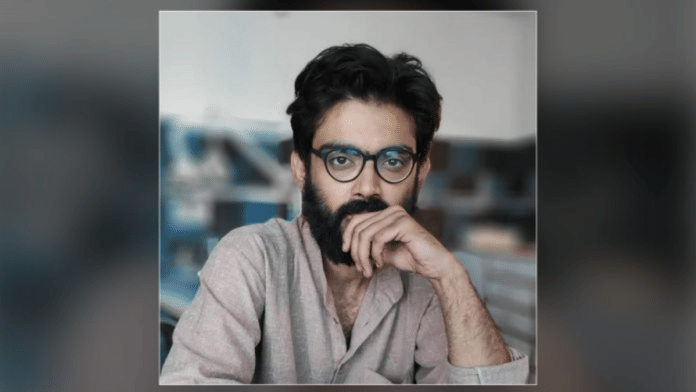

It’s a paradox that has always fascinated me: how easily left-of-centre spaces open their doors to the Muslim right. Reading Sharjeel Imam’s interview in The Quint, I was struck once again by that very same thought. How do two political forces with seemingly opposite worldviews find such comfortable common ground?
While reading the article, I wasn’t sure whether I should even bother writing anything about it. But after finishing the piece, particularly the way Imam seemed to present himself as a voice of the Muslim community, I felt I should write something.
As an Indian Muslim, reading such ideas in the 21st century makes me wonder: is this really the best our Muslim intellectual discourse can produce?
It feels like recycled ideas of Mohammad Ali Jinnah and Muhammad Iqbal, at a time when multicultural societies and shared spaces have shown us possibilities beyond religious identity. When so much of the world is trying to move beyond the limitations of identity politics, why are some of our intellectuals still returning to the same old questions of religious identity and political belonging?
I can understand Imam’s criticism of too much centralisation, his concerns about Muslim underrepresentation, and his arguments for proportional representation and constitutional protection for minorities. These are all legitimate issues to discuss, and I don’t see anything wrong in raising them.
But what I don’t understand is why these concerns have to lead us back to the idea that Indian politics is mainly a struggle between different religious communities, each trying to secure its own share of power.
Of course, minorities need constitutional protection. But there is a difference between protecting people from discrimination because of their religion, caste or identity, and making those identities the centre of our entire political system, and also talking about them as if they are tools of bargaining.
Blind eye toward own community
First of all, he has a problem with the secular framework and the centralised state, which he sees as reasons why minority rights are denied. And I quote his description of how “the handful of upper caste elites could rule South Asia in the name of the majority community” through what Iqbal called a “Communal Oligarchy”.
So if our current democracy is a communal oligarchy, what is the better alternative according to him?
To be fair to him, he does offer alternatives. He rejects nationalism in favour of constitutional republicanism, with more decentralisation and community rights. Well, that sounds like a familiar Left argument.
But then Imam also rejects traditional Marxist or left-wing secularism, which he calls a form of “secular majoritarianism”. For him, community rights seem to mean that Indian Muslims should have their own distinct religious and political identity, rather than becoming part of a larger secular political space.
So he uses the language of decentralisation and constitutional rights, but not necessarily to move beyond religious identity politics. Instead, it seems to me that he wants a separate and more autonomous political space organised around Muslim identity.
And there is nothing particularly surprising about this for me. Growing up within the community, I have heard such arguments many times. The language of the Constitution, liberalism, human rights and democracy is used to demand rights for the community, but there is very little willingness to accept these same values when they challenge the community’s own religious or political thinking.
No wonder he keeps returning to Jinnah and Iqbal.
While he talks at length about safeguarding Muslim rights, I keep wondering what exactly he means by rights. Because much of his argument seems to come back to political power and the bargaining position of the Muslim community. Isn’t that another version of the same communal oligarchy he is criticising? Power of Muslim elites (Ashraf) to bargain?
And while he speaks about how Jinnah and Iqbal were right in their vision, I wonder why he doesn’t spend the same time asking what happened when Jinnah’s political vision actually led to the creation of a country.
Also read: Bangladesh’s love affair with Jinnah is ending. It can help revive Sheikh Mujib’s legacy
Political cynicism
Did that vision create a fair, just, and beautiful world for Muslims? The fractured, blood-soaked history of Pakistan—and the subsequent linguistic and cultural tyranny that birthed Bangladesh—screams a resounding no. The elite Mohajir and Punjabi oligarchy that took over Pakistan ended up exploiting and marginalising Bengali Muslims, Ahmadiyyas, and Shias with the exact same ruthlessness Imam accuses New Delhi of today. The moment religious identity achieved absolute state power, the dream of “community rights” evaporated, replaced by a new, brutal internal majoritarianism.
This exposes the fundamental dishonesty at the heart of his crusade. This isn’t actually a noble, progressive fight against the tyranny of a centralised state. It is a raw, unadulterated struggle for political dominance. When Imam demands “rights,” he isn’t talking about human rights or civil liberties, values he openly scorns as secular traps. He is talking about hard, structural political power.
Ultimately, Imam does not want to dismantle the tyrannical machinery of the state; he just wants to know why his elite faction isn’t the one operating the levers. It is not an objection to communal oligarchies on principle—it is simply a bitter grievance that this specific oligarchy isn’t tilted in his community’s favour.
The entire article is filled with communal ideas, and I wonder if he really cannot see any problem with them. He talks about other marginalised communities too, but even there, it feels like they are useful groups in a political power structure rather than our fellow human beings with equal rights and dignity.
He says Muslims should not become an accessory to the BJP under the first-past-the-post electoral system. So he suggests that Muslim political groups should contest mainly from constituencies where Muslims make up 40–50 per cent or more of the population, or where the BJP itself is not contesting, even if one of its allies is.
And then he says that where the BJP has a dominant vote share, and Muslims cannot win independently, Muslims should support the anti-BJP secular or regional force.
It is a breathtaking display of political cynicism. He wants to exploit the security of a secular democracy whenever it is convenient to survive, but the second his community gains numerical dominance, secularism is discarded in favour of exclusive Muslim political representation.
The problem, at least from how I read his argument, is not communal politics itself. The problem seems to be that the present arrangement does not give the Muslim community the political power he believes it should have.
And I would go further. I think such an argument actually insults the Muslim community. Why should Muslims be expected to vote primarily as Muslims rather than as ordinary citizens with their own concerns? Why shouldn’t a Muslim vote for a candidate who can solve the problems of their area, improve education, provide jobs, ensure safety or simply do a better job of representing them? And why should Muslims themselves not be expected to practise politics based on justice, fairness and equal rights for everyone? Why should these values matter only when we are demanding protection for our own community?
Also read: Muslim dissenters need cover in India. The Republic cannot blame only the Qaum
The twisted narrative
The supreme irony is that Sharjeel Imam cannot see the mirror in front of him. In his obsession with the majoritarian enemy, he has completely internalised their logic. He has become the exact mirror image of the forces he claims to fight—arguing for the same segregation, the same tribalism, and the same cynical exploitation of democracy.
Ultimately, Imam operates in a dark, hyper-transactional universe where morality does not exist—only raw political leverage. Justice, in this understanding, is not something every individual should have simply because they are human. It becomes something a community has to bargain for, depending on how much political power it can gather. But the most noticeable giveaway in the interview is his revision of history- how he blames Congress for Partition, presenting it as something forced upon Muslims.
Now, this is a claim that can take an entire article in itself. But it also tells us something about how he understands the history of Muslim politics in India.
To Imam, the Muslim community—and specifically its feudal, communal elites—bears absolutely zero historical responsibility. The use of aggressive street power, the vetoing of democratic consensus, and the threat of civil strife to secure the privileges of a select elite are all entirely justified in his eyes. In this twisted narrative, the tragedy of Partition didn’t happen because communal elites chose to tear the subcontinent apart; it happened because the Congress government committed the ultimate sin of refusing to bow down to them.
Amana Begam Ansari is a columnist, writer, and TV news panellist. She runs a weekly YouTube show called ‘India This Week by Amana and Khalid’. She tweets @Amana_Ansari. Views are personal.
(Edited by Saptak Datta)