





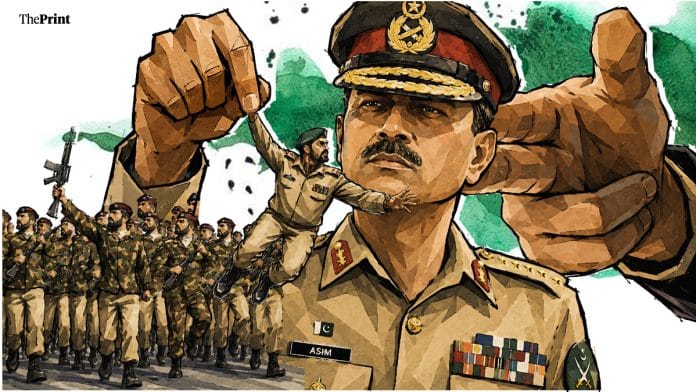

The reason all dictators live in paranoia is that they can never have a retirement plan. Today they might decide the fate of all their subjects, but if they lose power, they can’t determine what happens to them.
That’s why at some point Pakistani dictators begin to show signs of paranoia. It’s been the strategic reality most relevant to India since the late fifties after Ayub Khan took over and promoted himself to field marshal.
It usually takes about five to seven years for these fears to start oozing out. With Asim Munir, it’s been coming at T-20 speed. This is the era of 30-second Insta reels after all. Since Op Sindoor he has had at least four phases of bestowing additional powers or ranks upon himself. For now, let’s focus on the latest, this Thursday.
The sudden passage of the two most significant military-related laws in Pakistan National Assembly last Thursday was so dramatic it would stun the closest watchers of that establishment. It adds even more power, if it was still possible, to what Munir already has.
The Pakistan Cabinet met Thursday morning, approved Defence Forces Act, 2026, and the amended National Command Authority Act, 2010, took them straight to the National Assembly, passed them within 30 minutes and adjourned the House. The Opposition walked out. Pakistan Peoples Party (PPP), second-largest member of the ruling coalition, protested but voted for the laws anyway. And the President, from the PPP, signed it in a jiffy too. Nobody makes Asim Munir wait.
Some Pakistani analysts would say these laws only formalise, retrospectively from 27 November, 2025, the arrangements resulting from the 27th Amendment which mutilated the Constitution, created the post of Chief of Defence Forces (CDF), and laid down that only the army chief could have that position.
It gave Munir a fresh five-year tenure until 30 November, 2030, made his field marshal’s rank for life with full benefits, and granted him immunity from prosecution forever. The ‘it’s nothing new’ school would say a retrospective legal framework was needed to formalise the earlier constitutional amendment. On a close reading, however, additional powers Munir has grabbed are formidable. These could only come from a place of deep insecurity, or more likely paranoia. All dictators start fearing their shadow at some point. For Munir, it’s come the earliest.
Read the report on the changes in ThePrint by our Pakistan-watcher Debdutta Chakraborty. Under the new laws, it says, Munir can “hire, fire and retire” armed forces personnel. Or extend their tenure at his fancy. This applies not just to some loyal subedar-major or colonel, but to all his peers as well.
Also Read: Pakistan is tactically brilliant, strategically disastrous. It’s primed for repeated blunders
Read between the lines. It means he can retire any of his generals, especially Corps commanders, or give them a longer tenure. The first will make them fear him, and the second will make them greedy. There have been signs and whispers of restlessness among Corps commanders, the senior brass chafing at the glass ceiling, Munir perched atop it, and the entire line of succession blocked. This new law will scare some, give hope to others. A better name for the law could be Pakistan Defence (Formalisation of Sycophancy) Act. The same law, by the way, gives Munir’s latest appointee and loyalist Syed Aamer Raza, who he just promoted to four-star general and commander of the newly created National Strategic Command, an indefinite tenure at his field marshal’s pleasure.
How insecure do you have to be to keep finding newer ways, laws, ranks, awards, affirmation of your own position every few months? It’s the oldest truism that all dictators are lonely and scared. In Munir’s case, the better definition of his fears would be acrophobia. He’s risen too high, too soon, has no idea where he’s headed and is deeply conscious of enemies he has made.
In India, we fret over his ‘successes’ with Trump and in West Asia. The cruel fact, however, is that such stature must rest on the bedrock of comprehensive national power (CNP). That, in Pakistan’s case, is declining. It’s unidimensional, based on its efficient military. The economy is dead and there seems to be no effort to lift it; except to count on the possibility of a largesse from the Saudis. But the Saudis, under debt now, can’t spare more than a couple of billions—if even that—as gratuities to Pakistan for its army’s services. In any case, hope isn’t a plan.
Pakistan’s military also has severe limitations. They can’t close the issue with various rebellions along its western borders or make any military gains against India. They can be no more than a nuisance occasionally. Where does that leave Munir?
His genius lies not in military craft but in understanding the vicious praetorian politics of his military-owned state. He also understands the risks. This is by no means normal politics. I can give you a choice of three to describe this: cutthroat, stab-in-the-back, or take-no-prisoners. Munir can’t insure his future. He has to be obsessed with preserving his present. These new laws, therefore, are a coat of additional armour. That won’t save anybody with a box of mangoes on the plane.
Also Read: Pakistan is fighting a two-front war. I saw it coming 15 yrs ago
Munir was born in 1968. That makes him young at 58, to be close to the fifth year as army chief, now exalted to Chief of Defence Forces (CDF). On 30 November, 2030, when his latest five-year term ends—if it does end—he will be only 62. That’s the age at which an Indian Army chief retires. General Dhiraj Seth is already Munir’s third Indian counterpart and by November 2030 he will have a fifth. Where will he go from 2030, is his challenge.
Many Pakistanis believe he would declare himself president much before that. And it will be a presidency without any tenure. So he can rule forever. They’re probably right. But, as the record of his predecessors tells him, time doesn’t stand still.
Ayub and Yahya Khan plotted their decline and humiliation more systematically, through politico-military misadventures in 1965 and 1971, respectively. Zia was consumed by fate at the peak of his power. Musharraf tried to become a Pakistani Ataturk but didn’t have the intellect or peer support. He ended up a convict with a death sentence for treason. Why would the future treat Munir any differently? This is how India must read his mind, his phobic loneliness at the top.
As I’ve written often, there’s one of three ways a Pakistani dictator goes: jail, exile or assassination. Musharraf had once ‘admonished’ me for keeping on predicting this fate for him. In Davos, he wagged his finger and said, there was a time we respected your reading of Pakistan, but not now. And he referred to my three-exit theory for dictators. You’re wrong, he said, because you think I’m a dictator. I’m not, I’m a Democrat.
Dictatorship and delusion go together. But, if I were to do some future-gazing for Munir, I’d see three options and retiring to go home and play golf isn’t one. He can finish up and quietly go away to America. He’d have his stash and an estate there, and the grateful Americans won’t extradite him even after his successor repeals his immunity. Next, he can pronounce himself president for life like some Robert Mugabe. Or third, that he really turns Pakistan’s economy around, calms down its society, ends internecine conflicts and creates a new Republic. That will inevitably need peace with India, an end to the Kashmir fixation, and de-Islamising of his nationalism. This will be the safest. It will also be the toughest if not impossible.
Also Read: Swiss report should now close Op Sindoor debate. Knowing when to stop the fight is key too