





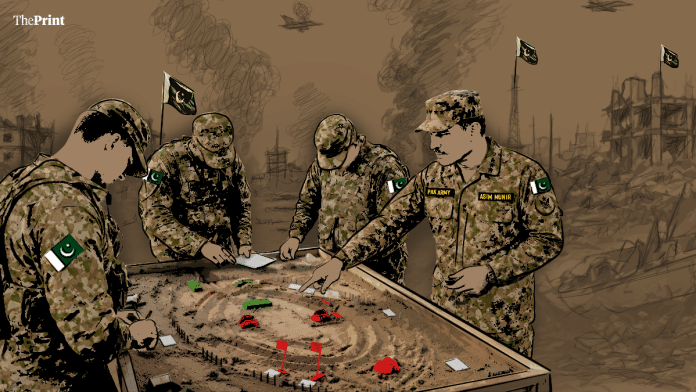

Now that the competitive anniversary events of our 87-hour skirmish are over we can assess how Pakistan has historically conducted warfare with India. Tactically brilliant and strategically disastrous can be a good headline for it. That’s the reason it has lost every war after beginning strongly, sometimes even spectacularly.
For sure that hasn’t prevented it from claiming victory in most, barring 1971 and Kargil. Let’s assess as much evidence as a mere 1250-word column would permit.
The revisionist history of every war or skirmish is a popular subcontinental phenomenon. Just that in Pakistan it’s carried out at industrial scale, school textbooks included.
Take the 87-hour skirmish. All of Pakistan, from the Field Marshal to the subalterns of its politics believes it won this round. That this was followed by Donald Trump’s embrace of the historical ‘stalwart ally’ America had dumped was seen as an endorsement of this self-proclaimed ‘victory’.
The fact is, Munir and his people had planned this earlier. The visit of Steve Witkoff’s son Zach and the crypto deal—through a Pakistani tech whiz kid, Corps Commander’s son-in-law and now crypto czar with a cabinet rank—took place just four days after the Pahalgam massacre and nearly two weeks before Op Sindoor.
When he set up Pahalgam Munir knew India would retaliate. He, therefore, planned this incredible move to exploit the Trump family’s greed. Give him full marks for understanding it before most people in the world. Or maybe the Saudis alerted him.
He had the Trump ‘system’ in the bag long before any fighting started. And Pahalgam, he had given us an indication a week earlier with his speech to overseas Pakistanis on 16 April, 2025. The killings were his tactics to draw an Indian response. To reopen the Kashmir issue, with Trump sewn up, was his strategic objective. The first worked perfectly, the second failed.
Also Read: A year after Op Sindoor, look East. Militarise Nicobar islands urgently
Switch now to the military aspect. Since Pakistan had provoked this knowing India was pre-committed to responding militarily, they could also anticipate the targets.
They also knew the tools India would use. They were ready when IAF soared at 1:07 AM on 7 May. They weren’t able to prevent the strikes on targets deep inside their territory but that wasn’t their objective. They wanted to limit their response to an aerial engagement.
The combination of AEW aircraft hanging back, J-10Cs and JF-17s with PL-15 missiles had been primed and rehearsed for just this tightly-focused action. They got some success, and have been dining out on it. India, at the highest levels, has acknowledged some aircraft losses that night. The outgoing Chief of Defence Staff even attributed it to a “tactical mistake”. Then, the IAF planned its payback.
It came first with the anti-radiation drone strikes to suppress Pakistani air defences and finally a series of air strikes on PAF’s most heavily defended air bases. No PAF aircraft, whatever the range of their missiles, now rose in defence or to fight back.
By the time Pakistan sought a ceasefire, only one side had the evidence of damage caused to the other: commercial satellite pictures of damage to at least 13 PAF bases and three radars. Pakistan still celebrates this as a victory simply because they shot down some planes. An Indian commander put it more fairly, even sportingly. It was like a hockey match and we won 3-1. Just that theirs was a centre forward’s field goal and ours three set-piece, perfectly executed penalty corner hits.
Their claims that they struck are backed by zero evidence unless the quivering voice of CNN’s Islamabad-based Nic Robertson claiming Indian bases were hit counts as anything. It’s fiction. All Indian air bases have cities around them, nothing remains hidden, no satellite pictures have emerged. All of the Pakistani claims are what they are: horse manure. Although I wonder why this is considered less rude and more printable than the other, more popular bovine product.
I’m not trying to restate recent history, but only buttressing my central point. That the Pakistani military mind thinks well but only tactically. It doesn’t anticipate how India would respond. It can be a function of inbuilt incompetence, disrespect for the Indian military or maybe a combination of both. This is an argument we learn from Pakistani writer Shuja Nawaz’s book Crossed Swords.
Talking about Kargil, he writes that the team playing India in the war game anticipated exactly the response the Vajpayee government gave. If they were taken seriously, Pakistan would have saved itself from defeat, retreat and humiliation. But, they were laughed away. Tactically, Kargil was brilliant too. In deception, planning, secrecy, choice of terrain and criticality of location. But, nobody thought about the ‘what if’ possibility: what if India fought back? That needs a strategic mind Pakistan lacks. That’s why we said, tactically brilliant, strategically disastrous.
Nobody in the Indian armed forces calls the Pakistanis good for nothing. But, their mindset privileges a few moments of glory over the big picture.
Kargil became a strategic defeat because it brought global affirmation of the sanctity of the Line of Control (LOC). Even on his short stopover at Islamabad airport Bill Clinton spoke to the Pakistanis on camera and said lines on the map of the Subcontinent can no longer be redrawn in blood.
Also Read: Pakistan is fighting a two-front war. I saw it coming 15 yrs ago
Let’s look at the post-Pulwama story. Since the initiative of launching a terror provocation is always with Pakistan, they knew that after a big enough strike IAF will be used for retaliation. That’s how Operation Swift Retort, involving more than 26 PAF aircraft to bait the IAF into a scrap where they didn’t have the numbers or the range, was planned and rehearsed, probably for years. They’re still celebrating shooting down an IAF MiG-21. Even if that’s a tactical plus, strategically, Indian deterrence lasted seven years. Until Pahalgam.
The same story has played out in our earlier, older wars. Operation Gibraltar (about 10,000 regulars in mufti infiltrated into Kashmir Valley), followed by Operation Grand Slam to take Chhamb, then Akhnoor, cut off Kashmir and grab it with ease.
Tactically, this was brilliant but again somebody in the Pakistani GHQ had to be extraordinarily dumb to think India would simply keel over to lose Kashmir and not expand the war to the plains of Punjab. There was inadequate thought given to the possible Indian response. Within the same war, the surprise armoured thrust in Khem Karan still remains the most audacious use of tanks in the Subcontinent and its objectives were grand. However, the headline to date remains its disastrous failure. Nobody gamed the Indian response. The most important and largest battle of that war was Pakistan’s defeat and a mauling of its best armour.
Pakistan claims victory in that war but ironically, observes 6 September as ‘Defence of Pakistan Day’. Their revisionist historians are happy to script pride in going on the defensive in a war where they had attacked with a clear objective. This was their last chance to take Kashmir militarily and they blew it.
Whatever the reality of Op Sindoor, the Pakistanis have taken the wrong lessons from it. This will be compounded by the delusions of a rising diplomatic stature. India has to keep that in mind and anticipate a new provocation earlier than what we may have imagined six months back.
Pakistan has decided to collectively buy into its own post-Sindoor propaganda and now believes the world is either dependent on it, or distracted. History tells us that these are conditions in which the Pakistani establishment makes its worst, ultimately self-defeating political and strategic blunders, however good they might be tactically.
Also Read: Swiss report should now close Op Sindoor debate. Knowing when to stop the fight is key too
Pakistan is a failed state. Period. Its existence is because of India, mental space of Pakistani security apparatus is obsessed with India. It has no unique culture of its own. Its roots are entwined with India. It merely exists because India allowed it to. Not on its own right. And its cessation will also happen because of India if it refuses to be a good neighbour. If it keeps trying to harm India using terrorism the day is not far when its existence itself will be erased. Ofcourse the people will exist but Pakistan the nation wont. It was amazing to hear the Army chief spell it out so clearly. Intellectual gymnastics has no place when talking about terror.
Mr.G’s “tactically brilliant, strategically disastrous” formulation gives Pakistan too much intellectual credit. A true critique would simply call it what it is: a terror state in perpetual self-defeat.
Calling it “tactically brilliant” implies there’s something worthy about how they execute terror operations. That’s apologetic language.
Calling Pakistan’s actions “tactically brilliant” gives intellectual credit to what are fundamentally terrorist provocations and military adventurism. The Pahalgam massacre wasn’t a tactical masterstroke, for crying out loud!!! It was mass murder designed to provoke. Framing it as strategic chess is sanitizing terrorism.
Pakistan is a state sponsor of terror that launches attacks, gets severely damaged militarily, then claims victory through propaganda while planning the next provocation. There’s nothing “brilliant” about that cycle. It’s a pattern of terrorism, military failure, and delusion.
So what you’re saying is that Pakistan will attack India again soon?
I disagree with Mr Gupta. The strategy works well for Pakistan army which can rule only with the pot boiling. With the nuclearization of arsenal theybhabe achieved an escalation parity so they can time and again keep poking India. I am sure they are well aware of costs on Pakistani people and ready to bear it. They also know their utiltiy to China and USA. For China its a syrategic asset which bogs India down while China competes with USA. Gloating over tactical victories is what India suffers from and the only utility of article Mr Gupta writes seems more to buttress Indian ruling party than anything else.
Was very happy to read recent statements by General Narawane, former Army Chief, and honourable Shri Dattatreya Hosabale. Calling for dialogue with Pakistan, an easing of tensions. India’s dispute with Pakistan over Kashmir is intractable. Unless some non territorial solution can be worked out, as was being attempted in the Singh – Musharraf talks, complete normalisation is not possible. However, that should not mean closing the door to normal diplomacy, reducing the prospect of future contingencies like Pulwama – Balakot and Pahalgam – Operation Sindoor. 2. China is the ever present factor to consider in the India – Pakistan relationship. Quad seems to be falling by the wayside. Dead in the water is Ambassador Vijay Gokhale’s assessment. President Trump’s visit to Beijing an acknowledgement of near parity. Not a positive development for India. Professor Happymon Jaclob’s recent Hindustan Times column. 3. Viewed objectively, a case for attempting a serious composite dialogue with China and Pakistan.
India needs to have pro-India political voices in Pakistan. That’s the only way to create a stable political peace.