



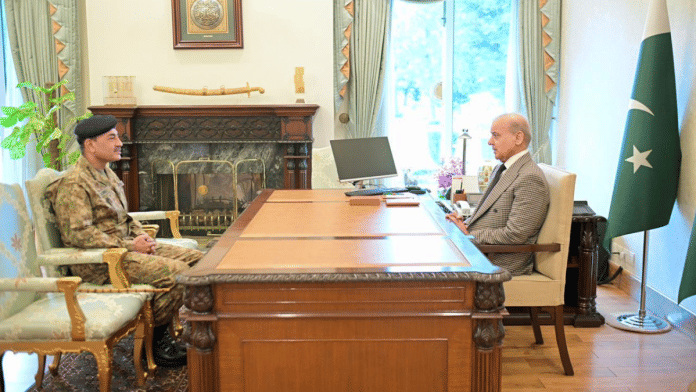
New Delhi: Pakistan’s Chief of Defence Forces (CDF) Asim Munir now has sweeping authority over the country’s armed forces, including the power to retire, discharge or retain personnel and to alter prescribed retirement limits under a new defence act.
Field Marshal Munir, who also serves as the Pakistan army chief, gained the authority under two new Acts—the Defence Forces Act, 2026 and the amended National Command Authority Act, 2010—approved Thursday by the National Assembly. The measures significantly expand the statutory role of the CDF, an office created only last year after the 27th Constitutional Amendment Act.
According to the draft of the law, the Chief of the Defense Forces shall exercise such powers and perform such functions as are necessary for “multidomain integration, operational cohesion, coordination and oversight of all matters which have joint, tri-services and strategic implications for the Armed Forces and national security of Pakistan”.
Now under these, CDF Munir may retire, release, accept or reject resignation of, or discharge from the service, or retain in service, or relax age or service limit of retirement of any person subject to the laws relating to the armed forces, but excluding those appointed under Article 243 of the Constitution—which includes Chief of the Army Staff concurrently the Chief of the Defense Forces; the Chief of the Naval Staff; and the Chief of the Air Staff, appointed by the President on the advice of the PM.
While the federal government will make the rules needed to implement the Act, the CDF can issue directions and orders to enforce its provisions. The accompanying National Command Authority (Amendment) Bill 2026 replaces references to the Chairman of the Joint Chiefs of Staff Committee in the 2010 law with references to the Chief of Army Staff and Chief of Defence Forces.
Because the CDF is constitutionally required to also be the army chief, Munir commands the Army, exercises operational command over the Navy and Air Force, and serves as the senior military adviser on matters linked to the country’s nuclear command structure.
The Defence Forces Act applies retrospectively from 13 November, 2025, while the NCA amendments apply from 27 November. Parliament approved both measures on 20 August, 2026, months after the dates from which they are deemed to have taken effect.
The concentration of these powers is significant. Operational command of the armed forces gives the CDF authority over the country’s military operations. The power to dismiss, retain or retire personnel gives the office considerable influence over military careers and the wider officer corps. Making the CDF the prime minister’s senior military adviser also gives the military leadership a central role in national security decision-making.
Also Read: Saudi, Turkey & Pakistan sign defence pact, committing to ‘treat attack on one as attack on all’
Munir’s military manouever
The legislation follows Pakistan’s 27th constitutional amendment, enacted in November last year, which radically reorganised its military command.
The contentious Amendment also rewrote Article 243 of the Pakistan constitution of 1973 and abolished the longstanding office of the Chairman, Joint Chiefs of Staff Committee (CJCSC) and created the posts of CDF and Commander National Strategic Command. The position of CDF is held concurrently by the army chief. Munir became Pakistan’s first CDF after the changes took effect.
The Defence Act, which took effect from 13 November, 2025 retrospectively after the 27th Amendment created the Defence Forces Headquarters as the main headquarters of Pakistan’s armed forces. The headquarters now serve as the prime minister’s senior military adviser on national security, defence and military matters. This role was previously held by the Chairman of the Joint Chiefs of Staff Committee.
Under the new law, the prime minister appoints the commander on the recommendation of the army chief and CDF for a three-year term. On 24 July, Prime Minister Shehbaz Sharif promoted Lt. Gen. Aamer Raza, then the Pakistan army’s chief of general staff, to four-star general and appointed him as the first Commander of the National Strategic Command.
The prime minister can reappoint the commander for one additional three-year term on the CDF’s recommendation. The appointment, reappointment or extension cannot be challenged in court. The law also exempts the commander from the Army Act’s normal retirement age, service-term and removal rules. He remains a serving four-star general in the Pakistan army.
The federal government can also give the CDF additional powers and responsibilities and will make rules to implement the Act, while the CDF can issue orders and instructions to enforce it. If problems or conflicts with other laws arise, the president can then issue orders to resolve them, according to the new law.
Under the new framework, the CDF’s term begins on the date of his official notification that is 4 December 2025, while the federal government determines his duties and responsibilities. The tenure of the serving army chief also restarts from the date he is notified as CDF.
The Bills were approved Thursday in a federal cabinet meeting chaired by Prime Minister Shehbaz Sharif. The Prime Minister’s Office (PMO) said the Bills were drafted as a follow-up to changes introduced by the 27th Constitutional Amendment.
Defence Minister Khawaja Asif presented the Bills following which the National Assembly was adjourned until Friday morning after approving the legislation. The Bills were passed amid an Opposition walkout and objections from the Pakistan Peoples Party (PPP), an ally of the governing Pakistan Muslim League-Nawaz. Neither of the Bills were on the National Assembly’s agenda.
‘The Defence Forces Act aims to determine the relevant administrative matters regarding the office of the Chief of Defence Forces and the Chief of Defence Forces Headquarters,” the PMO statement read.
While PPP chairperson Bilawal Bhutto-Zardari objected to the manner in which the legislation was introduced, his party’s lawmakers ultimately voted in favour of the Bills.
(Edited by Tony Rai)
Also Read: Munir’s messenger & ‘one-man army’, the rise of Mohsin Naqvi in Pakistan’s ‘hybrid system’