



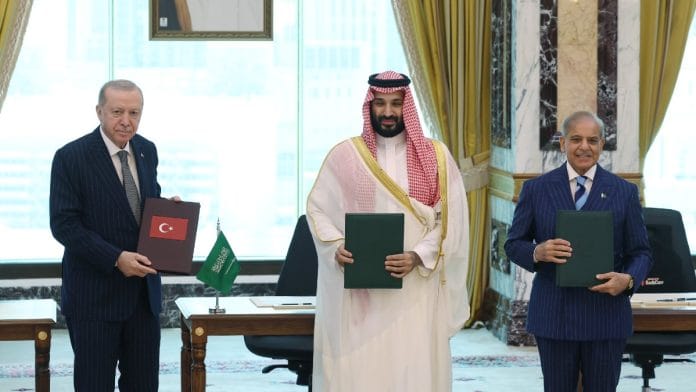
New Delhi: Saudi Arabia, Turkey and Pakistan Friday signed a joint defence pact in Mecca, formally committing to treat “an armed attack against any one of the three countries as an attack against them all”.
The Makkah Joint Defence Agreement, which follows nearly a year of negotiations, was signed following the Makkah Summit on Joint Defence, held at Al-Safa Palace in Mecca.
Its signing in Mecca lends symbolic significance to a pact among the three Sunni-majority countries. Earlier reports had indicated Egypt would also sign it, but did not eventually.
According to a joint statement issued after the summit, the trilateral agreement aims to strengthen collective deterrence against external aggression and deepen defence cooperation across all military domains among the three nations.
Türkiye, Saudi Arabia and Pakistan sign Joint Defence Agreement https://t.co/q9c42DOtTW pic.twitter.com/k1EKozqpKH
— Presidency of the Republic of Türkiye (@trpresidency) August 7, 2026
The joint statement said the agreement was guided by the “longstanding historical ties among the three countries, the enduring bonds of brotherhood and Islamic solidarity that unite them, and their shared strategic interests and longstanding defense cooperation”.
Pakistan’s Ministry of Foreign Affairs in a separate statement reiterated the contents of the agreement.
“Guided by the longstanding historical ties among the three States, based on the enduring bonds of brotherhood and Islamic solidarity that unite them, and building upon their shared strategic interests and longstanding defence cooperation…reflecting the three States’ shared commitment to further strengthening their collective security and to promoting peace, security, and stability in the region and beyond, in pursuit of a secure and prosperous future,” read Islamabad’s statement.
Saudi Arabia’s Minister for Public Diplomacy, Ambassador Dr Rayed Krimly, also commented on the agreement, describing it on X as the product of years of negotiations and decades of expanding strategic cooperation among the three countries. He said the agreement would enable Saudi Arabia, Turkey and Pakistan to develop joint defense capabilities, strengthen strategic deterrence, enhance military readiness, and further integrate their respective defense capabilities to jointly address threats to their safety and security.
Krimly reiterated that, under the treaty, any external armed attack against any one of the three countries would be regarded as an attack against all three.
The agreement, he added, would not come at the expense of Saudi Arabia’s strong strategic relationships with its Gulf, Arab and international partners.
“The agreement does not represent an effort to establish a military axis or a sectarian bloc. Nor is it linked to any nuclear ambitions or arms race, rather it is focused on building sustainable capabilities,” he wrote.
He further said that the pact does not constitute a threat to the security of any country in the region and should not be viewed as an escalation of tensions between any two states.
The Makkah Joint Defense Agreement reflects the depth and longstanding nature of the strategic relations among the three countries, which have developed over several decades, and represents the culmination of detailed negotiations conducted over a number of years.
The Makkah…
— AMB Dr. Rayed Krimly (@Rayedkrimly) August 7, 2026
According to Krimly, the trilateral agreement also does not supersede or replace any existing bilateral or multilateral agreements among the three signatories or between those countries and other states or international organisations.
Also Read: The mediator who cannot chose: Caught between Iran & Saudi Arabia, Pakistan’s West Asia dilemma
Why this trilateral defence pact is significant
The agreement comes a day after Pakistani Prime Minister Shehbaz Sharif, accompanied by Pakistan’s Chief of Army Staff, Field Marshal Asim Munir, arrived in Saudi Arabia and performed the Umrah pilgrimage in Mecca. Turkish President Recep Tayyip Erdoğan also traveled to Saudi Arabia Friday for talks with Crown Prince Mohammed bin Salman.
Earlier reports in March had suggested that Turkey, Saudi Arabia, Egypt and Pakistan were aiming to come together as a bloc to combine ‘strengths’ amid the West Asia conflict.
According to a report in Middle East Eye, the foreign ministers of the four countries held talks on the sidelines of the Riyadh summit of Arab and Muslim countries.
This trilateral pact also comes against the backdrop of a mutual defence pact between Saudi Arabia and Pakistan signed last September, with reports suggesting Turkey wanting to join the pact since January this year. While Turkey did not confirm any such development, Pakistan said it had been in the pipeline for a year.
According to the report, Turkey, a NATO member, wanted to bring Egypt into this security arrangement which “would not mirror the guarantees and commitments of NATO, but would instead serve as a security platform to enable greater cooperation in the defence industry and broader defence matters”.
“In principle, we need to recognise this: either we come together and learn to solve our own problems ourselves, or an external hegemon will come and either impose solutions that serve its own interests, or do nothing while preventing others from acting,” Turkish FM Hakan Fidan had then said.
Turkey has earlier condemned Iranian strikes and called it the primary instigator of the war.
Pakistan shares “brotherly relations” with Turkey. Moreover, Pakistan last week joined the Arab-Islamic states in condemning Iran’s retaliatory military strikes across the Gulf, calling on Tehran to “halt its attacks” and warning that the “future of bilateral relations would depend on respect for sovereignty and non-interference”.
The signing also comes as Saudi Arabia faces repeated attacks by Iran, Tehran-backed Houthi forces in Yemen and Shia armed groups in Iraq following the United States and Israel’s strikes against Iran that began on 28 February.
The conflict has also threatened Saudi oil exports and the kingdom’s ambitious economic development plans while raising broader questions about the reliability of its longstanding security partnership with the United States.
Although Turkey and Pakistan have largely avoided direct attacks, both countries have sought to diffuse regional tensions that threaten their security and economic interests.
(Edited by Amrtansh Arora)
Also Read: Pakistan’s paradox under Asim Munir: A broker for the world, a bruised state for citizens
Pakistani diplomacy is on a roll.