




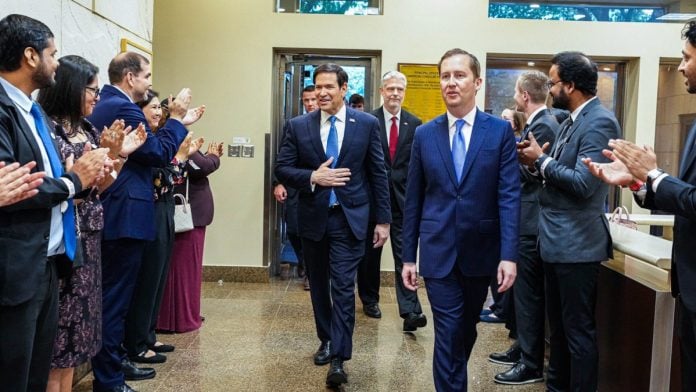

Barely two weeks after a grand speech in Athens about keeping the West at “the head of the world”, US Secretary of State Marco Rubio arrived in India and praised it as a “refining superpower”. Washington, after all, is working hard to solve a problem mostly of its own doing—the global energy crisis.
Rubio’s charm offensive came in Mumbai on Tuesday, ahead of his visit to the Reliance refinery in Gujarat’s Jamnagar. He added that he wanted Reliance to refine more Venezuelan crude and to even explore producing oil in Venezuela itself. Clearly, Washington sees Venezuelan oil as an alternative source of supply as the war with Iran and the situation in West Asia continue to roil global energy markets. And Rubio’s visit shows that the US needs India.
This is why Rubio’s second visit to India this year, his choice of cities, and his meetings with Indian officials as well as private companies—Adani, Ambani, Tata— make him ThePrint’s Newsmaker of the Week.
Even before Rubio landed in Mumbai, his visit had created a furore domestically. Opposition politicians accused him of “summoning” External Affairs Minister S Jaishankar to India’s financial capital. They met on 20 October and discussed energy, defence, nuclear cooperation and the war in West Asia.
Oil was not the only thing on Rubio’s agenda. India-US relations have been strained for much of the past 20 months, and Washington’s tariffs, restrictions on H-1B visas and embrace of Pakistan have all caused friction. An expansive Rubio had ready answers for all of these things in his interactions with the Indian media.
In a News18 interview, Rubio batted away criticism of Washington’s open-armed welcome of Pakistan and Field Marshal Asim Munir, saying engagement was necessary given Islamabad’s possession of nuclear weapons. On trade, he acknowledged India’s right to negotiate a deal in its own interests. As for H1B visa restrictions, he told the Indian Express that the measures were not targeted at India. He also stressed America’s “very important relationship with India”.
Rubio’s visit came in the wake of an about-turn by the Trump administration. Just a month after signing a law authorising tariffs of up to 100 per cent on major buyers of Russian oil—which would include India—Trump put the measures on hold last week, citing national security.
The US has also struck a deal to import Russian diesel to ease the fuel crunch, while Trump has blamed Ukrainian attacks on Russian refineries for the price spike. Brent crude, meanwhile, closed at $116.72 a barrel on Friday, nearly double its price at the start of the year.
With diesel prices touching $6.3 a gallon in the US and the Republican Party facing a difficult midterm election, fixing the fuel mess is the political imperative. And one road leads to Jamnagar.
Also Read: Global fuel crisis is not about crude oil. It’s the refineries, stupid
Raving over Reliance
On Wednesday, Rubio visited the Jamnagar refinery operated by Reliance and met Mukesh Ambani and his son Anant. The refinery is the world’s largest single-site complex, with the capacity to process some 1.4 million barrels of crude a day, or roughly 1.5 per cent of global oil demand.
“Reliance is a very important company. It has extraordinary capacity to refine,” Rubio told News18, also noting that “petroleum is useless if you don’t refine it into a useable product”.
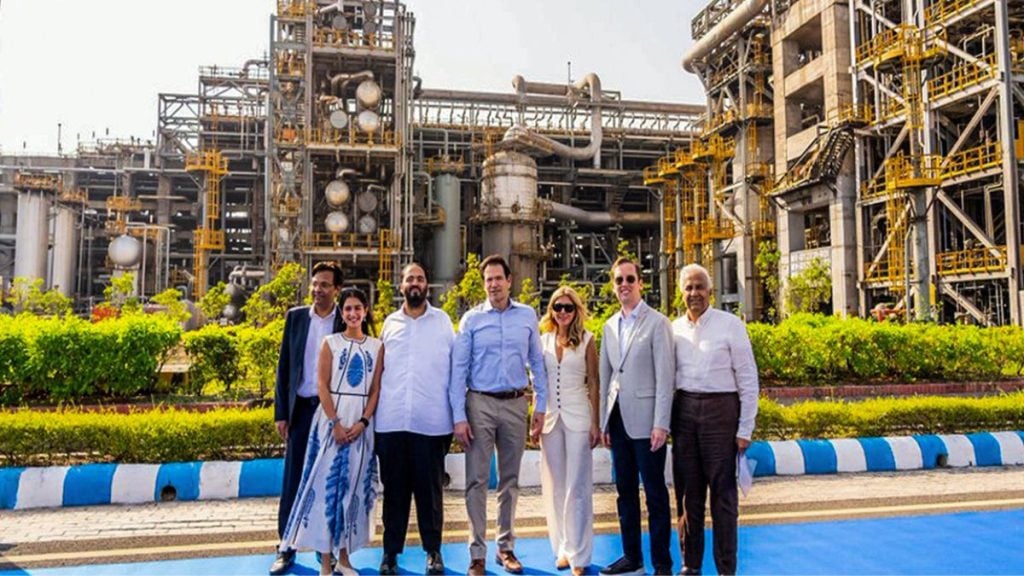
The Indian headquartered company has promised a large investment in a refinery in Texas, the first to be opened in the US in almost five decades. It has in the past also been a large importer of Venezuelan crude. Rubio made the pitch for Reliance to increase its purchases from Venezuela, following the US’ opening to the South American nation after capturing former President Nicolás Maduro in a midnight raid in January 2026.
American sanctions in 2019 disrupted Indian imports of Venezuelan crude, although purchases continued intermittently. In May, when Rubio visited India, Jaishankar raised the issue of sanctions “distorting” oil markets as well as India’s need for affordable energy from multiple sources.
The tune now is quite different from previous years.
“I think this is a company and this is a country that has refining capacity. And we have, for example, Venezuela that’s going to be rapidly increasing the production of oil and crude, heavy crude, which can only be refined in certain parts of the world,” said Rubio to The Indian Express.
He added: “One of the… few other places in the world that can actually refine Venezuelan heavy crude is in India, and it’s Reliance.”
Rubio’s wooing of Indian industry did not stop at Reliance. He also met Gautam Adani and Tata Sons chairman N Chandrasekhar. Tata Group’s TCS was recently suspended from a US programme allowing companies to sponsor foreign workers for green cards.
‘Never at the expense of relationship with India…’
The US Secretary of State genially answered questions about Washington’s diplomatic efforts with Pakistan, especially after Operation Sindoor in May 2025. Field Marshal Asim Munir was welcomed to lunch at the White House by Trump, while Islamabad has been trying to play mediator in the ongoing conflict between the US and Iran.
“Well, we’re against terrorism anywhere in the world. We’re against anybody who sponsors terrorism. In my new role – I’m no longer a senator; I’m the Secretary of State – I have to manage the foreign policy of the United States. And that does require us to have relationships with countries, including those that we may have some disagreements with,” Rubio told Network18.
In his defence of America’s overtures to Pakistan, Rubio also attempted to hold up the mirror to India by citing its friendly relationship with Iran.
“In the case of Pakistan, it’s a country that we have to have a relationship with. It’s a country that possesses nuclear weapons. It’s a country that, from a geographic standpoint, we need to be able to interact with them, in much the same way as the Government of India has to have and has a relationship and meets with leaders from Iran.”
This was one of the first attempts by a senior US official to explain Washington’s renewed closeness to Pakistan—a development that has irritated New Delhi. Trump’s repeated claims of having ended Operation Sindoor have only made the chafing worse.
Applying some balm, Rubio assured India in an interview with The Indian Express that America’s relationship with Pakistan or “with any country in the world” would “never come at the expense of our relationship… with India.”
Another sore point in India has been the Trump administration’s crackdown on H-1B visas and its suspension earlier this month of Indian IT firms, including Wipro, Infosys and TCS, from a programme to sponsor foreign workers for green cards.
Rubio insisted the restrictions were not an “anti-India” move but an attempt to fix America’s immigration system.
Also Read: Marco Rubio’s Athens speech is a warning to the non-Western world. India too
The China question
Rubio continued to promote the Quad, the grouping of India, Australia, Japan and the US, despite the perception that Washington has softened its approach towards China under Trump. Asked by The Indian Express whether the US had gone “soft” on China, Rubio called the “terminology” incorrect.
Once again, he pointed to India’s foreign policy to contextualise US actions.
“I think the right terminology is that China is—and you know this well, because India also has a relationship with China—but China is a large economy, it’s a powerful country, it’s a country we have to have relations with… We are most certainly going to have disagreements with them; we have them now,” said Rubio.
Trump made a state visit to Beijing this May, as the US and China continued to engage on thorny trade and strategic issues. Meanwhile, the Quad has not held a leaders’ summit since September 2024, when then US President Joseph R. Biden Jr. hosted it in his home state of Delaware.
The grouping has been focused on expanding cooperation across the Indo-Pacific region and has been perceived as positioning itself as a counterweight to China.
Rubio, however, warned that adversarial relations between Washington and Beijing would be bad news for the world at large.
“The attitude of this administration has been to try to find a level of strategic stability in our relationship with them, understanding that if things go bad, if the United States and China get into a trade war, or into any other conflict for that matter, it would be incredibly detrimental to the world.”
Views are personal.
(Edited by Asavari Singh)