




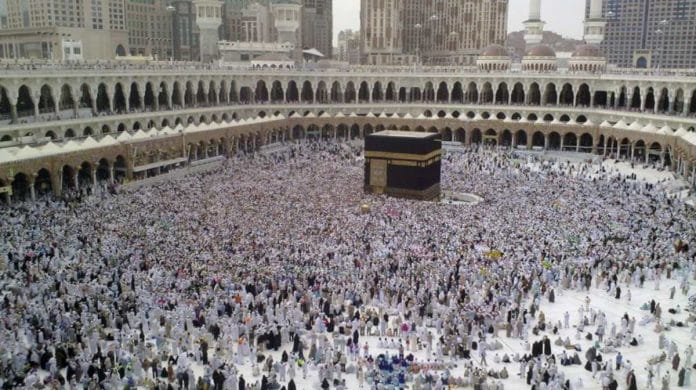

Saudi Arabia executed two Bangladeshi nationals, Nazerul Islam Abdul Basir and Siti Akhtar, on 14 October 2026. Authorities said that they were involved in immoral acts inside a mosque in Mecca.
What I find disturbing is that while the authorities justified the death penalty in the name of protecting the sanctity of a religious place, they did not clearly explain what exactly these two people had done.
There is a story circulating on social media that they were a married couple killed simply for kissing. But from what I understand, there is no reliable evidence to support that claim. Even the photographs being shared as theirs have reportedly turned out to be fake.
How can a state execute two human beings in the name of morality without even clearly explaining to the public what their offence was?
And more importantly, what kind of understanding of morality allowed them to take someone’s life? Saudi Arabia treated the Bangladeshi couple as if their lives had no value.
The ta’zir complication
For millions of Muslims, Mecca is one of the holiest places, associated with faith, mercy and spiritual renewal. I understand why people want to protect the sanctity of such a place. Every religious community has the right to expect people to respect its places of worship.
But there is a difference between respecting a religious place and taking someone’s life for violating its rules.
Even if the couple did something offensive or inappropriate according to local religious customs, that does not justify the death penalty by any means in this time and world.
One thing I think is very important to mention here is that there is no Quranic verse prescribing the death penalty for such an offence. From what has been reported, the Saudi authorities treated the offence under ta’zir, a category of discretionary punishment in Islamic jurisprudence.
For those who don’t know, ta’zir refers to punishments for offences where the Quran and Sunnah do not prescribe a specific, fixed penalty. In such cases, the judge or legal authorities have discretion in deciding the punishment, depending on the offence and its circumstances. And this is what makes the case even more troubling for me.
The use of ta’zir to justify the death penalty is itself a subject of debate among Islamic scholars historically. Many classical scholars argued that ta’zir punishments should generally be less severe than hudud, which are punishments prescribed for specific offences in Islamic law. The idea was that discretionary punishment should be used for correction and discipline, not simply to impose the harshest possible penalty.
There is also a hadith that says no one should be given more than 10 lashes except for an offence involving a punishment prescribed by God.
And this is what I find difficult to understand. When there are disagreements even within Islamic jurisprudence about how far such punishments should go, why should the harshest interpretation be used to take someone’s life?
If the punishment is not explicitly prescribed in the Quran for the alleged offence, and there is room for human interpretation, shouldn’t that make us even more careful before imposing something as irreversible as death? If the punishment is discretionary, then someone has decided that whatever these two people did deserved death.
Moreover, we live in an era where humanity has evolved to understand that human judgment is inherently prone to error. Because of this, we recognise the critical need to give every accused person the opportunity to defend themselves and appeal. Imagine the danger of a one-sided decision completely lacking in transparency. I am seeing many Muslim influencers on social media, who currently live under democracies, justifying the death penalty based purely on sentiment. Yet, I am certain they would not welcome a system where the state holds the absolute power to execute them without giving them a single chance to defend themselves.
Moreover, most of these individuals would not actually want to be punished under a strict implementation of Sharia criminal code today. They would not want their hands amputated or to face execution; instead, they prefer a legal system that punishes in fair proportion to the crime. It is highly shameful to see them boast, endorse, and defend such inhumane penalties online while actively relying on the protections of a democratic system.
Then there is Saudi Arabia itself, which, under Mohammed bin Salman Al Saud, is trying to present a modern and more open image to the world.
We see music festivals, concerts and entertainment events being promoted as part of this new Saudi Arabia. I don’t have a problem with people enjoying music or dancing. But I do wonder how a country can celebrate such changes while continuing to impose such extreme punishments in the name of religious morality. The death penalty given to the Bangladeshi couple is something we should remember when talking about Saudi Arabia’s so-called modernisation.
Modernisation cannot simply mean building beautiful cities, organising music festivals, attracting tourists and bringing foreign investment.
A country can change how it looks to the outside world while keeping the same attitude toward the rights and dignity of ordinary people.
For me, real progress is also about how a country treats its most vulnerable people, especially those who have no wealth, political connections or powerful government to speak for them.
What is the point of becoming a modern country if an ordinary person still has so little protection against the power of the state?
Also read: From Shaheen Bagh to CJP, who gets to decide when Muslims protest?
Bangladesh’s responsibility
What bothers me even more is that these two people were Bangladeshi nationals.
From what has been reported, even the Bangladeshi consulate was not informed in advance about their execution. We are talking about two human beings facing the most serious punishment possible, yet their own country’s representatives reportedly did not receive prior notice. What kind of dignity and protection does a poor migrant have in such a system?
Migrant workers are already in a vulnerable position. They are living in a foreign country, often unfamiliar with the language, the legal system and their rights. This makes access to lawyers, fair trials and consular support even more important.
I have also seen people on social media asking whether Saudi Arabia would have handled the case in the same way if these two people had been American citizens. It’s a legitimate question to ask. Would the authorities have been equally comfortable executing without informing the person’s embassy in advance? Would the case have received the same treatment if the individuals came from a powerful country?
Bangladesh also has a responsibility here. Its government should demand a clear explanation of the charges, the trial, the legal representation these two people received and why its consulate was reportedly not informed.
The life of a Bangladeshi migrant or any migrant should not be worth any less than the life of an American or a Saudi citizen. If Saudi Arabia wants the world to recognise it as a modern country, shouldn’t respect for human dignity and equal treatment under the law be part of that modernisation too?
In the end, we know that two people have been executed. We know that their deaths cannot be undone. And we know that justice worthy of the name demands far more than a vague accusation and an irreversible sentence.
A society is not judged only by the values it proclaims sacred, but also by how it treats those accused of offending those values.
Amana Begam Ansari is a columnist, writer, and TV news panellist. She runs a weekly YouTube show called ‘India This Week by Amana and Khalid’. She tweets @Amana_Ansari. Views are personal.
(Edited by Ratan Priya)