




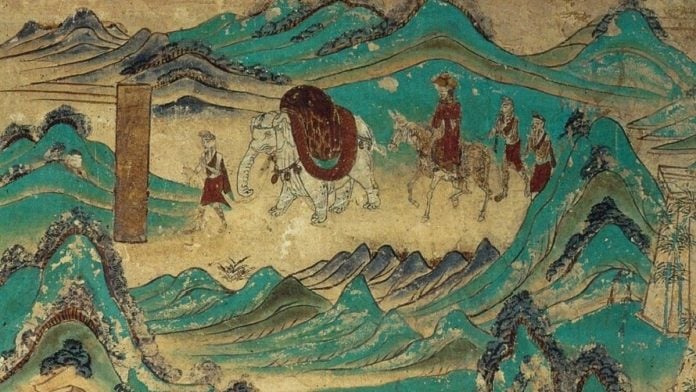

Who travelled the ancient Silk Roads, and how? The Chinese monk, seeking scriptures from India, is the archetypal traveller. But over the last few years, evidence has increasingly shown that Indians also went the other way: climbing through perilous mountain passes, riding across vast deserts and crossing icy rivers. Carrying precious goods and scriptures, these intrepid adventurers were able to make their way speaking a lost language: a vernacular Silk Road Sanskrit.
An ‘Indosphere’ on the Silk Roads
The land route between India and China was extremely difficult to traverse. Once past Kashmir proper, travellers had to circumvent the hostile Taklamakan desert by travelling from oasis town to oasis town, extending in chains both north and south. Both routes merged at Dunhuang in the Gansu Province of present-day China.
In ancient times, it was a wealthy city in the freezing desert, marking the entrance to the empires of the Yellow River Basin. At Dunhuang, over about 1,500 years, local merchants, kings and religious leaders commissioned roughly 500 Buddhist rock-cut temples in a cliffside 1.6 kilometres long—the largest such complex on the planet.
Today, the ancient towns of the Silk Roads are orderly Chinese cities with wide poplar-lined avenues and sparkling souvenir markets. But they very much orbited the ‘Indosphere’ in the early centuries CE.
The nomadic confederations of Central Asia, warring and retreating in conflicts with the Han Dynasty in the Yellow River Basin, moved through the region before eventually conquering and settling in present-day northwest India and Pakistan (ancient Gandhara).
The most powerful of these was the Kushan Empire. From teeming Gandharan cities, it extended its authority and cultural influence across the Himalayas into growing Silk Road kingdoms such as Kucha, Kroiana and Khotan.
Administrative documents from these sites, preserved in the cold, dry desert air, reveal that these kingdoms used Gandhari Prakrit for administration. Murals at Kumtura, a monastic cave complex in the kingdom of Kucha, suggest that aristocrats there cultivated pencil moustaches and hairstyles inspired by the Kushan elite.
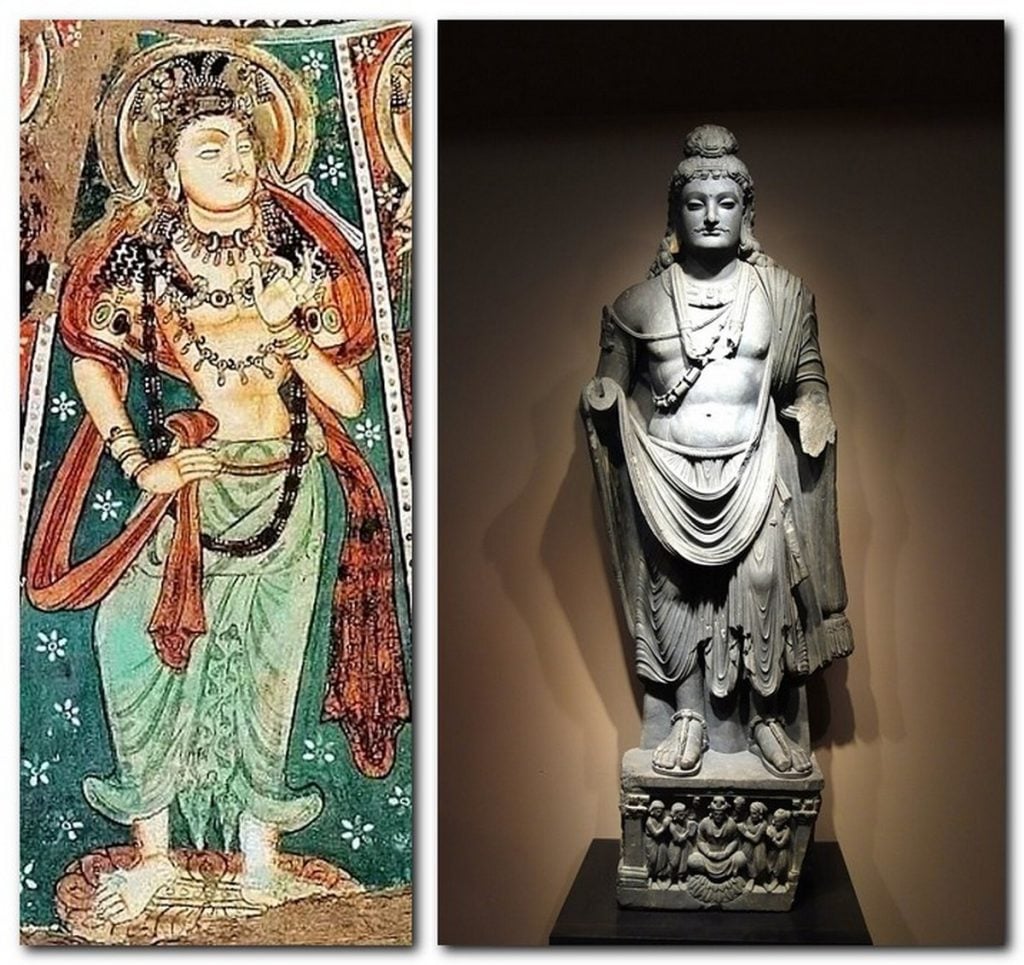
The Kushan king Kanishka summoned a Buddhist council and built stupas in the tradition of the ancient emperor Ashoka, seeking to link himself to the latter’s legacy. The kings of Khotan, too, claimed their city was established by the ministers of Ashoka. While there is little evidence to support this claim, it demonstrates how profoundly Central Asians were linked to Indian cultures, languages and ideas.
Also Read: India was once home to free-flying, meat-eating goddesses. Yoginis were feared and respected
‘Scurrilous’ Sanskrit exchanges
The claim of an Ashoka connection in Khotan endured for over half a millennium, well after the fall of the Kushans. In 981 CE, for example, when seeking a bride from the royal family of Dunhuang, a Khotanese king claimed in a letter to be as pious as Ashoka (Xin Wen, The King’s Road).
But a more interesting letter, to us, had arrived a decade earlier, in 970. Scholar Sam van Schaik studied it in his paper “A Sanskrit-Khotanese Colloquy”.
In the letter, the Khotanese king Viśa’ Śūra announced that he had defeated the Turkic king of Kashgar and captured “his wife, sons, elephant(s), and pricy thoroughbred horse” (Wen, The King’s Road). Since paper was valuable, the letter found its way from the Dunhuang court to the Khotanese Buddhist community.
There, a monk or nun used the blank spaces to write down a series of phrases: first in Sanskrit, followed by a “:” or “=” sign, and then the Khotanese equivalent. These must preserve traces of actual conversations along the Silk Roads. Here they are, as translated by van Schaik:
“— Where have you come from? I have come from Khotan.
— When did you come from India? Two years ago.
— Where did you stay in Khotan? I stayed in a monastery.
…
— Where are you going now? I am going to China.
— What is your business in China? I shall see the bodhisattva Mañjuśrī.”
This offers us a remarkable insight into the lives of Indian monks and pilgrims along the Silk Roads — the questions they were asked and the answers they gave.
Other phrases in the text suggest that they learned a smattering of Khotanese so as to speak with kings; that they had to hide their possessions from disreputable hosts; that they had to order attendants to beat people; and that they even had to tell people (ladies?) to take off or put on their clothes.
In one exchange, the phrasebook mentions a Tibetan tantric master who “is dear to many women”. Even in this rather devout monastic setting, the tone of these travellers’ phrases is best described, in van Schaik’s wording, as “scurrilous”.
Van Schaik is emphatic that the Indian monks would have spoken Sanskrit, with “conjugation according to gender and multiple conjugations of the past tense” — features which Prakrits spoken in India had already lost. Yet this Silk Road Sanskrit was not proper literary Sanskrit, like what one might see in the works of Kalidasa.
Van Schaik provides examples.
The phrase “When did you come from India?”, properly hindukadeśāt kim kāla āgataḥ, is rendered as hīdūkadeśe kī kale agatta. “I stayed in a monastery” (saṅghārāme tiṣṭhami) becomes sagarmai ttaiṣṭatta. The grammatical skeleton was of Sanskrit, but the flesh and blood — the sounds, the scurrilous tone, the travellers’ phrases — came from the Silk Roads’ world of ochre-coloured mountains and lapis-painted rock-cut temples and multiethnic markets in oasis cities.
Also Read: We talk about Indians Hinduising Southeast Asia. But Indians also converted region to Islam
A lingering Indian flavour
It was not to last. About thirty years later, the Qarakhanid Turks managed to conquer Khotan, ending centuries of Buddhist pre-eminence there. Persianate words and cultures would gradually replace Sanskrit and enter Indian vocabularies with words like anār (pomegranate), tarbūz (watermelon), ghazab (excellent) and yār (friend) — which my fellow travellers and I were still able to use to communicate with the welcoming Uyghurs of Xinjiang.
Train tracks, tunnels, and highways have replaced the ancient caravan routes. But ancient Indian legacies still survive in unexpected places, at these crossroads on the roof of the world. As our guide in Kashgar, Abdullah, told me, the term ‘sarth’ is still used in the region to refer to settled, trading populations, including Uzbeks and Tajiks. The word derives from Sanskrit sārthavāha, a trader or caravan leader.
Anirudh Kanisetti is a public historian. He is the author of ‘Lords of Earth and Sea: A History of the Chola Empire’ and the award-winning ‘Lords of the Deccan’. He hosts the Echoes of India and Yuddha podcasts. He tweets @AKanisetti and is on Instagram @anirbuddha.
This article is a part of the ‘Thinking Medieval‘ series that takes a deep dive into India’s medieval culture, politics, and history.
(Edited by Asavari Singh)