





Aline that one would not expect a government official to say in 2026, a year of widely publicised police violence against young women protesters, coupled with shocking gang-rape cases across the country and in the national capital: “Women (nārīs) should not be condemned or insulted, and one should not yell at them or lie to them… even if a woman commits a hundred crimes, she should never be struck, even with a flower.”
This comes from the Kularnava Tantra (Section 11 verses 64–65), a medieval text about fearsome female deities called yoginis, composed when Delhi’s Sanskrit name was Yoginipura, the City of the Yoginis. This is the story of a once-powerful royal tradition that worshipped them, patronised by kings and queens alike, and its disappearance.
Powerful and terrifying goddesses
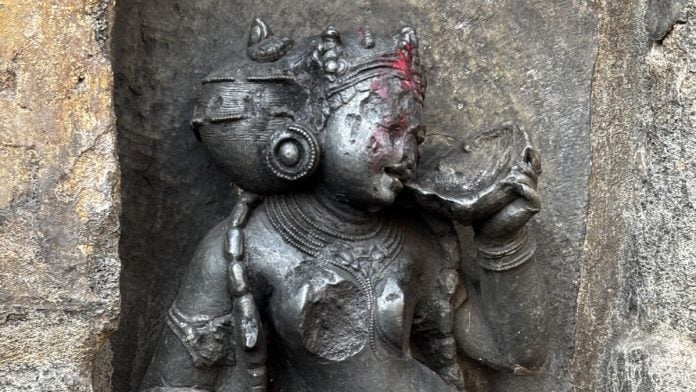
India today is dotted with the ruins of circular temples that don’t seem to fit any of today’s religious traditions. They have no towering spires or domes. Instead, at their centre is a shrine to Bhairava, the fierce form of Shiva. Facing him, set into the circular wall, are goddesses, typically 64. Some consume offerings of flesh, blood, liquor, or bodily fluids. Others wield weapons. Not all seem human: they possess the faces of asses, lionesses, sows, and elephants.
If not for the fact that one of the greatest of these temples — the Chausath Yogini temple at Mitaoli, Madhya Pradesh — partially inspired India’s old Parliament building, the tradition that they represent might as well come from an alien planet.
As hair-raising as they may be to Hindu sensibilities today, the cult of the yoginis was once India’s pre-eminent esoteric cult for royal initiates. At least three powerful Indian dynasties belonged to the tradition, while also patronising temples less terrifying to today’s Brahminised expectations. The Chandellas and Paramaras in Madhya Pradesh: the former built Khajuraho, the latter are famous for their polymath king Bhoja. The Somavamsis in Odisha, who built the great Lingaraj temple at Bhubaneswar. And the Kalachuris, in both Madhya Pradesh and Chhattisgarh. Jain sources also mention Ajmer, Delhi, Ujjain and Bharuch as great yogini centres. Kalhana, the medieval Kashmiri chronicler we’ve frequently run into in Thinking Medieval, mentions that several yogini circles were commissioned by Kashmiri royals. Few of these latter examples survive.
In his book Kiss of the Yoginī, historian David Gordon White studies the worship of these goddesses in great detail. “It was here [in these temples]”, he writes, “that royal cult rituals of the Yoginīs would have been enacted, with blood sacrifices and sexual transactions between male and female clan members taking place around the person of the king himself, the ‘god’ of his kingdom.” The clan in question were the esoteric initiates into the cult. This is supported by medieval texts, such as the Karpuramanjari, a play by Rajashekhara. In it, the esoteric master Bhairavananda stages a cremation-ground rite for a king and queen, with women wearing ogress masks shrieking and groaning while carrying human flesh. Other texts are quite clear that yoginis enjoyed sex, and would carnally enjoy male practitioners.
Why would anyone want to perform such rituals in the first place? (Leaving aside the obvious, that is.) Royal inscriptions give us the answer, as studied by historian Nilima Chitgopekar in her book chapter, Yoginīs in Madhya Pradesh: An Epigraphic Study. An inscription from the reign of the Paramara king Naravarman, himself a yogini adherent, claimed that the goddess Charchika granted her devotees the power to fly. In another, the Kalachuri ruler Gopala lists the various goddesses whom he worshipped and claimed that, after chanting mantras one crore times, the goddess announced that “thy strength, power and valour will be matchless,” helping him win a battle. Yoginis were also believed to prevent epidemics.
Also read: How Rajput patronage turned Krishna into Mughal India’s most popular god
Women’s position in the cult
The image of women free to come and go as they wished, capable of inflicting victory and defeat, of consuming what they wanted and rejecting those who did not respect them, is stirring even today. It may have been alluring for some medieval women who patronised the cult. The Kathasaritasagara, greatest of medieval story compendia, narrates the story of a queen who was “most eager for the supernatural power of flight but anxious about eating human flesh.” (Translation by White.) Her hesitation is only momentary, though. (A small price to pay, perhaps, for coming and going when she wished.)
Yoginis, like Indian goddesses throughout history, were not respected so much for who they were as what they could give (mostly male) devotees — or how they might punish them. The Kularnava Tantra, with which we began this column (translated by June McDaniel), was not arguing that women should be respected as women per se. They should be respected because yoginis love women. Any woman — and any female animal, from “pigeons and vultures to cows and cats”, might be a yogini, writes Sanskritist Shaman Hatley, who studied the Kaulajnananirnaya text (What is a Yoginī? Towards a polythetic definition).
Yogini texts even warn against caste discrimination when within the ritual circle. In South India, some yoginis are depicted holding winnowing baskets and brooms, suggesting that members of the cult may have come from so-called lower castes — or possibly were pressed into it by royals, against textual injunctions. “When they [yoginīs] assault non-devotees,” writes Hatley, “they manifest as snakes, rats, tigers and so forth, and as dangers such as disease, lightning, thieves and royals.”
Despite all this, women were rarely the central practitioners or gurus of yogini cults: men remained front and centre, except perhaps in some parts of east-northeast India. Over the centuries, as states shifted their patronage to respectable, vegetarian male gods with more pliant devotees and mythologies, yoginis steadily fell out of favour. Their offerings of meat and alcohol were substituted with fruits and milk; they were pressed into meditative diagrams and mantras, accessories to ritual, rather than goddesses in their own right. The dramatic defeat of yogini-worshipping dynasties by Sultanate armies may also have played a role — it is perhaps no coincidence that not a trace of them remains in Delhi, once the City of the Yoginis.
It is also worth questioning what the average Indian really thought of yogini cults, with all the blood, cannibalism, and sex. Ethnographic studies in Yoginī’ in South Asia: Interdisciplinary Approaches suggests that while some women still call themselves yoginis or worship in yogini temples, they tend to be vegetarian renunciants. They practice bhakti devotion with chants and songs, and distance themselves from these ancient, bloody, highly sexual goddesses — whom they see as witches. Some traces die hard, though. It is possible that Bengal’s meat offerings to the goddess Durga, which the Hindu Right objected to a few weeks ago, may be a remnant of this ancient practice.
Many medieval inscriptions related to yoginis are severely mutilated: almost certainly by people who could read them and object, rather than by foreign invaders. In my own visits to yogini temples, most recently at Hirapur outside Bhubaneswar, the locals could not tell me much about the goddesses except insisting that “the Mughals destroyed the temple”. But it is equally possible that the yoginis faced what autonomous Indian women have throughout history — a violent patriarchal backlash, followed by centuries of moralising discourse to erase almost all traces of who they once were.
Anirudh Kanisetti is a public historian. He is the author of ‘Lords of Earth and Sea: A History of the Chola Empire’ and the award-winning ‘Lords of the Deccan’. He hosts the Echoes of India and Yuddha podcasts. He tweets @AKanisetti and is on Instagram @anirbuddha.
This article is a part of the ‘Thinking Medieval‘ series that takes a deep dive into India’s medieval culture, politics, and history.
(Edited by Aamaan Alam Khan)