




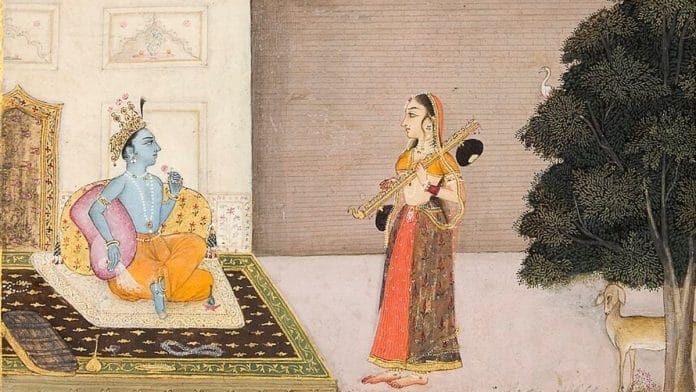

Hindus across the country celebrated Janmashtami last week, marking the birth of the god Krishna, with processions, song, and celebratory human pyramids. As a cowherd, wise teacher, and beloved trickster, Krishna is often assumed to have always been central to Hinduism, adored since time immemorial.
While he is an ancient god, his present-day superstardom is recent. It was the result of a strange entanglement between Rajput kings, Bengali ecstatics, and Mughal poets and emperors.
A donkey at Galta
Let’s consider a legend from Galta, a Vaishnava shrine near present-day Jaipur. In the 16th century, the region was ruled by Prithviraj Singh of Amber, patron of a shape-shifting yogi named Taranath and his unruly acolytes. One day, a wandering Vaishnava pilgrim, Paihari Krishandas, came by and asked the yogi to share his campfire. An enraged Taranath turned himself into a tiger and sprang at Krishandas, who said, “What a jackass!” Taranath was instantly turned into a donkey, and his terrified followers scattered. King Prithviraj, according to the legend, immediately changed gurus. Krishandas’ Ramanandi line, revering the divine Rama and Sita, took over the shrine at Galta.
Historian William Pinch, in Warrior Ascetics and Indian Empires (2006), reads this legend as a memory of a political and religious shift in the 1500s. Yogis such as Taranath were formidable but unreliable. As a result, royal patronage steadily moved into large religious institutions and networks of pilgrimage. The power that had saved Krishandas was not his own, but that of a deity standing beside him: one who could be worshipped in a state-administered temple embedded in larger pilgrimage networks.
Around the same time in Bengal, a Brahmin named Vishvambhara Mishra took the ascetic name Krishna Chaitanya, and led communities in ecstatic devotion to Krishna. Worshipped with singing, dancing, and weeping in the street, Chaitanya’s Krishna was not the charioteer of the Bhagavad Gita but the cowherd of Vrindavan, with his consort Radha. Chaitanya sent his closest followers, the brothers Rupa and Sanatana Goswami, west to Braj with instructions to recover its lost sacred sites: the groves and ponds where Krishna’s childhood was said to have unfolded. In 1534, Rupa is said to have found an image of Govinda-deva on a mound at the centre of Vrindavan. He raised a modest shrine over it the following year, claiming to have restored an ancient temple mentioned in the Puranas.
Eight years earlier, Mughal conqueror Babur had won the First Battle of Panipat.
Also read: BAPS Eiffel Tower row isn’t a Hindu vs the rest issue. I see it as a Gujarati problem
Vows and strategy
Forty years later, Chaitanya’s ecstatic worship and Amber’s state-administered pilgrimage centres became irrevocably intertwined. Chaitanya’s Vaishnavism, called “Gaudiya” for its origins in Bengal (Gaur), had rapidly spread across the eastern Gangetic Plains and Odisha, with a network of monasteries and pilgrim facilities patronised by local rulers and devotees. In 1571, Man Singh, descendant of Prithviraj Singh and soon–to–be the Mughal emperor Akbar’s most formidable general, visited the small shrine of Govinda-deva in Vrindavan.
According to historian R Nath in ‘Śrī Govindadeva’s Itinerary from Vṛndāvana to Jayapura, c. 1534–1727’ (1996), Man Singh vowed to build Govinda-deva a worthy home if he prevailed over Mewar. In June 1576, at Haldighati, he led a Mughal army against Rana Pratap of Mewar, who was wounded and escaped. Man Singh, seeking to fulfil his vow, started building.
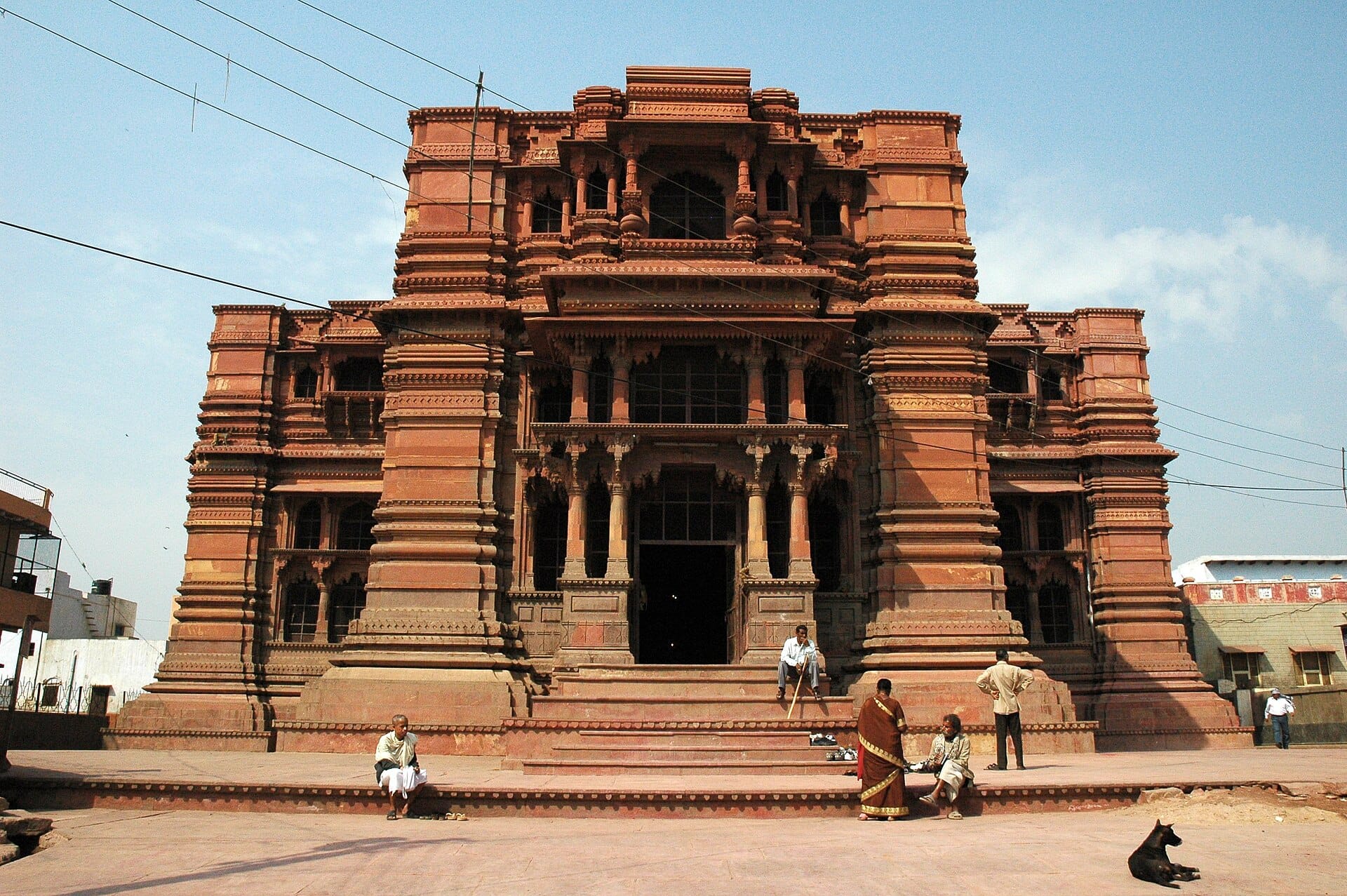
His colossal temple to Govind Dev Ji was possibly the largest temple North India had seen in centuries: a sandstone structure whose five spires were once visible for miles across the Braj plain. Its cavernous interior was vaulted with Mughal-esque arches. Architectural historian George Michell suggests that it was likely built by the same craftsmen employed at nearby Fatehpur Sikri.
In fact, Akbar had been endowing Braj’s Vaishnava temples since 1565, and he backed Man Singh’s Govind Dev Ji as well. Muslim writers across North India were also writing devotional poetry to Krishna around this time—a subject studied at length by Professor Francesca Orsini. Akbar may have had a strategic reason for his patronage. Raja Man Singh would govern Bihar, Bengal, and Odisha on his behalf from 1588. These were the heartlands of Gaudiya Vaishnavism. Endowing its holiest shrine in the Mughal territorial core was an intelligent outreach; it bound distant subjects through pilgrimage into the imperial network.
This model of Vaishnava patronage travelled fast. At Orchha, the Bundel chief Madhukar Shah devoted himself to Krishna and Rama. His enormous Chaturbhuj Temple at Orchha, the tallest in North India, appears to have been modelled on Man Singh’s Govind Dev Ji.
Also read: Why Manusmriti can’t be defended by cherry-picking its punishments for men
God moves into the palace
In the 1630s, Shah Jahan handed management of the Govind Dev Ji temple directly to the house of Amber, though the arrangement did not last. Forty years later, amid political turbulence with his vassals, emperor Aurangzeb ordered the Keshav Rai Temple in nearby Mathura to be demolished. According to historian Munis Faruqui, this was because of its custodians’ support for Jat rebels. In contrast, Aurangzeb had actually renewed Govind Dev Ji’s land grants on several occasions in 1661, 1671, 1695, and 1707. Though the sequence of events is debated, the temple was eventually damaged in regional upheavals.
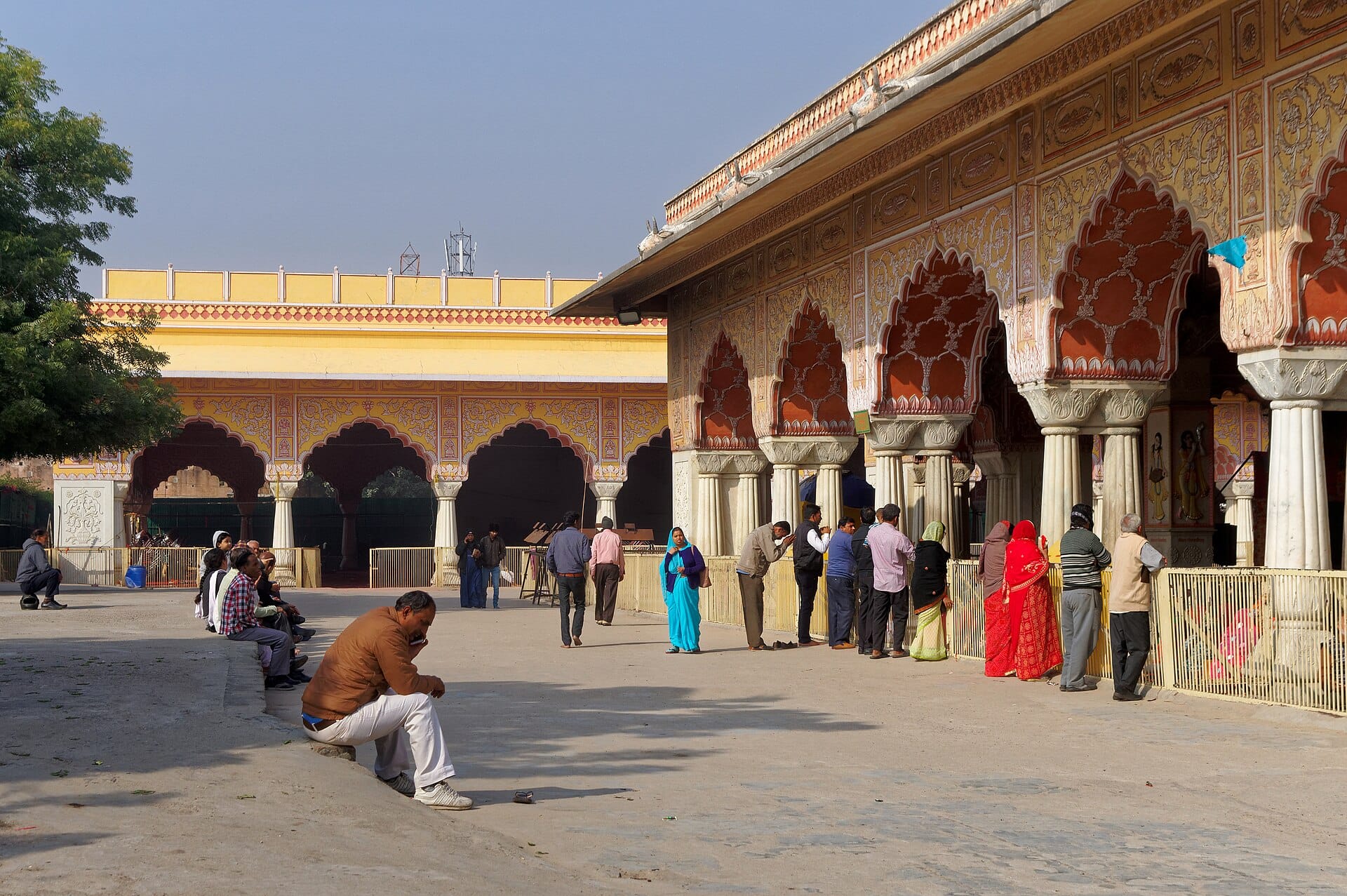
The temple custodians had already swung into action. Govind Dev Ji’s idol left Vrindavan and moved west in stages, arriving at last in Amber in the early 1700s, where the ruler, Sawai Jai Singh II, was constructing a new capital: Jaipur. The Rajput king also built Govind Dev Ji a garden retreat, moved him into Jaipur when the city was completed, and finally installed him inside the palace compound itself. (Historian Sam Dalrymple shares photos and an overview of the shrine’s history here.)
In 1740, Jai Singh II ordered every title-holder at his court to pay toward the god’s upkeep, effectively declaring him the state deity. His shrine was designed to resemble an imperial Diwan-i-Aam, writes Dalrymple, rather than the “towering shikharas (spires)” that had once crowned his temple in Vrindavan.
Krishna and the State, however, were somewhat uncomfortable bedfellows. Kiyokazu Okita, in Hindu Theology in Early Modern South Asia (2014), writes that Jai Singh II made several interventions to bring his territories in line with orthodox Hinduism. He performed Vedic sacrifices, including the Asvamedha horse sacrifice. He forced the Mughal court to abolish jizya and other pilgrim taxes. On the other hand, he directly intervened in his subjects’ devotional lives, stopping the Ramanandi practice of meditating on the intimate life of Sita and Rama. This was the same group that the king’s ancestor, Prithviraj Singh, installed at Galta near Jaipur.
Jai Singh II recognised only four legitimate lineages for Vaishnava devotion. One Rup Lal of the Radhavallabhas refused to affiliate with anybody, and was driven out of Vrindavan with his family. The king was also determined to prove that Radha and Krishna were married. (Strictly speaking, according to the Gaudiyas, Radha was married to another cowherd, but since she was an emanation of Krishna’s energy, their union was metaphysically sanctioned.) In 1719, Jai Singh II convened a conference at Jaipur to settle the matter, and sent an envoy to argue the case in Bengal.
However, even a king had no authority over whom god was permitted to love. The Bengalis heard Jai Singh’s envoy out and rejected his arguments. Govind Dev Ji stayed in the palace, but Radha, theologically, stayed married to somebody else.
Anirudh Kanisetti is a public historian. He is the author of ‘Lords of Earth and Sea: A History of the Chola Empire’ and the award-winning ‘Lords of the Deccan’. He hosts the Echoes of India and Yuddha podcasts. He tweets @AKanisetti and is on Instagram @anirbuddha.
This article is a part of the ‘Thinking Medieval‘ series that takes a deep dive into India’s medieval culture, politics, and history.
(Edited by Prasanna Bachchhav)