




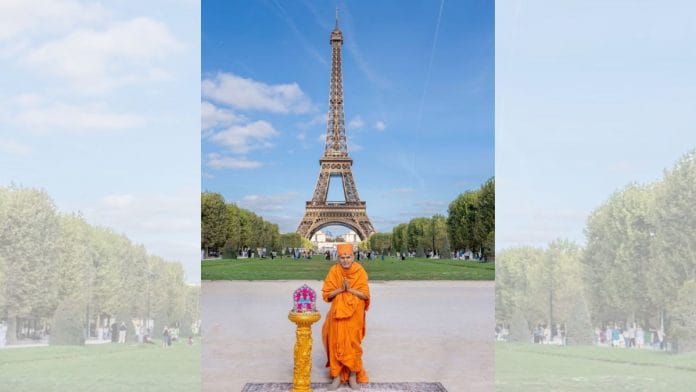

I want to discuss the international furore over the demand made by the largely Gujarati Swaminarayan sect to remove all women from the Eiffel Tower. But first, we need to talk about today’s Gujaratis as a whole.
Let’s face it. Gujaratis have never had it so good. The two most powerful men in the country are Gujarati. So are the two richest people. Any list of India’s wealthiest people is sure to be full of Gujaratis.
These glory days for Gujarat and Gujaratis are a surprise. When the textile industry collapsed in the late 1960s and early 1970s, many great Gujarati fortunes were destroyed. Textile mills that had long been a symbol of Gujarat’s prosperity were shut or shuttered, unemployment grew, and an air of demoralisation spread through the state.
Gujarat didn’t become more politically significant, either. You can count on your fingers the number of Gujaratis who became national political leaders in the two decades before Prime Minister Narendra Modi came along. When it came to trumpeting Gujarat’s contribution to national politics, people had to go all the way back to MK Gandhi, Vallabhbhai Patel, and possibly, Morarji Desai.
I have always argued—from when he became Gujarat chief minister—that one reason so many Gujarati Hindus are fiercely loyal to Modi is that they identified him early on as the man who could restore the state’s stature and bring prosperity to it.
Whatever your views on the prime minister, it is hard to deny that he has delivered on those expectations. Gujarat is more prosperous than before. Its towns and cities are booming. There are more Gujarati millionaires and billionaires than there ever have been, and Gujaratis take pride in their regional identity.
Which, ironically enough, may be how the problem began.
Medieval prejudices in a modern world
The Swaminarayan sect is a largely Gujarati operation, so people in the rest of India don’t know much about it. It may even have a higher profile abroad, with well-known temples in such places as New Jersey and the London suburb of Neasden. While there has been criticism about its beliefs from some Hindus, who are uneasy about the sect’s tendency to regard its founder Swaminarayan as a figure to be worshipped, most Hindus accept that the sect is entitled to its own beliefs within the broader Vaishnavite tradition.
For instance, Modi was extremely friendly with the sect’s late leader Pramukh Swami—when Pramukh Swami died in August 2016, Modi flew directly to Gujarat right after his Independence Day address to pay his respects. He has often praised Pramukh Swami and the sect itself, and the sect loves him.
None of this evoked much comment until the Swaminarayan sect made global headlines this week. Its demand that the management of the Eiffel Tower remove all women from the structure when its members came visiting drew condemnation from every political party in France.
As a Gujarati, I know a little about the sect’s medieval view of the world. But even so, I am shocked that they made such a demand. The sect’s rule, dressed up in the usual cant about brahmacharya (celibacy), is that its monks should not ever look at women.
This may be fair enough. Some Christian sects keep monks locked up in monasteries far away from women, and as long as the monks don’t object, I treat it as their own business.
The problem arises when the Swaminarayans try to engage with the outside world on their medieval terms. Nearly four decades ago, when I was editor of Sunday, a delegation of swamis came to see me to ask for coverage of their operations in New Jersey. Would I send someone to visit their temple?
I said I would. At this stage, they made it clear that the journalist assigned would have to be male. Naturally, I assigned a woman correspondent.
The swamis were upset, but not so upset that they were willing to forgo coverage in a national news magazine. A young woman correspondent from Sunday duly went to New Jersey and wrote the story. My correspondent told me later that a well-known Gujarati female journalist had also covered the event, and the organisation had co-operated—though she added that every time a monk saw her, he would begin running away in the opposite direction.
It’s hard to operate in the modern world if your prejudices are rooted in medieval times. Some of the swamis I met eventually agreed that this no-women policy would be impractical in the 21st century.
So, you can imagine my surprise when I discovered that, decades later, not only were the Swaminarayans sticking to this policy, they now had the nerve to demand that famous global attractions be cleared of women. What’s more, they were getting their own way, perhaps because the sect is extremely wealthy—and as we have seen, extremely well-connected at the highest levels in India.
Some people see this as a ‘Hindus vs the Rest’ issue. I don’t. I see it as a Gujarati problem.
Also read: Why India’s Budget planning needs a brutal overhaul
The nasty underside of Gujarati ostentation
Over the last decade or so, as Gujarati wealth and influence have grown, something strange has happened to my people. We are now so conscious of our wealth that we flaunt it in the most ostentatious manner possible at oversized functions and big weddings. We act like everything is for sale. Why can’t we have the Eiffel Tower emptied? Why can’t we have streets in a European town shut down so that our wedding parties can proceed? And because Gujaratis have the money, we find ways of getting what we want. It’s as true of Gujarati industrialists as it is of Gujarati religious sects.
Sadly, it is also true of those who lack the billions, but have all the bossiness and vulgarity. So Gujaratis will think nothing of turning an aeroplane cabin into a private Jamanvaar (feast). Once, Gujarati families would pack a few theplas and eat them quietly. Now, they pack a feast and take over a whole plane as loudly as they can.
Never before have I heard of Gujaratis deciding to dance the garba on the airport tarmac before they board their flights. They must realise that this is not normal behaviour, because no other passengers are doing it. But they don’t care. They will follow their own rules.
The ostentation and vulgarity are only one part of the story. There is a nasty underside to this new confidence. They will impose vegetarianism wherever they can. They will ban Muslims from attending harmless dances, where once everyone was welcome. They will turn festivals into occasions for displays of bigotry by refusing entry to those of a different faith.
As time goes on and our smugness increases, the behaviour of Gujaratis in public becomes more and more questionable. Some people call us an international embarrassment to India. That may or may not be too harsh. But it worries me that so few powerful Gujaratis speak out against this kind of behaviour. I can’t think of many powerful Gujaratis who have condemned the Swaminarayans.
There is a cost to be paid. A national backlash against Gujaratis is growing. Our arrogance and insensitivity are slowly turning the rest of the nation against us.
People forget that we are the land of Gandhi and Patel. We must remind ourselves of that: of our culture and heritage. The strongmen and the oligarchs will come and go. But there is more to Gujarat than the sad spectacle of its people travelling the world and embarrassing our nation.
Vir Sanghvi is a print and television journalist, and talk show host. He tweets @virsanghvi. Views are personal.
(Edited by Prasanna Bachchhav)