





“If anything in this life is certain, if history has taught us anything,” says Michael Corleone in The Godfather Part II, “it is that you can kill anyone.”
He was not entirely correct. The two men who tried to kill Tiger Shroff at virtually point-blank range in Mumbai failed, apparently because one of their guns jammed. But the history of the Mumbai underworld suggests that Corleone (or Francis Ford Coppola, who is sometimes credited with writing that line of dialogue) was right. For years the underworld killed anyone they wanted, no matter where their victims were: at home, at temples, in cars or even in crowded courtrooms. And it is starting again.
Right from the 1970s, there has been a link between the film industry and the gangster business. In the old days when films needed outlaws, they fell back on dacoits (Ganga Jamuna, Mujhe Jeenay Do, Jis Desh Mein Ganga Behti Hai, Mera Gaon, Mera Desh), a trend that reached its peak with Sholay.
But while the writers Salim and Javed were plotting Sholay, they were also creating a new genre. They wrote Deewaar by taking the theme of Ganga Jamuna and setting it in the Mumbai docks rather than the ravines of Chambal. Within the film industry it was no secret that Deewaar (released a few months before Sholay) was loosely based on the life of the smuggler and gangster Haji Mastan.
It became a superhit and launched a new romance between the film industry and the underworld. Mastan loved the attention, loved mixing with film stars, financed more movies and reportedly even commissioned a biopic in which he played himself. (The film was never completed.)
It would be nice to think that the industry put up with Mastan out of fear. But in reality they loved him and enjoyed the whiff of danger that came from hanging out with gangsters. Plus the gangsters had money, which they poured into the industry.
Also Read: Bollywood is shaking with fear. Not everyone is as lucky as Tiger Shroff
An old romance turns ugly—again
By the time the Mastan generation of hoods had passed on and a new set of gangsters called the shots, the industry was fully on board. Stars were hosted by Dawood Ibrahim in Dubai, mafia types organised live movie star shows and took over the music and video cassette business. A new set of underworld movies, some of them based on real gangsters, hit the screen, from Mani Ratnam’s Nayakan (remade in Hindi as Dayavan) to Ram Gopal Varma’s Satya. (Nayakan was based on the gangster Varadarajan Mudaliar, who also inspired the voice Amitabh Bachchan adopted in Agneepath.)
But when you dance with the devil there are always consequences. Gangsters began demanding loyalty from stars. Their underworld rivals took to targeting actors who were seen as being too close to other criminal camps. The awe and fandom with which gangsters had once regarded movie stars vanished. Now, if a star refused to act in a movie sponsored by a criminal, his life was threatened. Producers would be forced to sell the distribution rights to their movies to the underworld.
The relationship between dons and stars became public knowledge after the 1993 Mumbai blasts.
The police arrested Sanjay Dutt in connection with the blasts. He explained that he had procured an assault rifle only to protect his family. That may have been true but the police said that he had secured the rifle from his pals in the underworld. Dutt was convicted under the Arms Act in the blasts case. Hanif-Samir, the duo who ruled the video cassette market and had long been rumoured to have underworld links (and had given the rifle to Dutt), were also implicated. Samir was eventually sentenced to several years in jail, while Hanif was murdered before the verdict.
After the Mumbai police ran a campaign against the film-underworld links, the dons began to lose their influence. The film industry began to breathe easy again and apart from the odd extortion case the dons learned to lay off.
Judging by the events of the last couple of years, that phase is over.
Almost every month brings new attacks and new threats. Two men on a bike fired several shots at Salman Khan’s house in April 2024. Fortunately, Salman was not injured. A few months later NCP leader Baba Siddique was shot dead outside his son’s office. In September 2025, actress Disha Patani faced threats after which shots were fired at her family home. In February this year, five shots were fired at director Rohit Shetty’s house. In the same month, the actor Ranveer Singh received extortion demands and death threats. Extortion demands and threats were also made to Aayush Sharma, Salman’s brother-in-law.
And these are only the incidents where film people have had the courage to ignore the threats made by the gangsters and go to the police. There is no telling how many others have been threatened with death if they dare speak to the cops.
Mysterious motives
There are parallels with the attacks of 20 years ago. But there are also important differences. This time the gangsters don’t seem fascinated by movie stars and don’t want to control the industry. Their primary motivation seems to be extortion.
But this leads to more questions. If this is all about money, why target stars when there are thousands of businessmen in India with more wealth? Nor are the underworld’s motives entirely clear. After each attack, gangsters post messages on social media which often include some reference to Salman Khan. Nearly everyone targeted is said to be guilty of being friends with Salman.
Why this obsession with Salman? Or is it just a convenient excuse?
Sometimes the social media messages allege that the target has offended some Hindu icon and that the attack is retribution. None of this makes much sense.
Nor do the police seem to get much out of the attackers even when they apprehend them. Six people were arrested for the attack on Salman’s house and the police discovered almost nothing, though given that one of the alleged assailants ‘committed suicide in custody’, the police clearly gave them a thorough ‘interrogation’. Likewise with the Baba Siddique murder, where the police say that the shooters have been arrested. In the Disha Patani case, the shooters were ‘killed in an encounter’.
It’s the same in nearly every case. The shooters seem to be unemployed youth who carried out the hit for money without understanding who was behind it or what the motive was.
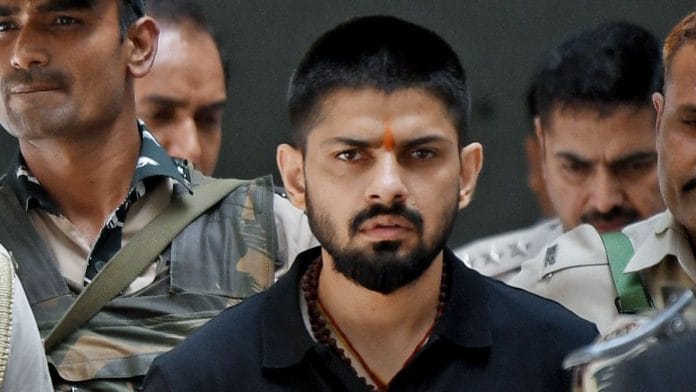
The trail nearly always leads to a gangster called Lawrence Bishnoi. The social media messages from the gangsters usually invoke his name and the attackers claim he is their boss.
Also Read: Modi’s obsession with UP elections is blinding him to larger reality. He’s helping Rahul, CJP
The Gujarat connection
What makes this fascinating is that through this murder and mayhem, Bishnoi has been in prison custody at Ahmedabad’s Sabarmati Jail. His brother Anmol, who was deported to India by the US authorities late last year, is also in an Indian jail: Tihar in his case.
It’s hard to think of a single other case where a man in prison can create so much havoc from his jail cell. Moreover, police forces complain that the Home Ministry (citing legal restrictions) refuses to allow Bishnoi to be taken out of his cell in the Gujarat jail for them to probe his motives and methods.
Would Bishnoi be able to tell the investigators what they want to know if they obtain his custody? Or would he also ‘commit suicide while in custody’?
Besides, if he is really the mastermind, how does he communicate with his gang members from inside a cell? Nobody is willing to explain that. What are conditions like in his Gujarat prison if he can run a multinational criminal gang from inside?
So while there are some parallels with earlier attacks on film stars from the underworld, this campaign against the film industry is significantly different because the motives seem murky and the alleged gang leader is a guest of the government of India.
So far at least, the central government has not provided satisfactory answers to any of the key questions about Bishnoi. But as Michael Corleone said, if a gangster really wants to kill somebody he will succeed sooner or later.
I am not sure if the central government knows that it is sitting on a powder keg. The day a major star is bumped off, all of India will question the state of law and order in our country. And inevitably they will ask: how is a gangster organising this violence from inside a Gujarat jail?
Vir Sanghvi is a print and television journalist and talk show host. He tweets @virsanghvi. Views are personal.
(Edited by Asavari Singh)