





For all the talk of Gujarati dominance, no state matters more to Prime Minister Narendra Modi than Uttar Pradesh. And no Assembly election matters more to the BJP than the one in UP.
Consider the saga of the BJP’s last big climbdown. It came in November 2021, around five years ago. That was when the government finally gave in to demands to repeal the controversial Farm Laws that it had passed over a year before. It had spent the year between the passage of the laws and their eventual repeal refusing to give in to a movement launched by belligerent farmers.
Then, as the UP elections loomed, it took the advice of state leaders that it was best to bury the laws before they became a major election issue.
From all accounts, Modi was not happy to surrender to the protesters and damage his strongman image. But the prospect of losing UP worried him even more.
Afterwards, BJP tacticians said that the surrender had been a mistake. The Farm Laws were not as major an issue as Delhi strategists had been led to believe, and the BJP won UP easily.
But that was not the end of the obsession with UP—with good reason. At the last parliamentary elections, when the BJP lost its overall majority, the primary cause of the reverse was UP. The BJP’s seat share in the state went down from 62 to 33. Its vote share plummeted from about 50 per cent to 41 per cent. Even Modi’s own victory margin in Varanasi was slashed.
While the BJP managed to form the government at the Centre with the help of allies, it has never quite recovered from the losses in UP, which it had come to regard as its political bastion. This year, with elections in the state only a few months away, it cannot risk another electoral setback. Hence the obsession with UP.
Why is Modi protecting Gyanesh Kumar?
With no issue akin to the Farm Laws (which can be handled) dominating debate and some internal polls suggesting that the UP Assembly election will be close, the BJP needs all the help it can get. Will Chief Election Commissioner Gyanesh Kumar’s role in the election be the X Factor that could lead to a BJP victory in UP?
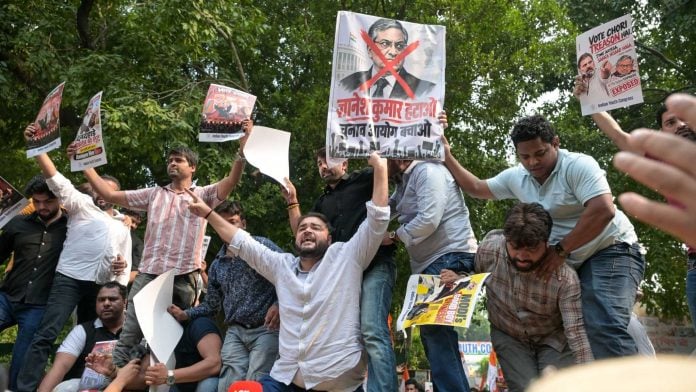
Well, that may explain why the government is determined to hang on to him. After all, the chaos surrounding the anti-CEC protests and the consistent damage the agitation is doing to the government’s reputation can be ended at a stroke. All Modi has to do is nudge Kumar into resigning by offering him a face-saving job such as Governor or Ambassador. Once that happens, life returns to normal.
So why won’t Modi do that?
Because he needs Kumar for UP?
That certainly is the only explanation that makes sense. Why else is the government willing to alienate a whole new generation of voters? Why is it willing to turn Delhi into a fortress, as it did on Saturday? Why is it willing to defy the Supreme Court’s directions to not totally shut down metros and trains? Why is it willing to anger lawyers by detaining them? Why is it willing to admit to its own fear and vulnerability by using over 30,000 cops and paramilitary troops to secure a small area in the centre of Delhi? Why is it sending policemen to board planes and arrest dissidents in the manner of some tinpot dictatorship?
And the big one: what started as an anti–Gyanesh movement has now become an anti-Modi movement. Why is it still worth it for the prime minister to risk so much, including his own popularity, for the sake of Kumar? Could it be because a defeat in UP would be an even bigger setback?
If that is in fact the intention, then the government’s obsession with the UP election may be blinding it to a larger reality. No election conducted under Kumar will have the stamp of legitimacy in the public mind. Even if Modi wins Chief Minister Yogi Adityanath another term, it will be at the cost of his own personal standing and moral authority. And within the party, Yogi will take the credit for the victory, arguing that he pulled it off despite the unpopularity of the central government.
Also read: What bypoll results say about ‘vote theft’ politics and Gen Z protests
Modi’s choice
Though the movement’s stated aim is the removal of Kumar, it has now got to the stage where the longer Modi dilly-dallies, the more the protesters will gain. The Cockroach Janta Party (CJP) was perceived as a single-issue party. When the government gave in to its demand and sacked Dharmendra Pradhan, the CJP was seen as having achieved its objective. The CJP leaders had a cordial meeting with two Union ministers and urged protesters to go back home.
That would have been that. But the agitation over Kumar’s ouster has given it a new lease of life. The show of force on Saturday proved to its supporters how frightened the government was of another CJP agitation. If Modi plays into the CJP’s hands and keeps delaying Kumar’s exit, its agitation will have a chance to gather more momentum, creating more anti-Modi sentiment.
It’s the same with the Congress. Rahul Gandhi has had a rocky ride so far. But thanks to the anti-Kumar sentiment, he has emerged as a rallying force for the parliamentary Opposition. The longer Modi gives him a reason to keep agitating, the better it is for Gandhi.
Frankly, the best strategy for Modi is to say that he has listened to the voice of the people and to kick Kumar aside. The BJP might still win a free election in UP; it’s certainly a risk worth taking.
But for that to happen, Modi must recognise that the public mood has changed. The old certainties are dead. The government can’t do whatever it wants any longer by relying on a benign Supreme Court and pliant governing officers in both Houses of Parliament. Even the print media are now showing more resistance to governmental firmans than before. Nobody takes the abuse on social media seriously any longer, and nobody believes WhatsApp forwards.
As the public mood changes, people change with it. Even within Modi’s own government and party, fewer and fewer people are willing to speak up for Kumar, except for lightweights like Kiren Rijiju and has-beens like Ravi Shankar Prasad.
There is the practical factor to consider. Yes, you can turn Delhi into a fortress and get your cops to manhandle the leaders of the Opposition once or twice. But are you going to rely on the paramilitary every time there is a major protest? Can you even run a government in that manner?
Modi still has an opportunity to neutralise the protests. But he has to choose: short-term shows of strength or long-term stability? So far, at least, he doesn’t seem to have decided one way or the other.
Vir Sanghvi is a print and television journalist and talk show host. He tweets @virsanghvi. Views are personal.
(Edited by Prasanna Bachchhav)