


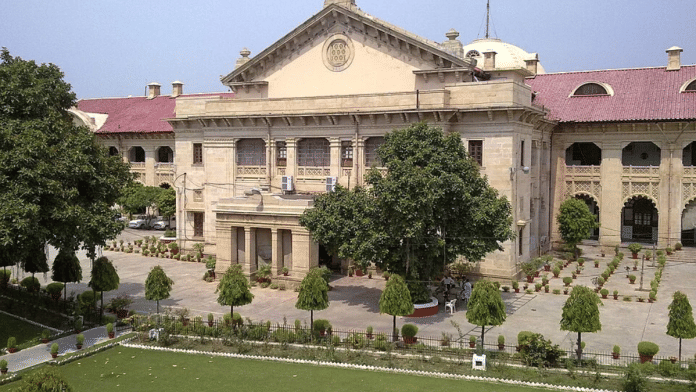
New Delhi: The Allahabad High Court Thursday issued 12 mandatory binding directions to regulate the Uttar Pradesh Gangsters and Anti-Social Activities (Prevention) Act, ruling that independent application of mind by approving authorities is an indispensable jurisdictional requirement.
A bench of Justices Chandra Dhari Singh and Tarun Saxena was dealing with a case involving allegations of excise duty evasion at a distillery, but the court’s scrutiny extended to how the 1986 Act was invoked, the manner in which the gang chart was approved and whether the authorities independently evaluated the material against each accused.
In the 45-page verdict, the bench went on to make some observations on the “routine invocation” of the Act which went beyond the case.
“Heightened care is called for when penal proceedings of an exceptional kind are begun shortly after the same State authorities have suffered an adverse outcome in civil, fiscal or regulatory proceedings on the same facts. The State may pursue every lawful remedy,” it said. “The record should then, however, show on its face that the decision rests on independent grounds.”
The 1986 Act is a state law aimed at curbing organised crime and anti-social activities by groups seeking economic, physical, or undue gain or disrupting public order. In August, the Supreme Court held that the Act is “stillborn” as a person cannot be punished merely based on being labelled a “gangster”.
To prevent arbitrary invocation of the Gangsters Act, the High Court mandated authorities across Uttar Pradesh to strictly observe these 12 steps prior to initiating proceedings under the Act and its 2021 Rules.
First, threshold determination. The initiating officer must record for each person the specific Section 2(b) clause invoked, specific acts of violence or coercion attributed, and the unlawful object alleged.
Individual assessment and inadequacy of ordinary process: The High Court has said that satisfaction at every tier must be individual to each accused, stating why that person is a gang member or leader as distinct from a co-accused in the base crime. Collective entries shall be invalid.
Plus, where the base offence is charge-sheeted or pending trial, authorities must record specific reasons showing why ordinary prosecution is inadequate, such as bail breach or witness tampering.
Fourth, there must be temporal proximity. The gang chart must state the exact date of the last act attributed, the HC said. And where significant delay exists, specific reasons for belated invocation must be recorded.
There must be full disclosure on the chart of the current status of all base cases (stays, bail, quashing), related civil/fiscal orders, and investigating agency recommendations with reasons for departure.
Joint meetings under Rule 5(3)(a) between the District Magistrate (DM) and the Senior Superintendent of Police (SSP) must be recorded with date, time, venue, and participants. Minutes detailing material examined and reasons for approval or rejection must be entered in a register; mere recitals of “consensus” shall not suffice.
Seventh on the list is independent and dated endorsements by forwarding and approving authorities, i.e., in their own words with reference to evidence, recording date and time below signatures.
Also, no FIR can be registered until approval and joint meeting minutes are complete, with exact time of approval recorded to verify administrative sequence. Plus, only offences explicitly listed under Section 2(b) clauses can be reckoned as base cases.
The HC has mandated clarifying how unrelated criminal history must be shown separately. If a public servant is included, authorities must document why the Gangsters Act is invoked over departmental remedies, specifying whether Section 3(1) or 3(2) applies.
In any judicial challenge, the State must produce the original gang chart, minutes register, and evaluated material before the court.
Lastly, judicial findings of non-compliance will be sent directly to the Chief Secretary and Additional Chief Secretary (Home) for formal examination of official conduct.
Also Read: Why a UP top cop & home secy got Allahabad HC rap as court dropped Gangsters Act charges against 3
The genesis
The case stems from an incident from March 2021 where an Assistant Excise Commissioner alleged that distillery executives, employees, transporters, wholesale licensees, and excise officials removed liquor twice on a single pass using duplicate barcodes to evade duty. The distillery was sealed immediately in March 2021.
Over the next four and a half years, police completed investigation in the base case, filing 10 charge-sheets, while all accused were given bail.
In 2023, a Special Investigation Team (SIT) chaired by the Principal Secretary (Home) recommended the Gangsters Act proceedings against nine primary individuals.
However, in December 2025, shortly after the HC set aside the distillery’s license cancellation for a second time, the police prepared a fresh gang chart expanding the accused list to 27. This chart retained seven SIT names and added 20 individuals, including company employees and four excise officers, without recording any justification for departing from the SIT report.
‘Mechanical approvals’
Scrutinising the record, the HC identified glaring violations of the U.P. Gangsters Rules, 2021. It observed that intermediate endorsing officers—the Circle Officer, Nodal Officer, and Superintendent of Police—wrote identical, three-sentence statements. Terming this a “cyclostyle reproduction” prohibited under the Rules, the bench held that copied formulations reflect a complete absence of independent thought.
It noted that several endorsements were undated and that the DM approved the chart on 9 December, 2025, by recording mere “consensus” and satisfaction with the police report, rather than independently evaluating the evidence against each individual.
Additionally, the State failed to produce contemporaneous minutes of the mandated joint meeting, relying on a signature register produced weeks after petitions were filed.
The HC held that employees acting within a corporate hierarchy under supervisory instructions do not constitute an organised criminal gang merely because business operations are alleged to be unlawful.
Concluding that the delay of over four years lacked fresh anti-social activity and that approving authorities acted as rubber stamps, the High Court ruled that non-compliance with Rules represents an incurable jurisdictional defect.
Consequently, the court quashed the 2025 FIR, emphasising the Gangsters Act requires evidence of violence, threat, or coercion under Section 2(b).
(Edited by Tony Rai)
Also Read: Gangsters Act: The controversial law behind Yogi govt’s crackdown on dons like Mukhtar Ansari