





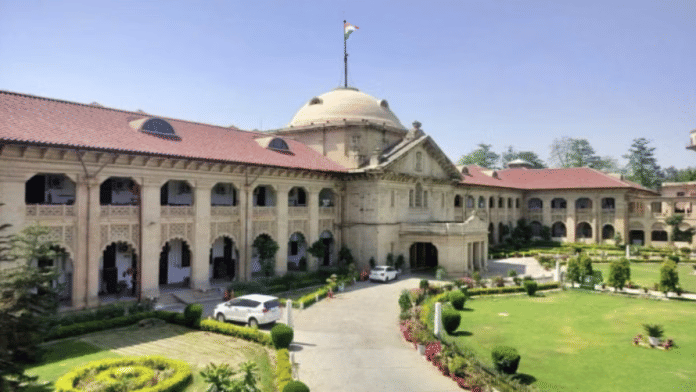


New Delhi: The Allahabad High Court has pulled up a top officer of the Uttar Pradesh Police for booking three members of a family including a 35-year-old woman under the Gangsters Act without fulfilling the required parameters in the law that could justify their arrest.
The three—father, son and daughter-in-law—are residents of Ghaziabad and were arrested in February 2023 on allegations of operating a gang involved in defrauding citizens. While the father and son were taken into custody a day after an FIR was registered against them on 12 February that year, the daughter-in-law was arrested two days later. All the three were granted bail in May 2023.
The officer who faced the court’s is Ajay Kumar Mishra, who was then the Ghaziabad police commissioner, now posted as inspector general of police (IGP), Prayagraj. The current proceedings before the court arose as the three Ghaziabad residents moved the HC seeking quashing of the Gangster Act charges slapped on them.
While quashing the case against the three, a bench of Justice Vinod Diwakar shared the court’s deep concern over Mishra’s failure to exercise supervisory control over his subordinates and question their actions for converting a civil dispute into a criminal case.
Though the petitioners had raised questions over what they referred to as Mishra’s conduct, his volatile and unpredictable behaviour and arbitrary approach to administration, Justice Diwakar refused to examine or assess what he called unsubstantiated submissions.
However, in view of the fact that the HC found no material to sustain the charges under The Uttar Pradesh Gangsters and Anti-Social Activities (Prevention) Act—invoked against the three family members on Mishra’s orders—it directed the senior officer to remain vigilant and circumspect in the discharge of his official functions.
The court said it had taken a lenient view towards Mishra because it did not want to impact his future career prospects. But it told the officer that he should carry out his duties in such a way that it befits “responsibilities of a position that demands balanced judgment, institutional restraint, and scrupulous adherence to law”.
Since the petitioners had accused Mishra of high-handedness, vindictiveness and abusing his position, the court, in its order, asked the state home department to make an independent evaluation on the suitability and operational effectiveness of its officers, particularly those who get field postings.
Their primary grievance was that no joint meeting was held between the police commissioner and the district magistrate before this law was invoked against them, a consultation necessary as per the rules framed under the UP Gangsters Act.
While hearing arguments, the court was told by the State that according to a November 2022 notification, in districts notified as ‘commissionerates’, there was no requirement for the DM to participate in such a joint meeting. In these districts, the police commissioner is both the head of criminal administration and executive magistracy.
The move to create commissionerates, in cities with a population exceeding 10 lakh, was done to tackle rapid dismantlement of fast-moving criminal networks without bureaucratic latency, the state told the court when it raised an apprehension over the legality of such a notification.
Initially inclined to determine its constitutional validity, the HC chose not to rule on the November 2022 notification’s legality due to a pending batch of cases challenging the vires (the constitutionality) of the UP Gangsters Act before the top court. However, it took serious note of several systemic failures, including the absence of any state policy for the expeditious disposal of cases against habitual gangsters; the lack of any mechanism to secure witness production; the absence of a fair and effective witness protection scheme; the failure to ensure timely production of prosecution witnesses before the court; the failure to sensitise District Government Counsels to provide meaningful assistance to the court.
‘A conduit for self-serving interests’: Court raps UP home secretary
Justice Diwakar’s order also drew attention to the “deeply entrenched culture” in UP where, he said, a considerable section of the officer cadre treats the rule of law not as a constitutional obligation but as an operational inconvenience.
“Arrests are effected without due process, many times FIRs are registered or suppressed with ulterior motives, and preventive detention provisions are invoked arbitrarily, at the whims of officers,” said the judge, frowning upon non-compliance of judicial orders that are routinely bypassed and “defeated in substance”.
The state, driven by the feudal mindset of politicians and bureaucrats, has been reduced to an instrument of personal dominion rather than public service, the judge observed in his order.
As he strongly criticised the police officers for calibrating their conduct to satisfy political superiors, Justice Diwakar came down heavily on the state bureaucracy, particularly the home secretary. According to the court, the home secretary of UP has in practice served as a conduit for self-serving interests.
“Recommendations on postings, approvals of departmental proceedings, and responses to court proceedings have, in such instances, reflected considerations driven by personal or extrinsic calculations rather than dispassionate and constitutionally informed administrative judgment. This fundamentally compromises the institutional integrity that the position demands,” the judge said.
(Edited by Gitanjali Das)
Also Read: Delhi HC’s order on the right to be forgotten isn’t very practical—the internet never forgets