





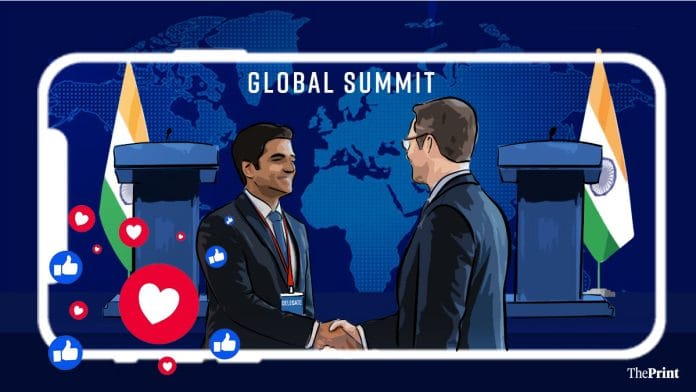


New Delhi: The Instagram reel starts with a young man in sunglasses, running his hand through his hair as an electropop song plays in the background.
Next appears a picture of an ID card, and what seems to be an attempt at an ultimate flex. “Nothing much…Negotiated UK FTA, G20, made policies with foreign govts, casually clicking pics with foreign ministers, prime ministers”.
From then on it’s a relentless slideshow of him dressed in suits, sitting behind ministers or shaking hands with foreign officials, attending think-tank events or accepting awards, or posing outside fancy restaurants and monuments abroad. He has around 80,000 followers.
From slick videos showcasing access to officials from the Ministry of External Affairs (MEA) and foreign diplomats, to offering paid mentorship sessions to young Indians to make it in public policy without being IFS officers, a group of consultants-turned-Instagram influencers is amassing thousands of followers.
Their videos carry descriptions mentioning “the Government of India” or MEA, in a bid to add a further layer of legitimacy, despite having no official connection to either.
With growing interest in serving in the government, many who fail to crack the UPSC exams become the target audience for these flashy videos promising a chance to shape public policy despite being outside the system.
The MEA, is not at all impressed. On Sunday, it came out against such social media accounts. “Certain individuals are making posts suggesting that they are advising MEA on policy related matters including on trade, migration and other issues. These handles are also offering paid advice/sessions on how to work with MEA. These individuals have no connection to the Ministry and the Ministry urges all to be careful against such fraudulent posts on social media platforms,” the MEA fact-check handle stated.
One of the more prominent influencer accounts dropped “GoI (Government of India)” from their profile description within hours of the MEA statement.
However, they still have videos asserting that they “negotiated” a free trade agreement with a third country, advised foreign governments on policies with regards to India, advised the MEA and state governments, as well as have access to foreign ministers and other international leaders.
These individuals highlight “policy career” opportunities and charge individuals for mentorship sessions that in some instances can cost Rs 1,000 or even more per hour for a phone call and strategic career planning. The promise is to “advise” them on alternative career paths to do similar work as a diplomat without requiring them to clear the UPSC.
The accounts of some of such individuals have anywhere from 50,000 to close to 100,000 followers, with some of the videos posted on Instagram, having more than a million views.
The reach, popularity and proliferation of such accounts led to the MEA’s warning, sources informed ThePrint. The fact remains that the ministry invites a number of individuals in their roles as employees of think-tanks focusing on specific issues for events, but that by no means indicates any employment or official status within the ministry.
The ministry also commissions research by policy think-tanks for informed decision-making. In such instances, the individual connected with the research may be invited to sector-specific brainstorming sessions organised by the MEA, and may speak at other forums.
The social media accounts in question use photos from such events to piece together a video no longer than a minute, implying certain approbation from the ministry. The consultant now becomes an influencer, offering to advise others to follow their footsteps.
The claims of fully funded foreign trips at the invitation from a third country’s embassy in New Delhi and attendance at forums open for those in the public policy space such as Raisina Dialogue, is used to further the image.
Over 5.49 lakh Indians appeared for the UPSC preliminary examinations this year, aiming to become one of the 1,016 officers across the administrative service (IAS), foreign service (IFS) and the police service (IPS).
Also Read: Inside the influencer industry—relevance, relatability and revenue
Patterns of social media posts
The slickly created videos showcase the individual travelling across the world, attending events, including those open for public policy professionals, and getting photographed with the Indian flag in the background.
Indian flags, photos with ambassadors, or even videos indicating attendance of national day celebrations held by embassies are further shared, indicating access to both the government and embassies in New Delhi.
It should be noted that national day celebrations by embassies are usually open to those by invitation, and invitee lists are usually large, in some cases crossing 2,000.
Another account seen by ThePrint pitches public policy as an alternative career for those who failed the UPSC examinations. The account also has video montages of the individual getting clicked with Union cabinet ministers, attending events such as the Raisina Dialogue organised by the Observer Research Foundation (ORF), and appearing at embassy programmes.
The comments on such videos often have users calling for guidance from the individuals, which usually includes a response asking them to “tune in for more.” In some cases, the descriptions of such accounts include links with names such as “MEA role links” and include a menu for different offers of mentorship opportunities, often with paid advisory services by the influencer.
(Edited by Ajeet Tiwari)
Also Read: Influencer Ankush Bahuguna walked London streets in a pink suit. Homophobic slurs followed