








A few weeks ago, a friend who had attended a screening of a restored version of Do Bigha Zamin came back disheartened. The raw, despairing power of Bimal Roy’s 1953 classic has remained intact, but the audience has changed over seven decades. The film would have caused anguish even a few years ago, but parts of it are now fodder for laughter.
Even in a harrowing meditation on poverty, there are two poignant scenes which stand out in Do Bigha Zamin. First, Shambhu Mahto — played with aching misery by Balraj Sahni — teetering on the edge of landlessness, goes from pillar to post in search of work. He and his hungry young child land before a man in a suit on a Kolkata street to ask, “Gareeb aadmi hoon babuji, kahin kaam milega? (I am a poor person, sir. Can I get a job anywhere?)” The man doesn’t bother slowing down long enough to answer and waves him off rudely.
Second, Shambhu has become a hand-pulled rickshaw driver. Two lovers, mid-quarrel, hire a rickshaw each, chasing the other through the city streets. Shambhu hauls the man through Kolkata traffic, who exhorts him to go faster and faster for a higher fare, running until he draws level with a horse carriage, eventually outstripping the animal. The lovers, meanwhile, oblivious to the pain of the men ferrying them, laugh with abandon.
That laughter echoed through the Mumbai hall. The audience laughed along with the couple on screen at exactly the moments that are meant to be unbearable.
Same thing, different era
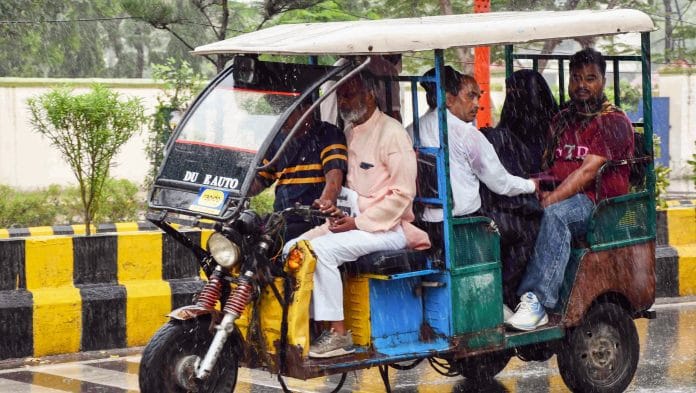
A few weeks later, the same thing happened, this time on actual streets. The same desperation that Shambhu Mahto’s face once bore, reflected in the faces of e-rickshaw drivers stalled in the middle of the street in parts of North India.
A new genre of social media clout-chasing, tagged “tirri control” across Instagram and YouTube, has unfolded over the last few days. It shows young men riding a bike and tailing e-rickshaws, derogatorily labelled ‘tirri’, and disabling them mid-journey using a phone app called BAT-BMS. The app was built as a companion app for technicians, meant to monitor Bluetooth-enabled lithium-ion batteries.
But most cheap batteries powering India’s e-rickshaws, which have no password protection, can be accessed by anyone with the app within 10 to 15 metres. Anyone can connect to a passing vehicle and switch it off, leaving the driver and passengers stranded.
Each video is staged as a prank, and the poor driver’s confusion and distress are meant to be the punchline. The comments on these videos cheer and encourage this behaviour. Although e-rickshaws provide a crucial service for last-mile connectivity in India’s cities and towns, the pranksters’ justification is the rash driving exhibited by some operators. At least in some cases; most content creators feel no need to justify their actions, and the suffering of e-rickshaw drivers is enough.
Some drivers, unaware that their vehicles had been remotely switched off rather than genuinely broken down, ended up paying mechanics to help restart them. Nearly all of them lost their daily wages.
In one video that has racked up several thousand views, an influencer named Amaan Siddiqui encountered a driver who had been stranded all day, with no way to pay the daily rent for the vehicle. Siddiqui helped the driver restart the rickshaw using the app, and the driver told him he had lost an entire day’s earnings.
Also read: Madras HC, don’t police wardrobes of folk artists. Protect their fundamental rights instead
Recreational cruelty
There’s a term for this kind of sport, borrowed from wildlife conservation, which describes hunting, baiting, or capturing an animal for the pleasure of watching it suffer: Recreational cruelty. The tirri videos are their most extreme and literal form, but the same instinct guides the casual humiliation of working-class people.
The app-ification of modern convenience relies on a level of impersonality. Interfacing with an app or a website, mediated by a delivery fee topped up with a stock tip, ensures that you do not have to think too much about the person on the other side. The app replaced the person, and the person became an ETA.
This has meant that many of us don’t even register working-class people as humans at all. But we can think of them as content.
Until a few years ago, social media creators would film themselves walking up to destitute men, women, and children and help them with a cash handout. They would set up UPI IDs for thelawallahs and instruct their followers to buy from vendors that did no business at all. So prolific was this genre of video that thousands of parodies began to do the rounds, critiquing the creators’ hunger for reflected glory.
Thanks to the beastly edgelord takeover of the Internet, that impulse has been replaced by something meaner. The ability to mock, disrupt, and attack a helpless person and their livelihood is what passes for ground-breaking entertainment today — and dressing it up as harmless fun allows these creators to minimise the pain of their victims.
Of course, the targets have to be people who fall below the pranksters in the social pecking order. They wouldn’t dare try this with a Thar driver, for instance.
Also read: Every time women produce proof of sexual harassment, the goalpost moves
Embedded deep in society
Last year in Patna, a woman filmed herself running into an old schoolmate delivering pizza. She mocked him in the video and promised to forward the clip to their entire batch. Faced with backlash, the woman later called it “scripted content”, a typical defence creators reach for whenever their cruelty goes viral for the wrong reasons. Whether her classmate’s discomfort that day was real or performed made very little difference to its eventual impact.
Little unites actor Dia Mirza and the social media creators who chase e-rickshaws, except a tacit knowledge of class hierarchy. Mirza found herself in a vortex last week while congratulating herself on her plastic-free household on a podcast. She described how her five-year-old son told off a coconut-water vendor at their door: The indignant child had instructed the poor vendor to take his plastic bag back. Soha Ali Khan, who was one of the panellists, labelled the young child’s chutzpah, “courage to stand up to a grown-up”. Neither of them examined the class reality that emboldened a privileged child to talk down to a non-privileged adult.
The sociologist Amita Baviskar coined the term for this unseemly display of high-minded concern: “bourgeois environmentalism”. Baviskar wrote, for the bourgeois environmentalist, “the ugliness of production must be removed from the city”.
This includes “smokestack industries, effluent-producing manufacturing units and other aesthetically unpleasant sites that make the city a place of work for millions, should be discreetly tucked away out of sight, polluting some remote rural wasteland”.
It’s the same impulse with the labouring millions. “Even people whose services are indispensable for the affluent to live comfortable lives – domestic workers, vendors and sundry service providers – should live where their homes do not offend the eyes, ears and noses of the well-to-do.”
Nowhere is this manifestation of recreational cruelty more visible than in the arbitrary orders issued by RWAs and high-rise management societies. Their diktats include banning delivery executives from using conveniences like elevators and disallowing “maids” and nannies from gathering in open areas like parks for their lunch hour. In Gurugram, a housing society fined two domestic workers, Kajal and Manju, 100 rupees each for using the main lift instead of the service lift.
There’s also the matter of how much they should be paid. Actor Kirti Kulhari — who has worked in several films championing the unlikeable female heroine — told an interviewer a few months ago that she was unable to hire help at her new house on Yaari Road. Apparently, a cook-cum-domestic worker had quoted her 10,000 rupees a month for two hours of work a day. Kulhari felt the number was too high and wondered aloud whether the woman had set the price based on who her potential employer was.
What probably didn’t occur to the actress was the fact that the domestic worker would free up two hours of Kulhari’s own time, which is priced rather differently.
But maybe pausing to think about these things is expecting too much of ourselves. Laughter is infinitely easier, especially when the joke isn’t at your expense.
Karanjeet Kaur is a journalist and a partner at TWO Design. She tweets @Kaju_Katri. Views are personal.
(Edited by Saptak Datta)