




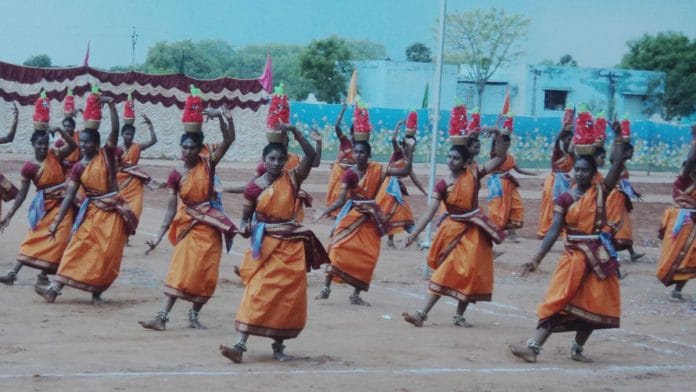

Let’s consider a typical setting of Tamil director Mari Selvaraj’s film. The camera in his movies serves as a witness to the disruptive force of Tamil Nadu’s cultural life, especially in the rural areas, focusing on the lives of the marginalised strata. We can visualise the thumping defiance of the parai drums in Pariyerum Perumal or the explosive fury of village celebrations in Karnan.
In both events, Selvaraj rejects the comfortable elite gaze. This gaze has treated folk art as a quaint, decorative spectacle. What he does through his art form is reframing and re-foregrounding subaltern performance for what it truly is: a battleground for dignity, historical memory, and material survival. What we witness as an audience under the blinding halogen lights of a real-world village thiruvizha (temple festival) is a late-night arena that functions as a democratic cultural common. For generations, this space has belonged to communities that gather to witness Adal Padal and Karagattam — performances in which the moving body serves as an engine of economic endurance and ritual sovereignty.
Yet, when the state or its arms come with a tape measure, the underlying anxiety is rarely about fabric. It is truly about power, spatial control, and, more importantly, deciding who belongs in the public eye. The Madras High Court’s recent order, handed down by Justice L Victoria Gowri, lays bare these deep-seated anxieties of the state. By the leviathan imposition of a sweeping prohibition on female festival dancers who “expose” their midriffs, thighs, legs, or chests, the court argues that the prohibition is to shield the fragile “minds of students and youth” from corruption. On paper, it seems to be judicial puritanism. But in practice, it is an execution of a far more calculated structural erasure. Let’s call a spade a spade: the state is aggressively enforcing a hegemonic elite, upper-caste aesthetic code over rural performance spaces. It is turning informal livelihoods into legal liabilities and weaponising law enforcement against marginalised women.
To understand this phenomenon, a cursory look at the history of cultural displacement is needed. This judicial overreach is a modern-day manifestation of “aesthetic enclosure.” By this term, I mean that the move mirrors the late-19th-century colonial anti-nautch campaigns. The British bureaucrats and English-educated Indian elites combined forces to criminalise hereditary women performers under the banner of “social reform.” They successfully purged subaltern women from the nation’s cultural balance sheets. I recall how historian Janaki Nair has brilliantly charted similar early-state interventions in public spaces that consistently pathologised working-class women’s labour to satisfy bourgeois anxieties about order and respectability. When judges become fashion designers, the contemporary state fails to reform rural art. It is gentrifying the cultural commons, sanitising village shrines to clear a path for middle-class consumers, real estate expansion, and corporate-sponsored tourism.
Criminalising the livelihoods of the marginalised
This historical paternalism has a marked effect on the informal economy’s economic base. For thousands of subaltern women across rural Tamil Nadu, Adal Padal and Karagattam are not casual hobbies. They are their survival mechanisms for satisfying their basic economic needs. These folk performances are the economic foundation for these generational artistic communities. They navigate their lives without a single safety net. By putting the entire legal burden of “decency” on a dancer’s wardrobe, especially the labouring bodies of these women, the court transforms precarious living into a legal minefield.
Drawing on the political economist MSS Pandian, his works have frequently pointed out how elite classes in Tamil Nadu use state machinery for furthering their own ideas of civility. They push the cultural expressions of people experiencing poverty to the periphery by branding working-class survival tactics as “uncivilised.”
Consider the volatile ecosystem of live rural festivals. A single costume dispute or an arbitrary complaint may lead to immediate cancellation. This isn’t just a cancelled show; it is instant financial ruin for women who rely on seasonal festival cycles to keep their households afloat for the rest of the year. When an artist’s wardrobe becomes a liability, the state isn’t protecting anyone. It is an upfront attack on their basic human rights, as well as on their constitutional right to livelihood. Because these artists operate entirely in the informal economy, especially in rural areas, they lack formal contracts or union backing to fight these arbitrary diktats.
The weaponisation of the police gaze
The operational mechanics of the judicial order now compound this economic vulnerability. It expands state surveillance over historically oppressed communities. Giving local police officers the power to videograph live shows and shut them down if an outfit isn’t “modest” enough is a method of madness that turns law enforcement into literal fashion police.
This hypervigilance strips away whatever agency these vulnerable women have left. It places them squarely under a punitive state apparatus. Anthropologist Gajendran Ayyathurai’s work is important here, as he has documented the local state machinery in rural areas. He says that they often function as an extension of dominant-caste authority. Handing local police absolute discretionary power over subaltern spaces never protects the marginalised. Instead, it opens the floodgates for extortion, bribery, and targeted harassment. Performers now have to navigate bureaucratic quixoticism. Now their paychecks depend on satisfying the moral whims of a local cop. The constant threat of an officer pulling the plug mid-performance introduces a power dynamic. It leaves women entirely defenceless against exploitation.
The classist divide: folk art vs. elite classical dance
Historically, the state’s policing gaze has been seen as highly selective. There is a glaring class and caste bias. It dictates whose body is seen as pure and whose is labelled impure. In urban, air-conditioned setups across Chennai, elite Bharatanatyam dancers routinely perform with bare midriffs. These events are celebrated under the prestigious banner of “divine classical heritage.” Their movements are historicised as sacred, intellectual, and worthy of hefty state patronage and corporate sponsorships.
But when rural subaltern women wear similar traditional attire to perform Karagattam or Adal Padal, the discourse is turned on its head. Their bodies are immediately marked as “vulgar” threats to public morals. This can be understood by looking at scholar Gopal Guru’s thesis in his seminal work, Aesthetics of the Dalit Body. He notes that elite aesthetic structures routinely strip the subaltern body of its natural artistic validity, viewing it only through the lens of labour or hyper-sexualisation.
This mechanism of control is a local manifestation of a broader, global reality. The Black feminist thinker and poet Audre Lorde has pointed out how dominant structures suppress the organic expressions of marginalised groups. She further observed that the master’s tools will never dismantle the master’s house. Lorde argued that dominant cultures weaponise puritanical notions of “decency” to suppress the deep, authentic vitality of subaltern expressions. They effectively render them “suspect” because they cannot be easily policed or catalogued by state authority. This double standard exposes a paradoxical, sharp classist outlook. On one hand, the state aggressively sanitises and penalises the working-class body. On the other hand, it exalts the upper-caste body performing under identical physical configurations. The message here is clear for one to read: bodily autonomy and aesthetic freedom are privileges reserved exclusively for the elite and elite spaces.
Socio-cultural erasure under a ‘civilising mission’
By enforcing these double standards, the judiciary is aggressively pursuing a “civilising mission” It primarily seeks to domesticate rural expression. The Madras High Court’s directives — which remarkably went so far as to order Karagattam dancers to mimic the specific, sanitised cinematic attire worn in Gangai Amaran’s 1989 film Karagattakaran — completely ignore how these folk traditions organically evolve.
Imposing a rigid standard of respectability onto rural art systematically erases historical, body-positive subaltern traditions. These performance practices have proudly thrived outside the sanitised, Brahminical gaze for generations, using the body as a site of celebration and ritualistic endurance rather than shame. By forcing these art forms to conform to an external, elite ideal of purity, the judiciary actively participates in cultural erasure. It flattens the rich, diverse history of subaltern bodily expression to make it palatable for a middle-class audience that views folk heritage through a lens of deep-seated condescension.
Also read: Casteism didn’t disappear in Indian cities. It just learned English
Legal overreach and constitutional rights
This judgment sets a dangerous legal precedent that directly undermines fundamental constitutional protections. Article 21 of the Indian Constitution guarantees the right to life and personal liberty, which includes the right to livelihood. Article 19(1)(g) similarly guarantees the right to practice any profession or occupation. In the landmark Indian Hotel and Restaurant Association (AHAR) vs. State of Maharashtra (2019) case — commonly known as the Mumbai Dance Bar Case — the Supreme Court strictly struck down overbroad restrictions on female dancers. The apex court explicitly ruled that the state cannot restrict women’s livelihoods under the paternalistic guise of “safety” or subjective “public morality.” By tying a citizen’s economic survival to shifting definitions of modesty, the Madras High Court oversteps these clear legal boundaries. It replaces established constitutional doctrines with arbitrary moral anxieties. The bigger issue is that they are setting a volatile precedent where any marginalised community’s livelihood can be dismantled if it offends elite sensibilities.
To conclude, this trend of judicial overreach is preposterous. It is not merely an isolated debate over cultural propriety or religious decorum. It is a direct structural assault on the economic autonomy and, more importantly, on the cultural heritage of subaltern women. Justice mechanisms must protect the vulnerable strata, but here it seems that they are enforcing a sanitised, upper-caste aesthetic that criminalises their existence. The court must step back from policing the wardrobes of the poor and instead refocus on upholding their fundamental right to life, work, and express themselves with dignity.
Nikhil Sanjay-Rekha Adsule is a lawyer, an alumnus of TISS, Creighton Peden Scholar, USA, and a Senior Scholar at IIT-Delhi. He tweets @Surajya_Raje_. Views are personal.
(Edited by Aamaan Alam Khan)