



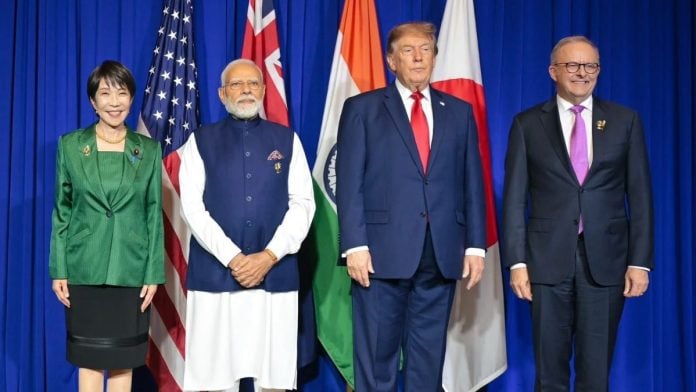
Four countries of the Quadrilateral Security Dialogue, popularly known as the Quad, met for less than two hours in Manila, Philippines, on the sidelines of the ongoing ASEAN summit. The meeting, held more as a ritual on 17 November, took place two years after the Delaware gathering. It’s being touted as a strategic step toward reaffirming the Quad’s commitment to a free and open Indo-Pacific, strongly opposing any unilateral attempts to change the status quo by force or coercion.
The Quad leaders launched the Indo-Pacific Maritime Surveillance Collaboration (including plans for a 2027 maritime patrol aircraft exercise) and focused on cable connectivity, cybersecurity, and countering economic coercion, all of this in the presence of US President Donald Trump, who is unrelenting in weaponising tariffs to coerce the global economy and international trade.
Four aspects of the Manila meeting are being highlighted for adding value, salience and seriousness to the significance of the Quad.
Quad’s China challenge
First, at a time when China’s military assertiveness, economic impact and technological accomplishments are reshaping the regional balance of power, the meeting carries significance beyond the customary diplomatic symbolism of four leaders coming together, by sending strong signals to China.
Has the Manila meeting really sent strong warning signals to Beijing and shaken it to the core? Doubtful. Even as the Quad leaders were unveiling their maritime cooperation and naval exercise, both Chinese President Xi Jinping and his Russian counterpart Vladimir Putin blasted the protectionism of the West, describing the situation there, especially Europe, as “humiliating decline” and criticised US sanctions as they have backfired.
While the Quad clearly addresses economic coercion, freedom of navigation and unilateral attempts to change the status quo, it avoids explicitly naming China or even mentioning references to maritime disputes and the 2016 South China Sea arbitral award. The September 2024 Wilmington Declaration reaffirmed support for ASEAN centrality, the Pacific Islands Forum (PIF), the Indian Ocean Rim Association (IORA), international law (including UNCLOS in the South and East China Seas), and condemned the 26/11 Mumbai and Pathankot attacks.
There is nothing to establish that the Quad Manila meeting marks the revival of the Quad as a credible strategic counterweight to China. Incidentally, while India has refused to develop the Quad as a security architecture against Beijing, Australia and Japan have robust trade relations with China. With Trump meeting Xi Jinping for a third time in a year, there is very little deterrence that the Quad is offering as far as China’s forced forays into the Indo-Pacific and the Quad’s legitimate geography in Asia and the Pacific.
Also read: Why the upcoming Trump, Xi, and Putin summit risks repeating the mistakes of Yalta 1945
Manila’s diplomatic optics
Second, choosing Manila as the venue carries strong historical symbolism, as it was here in November 2017 that the Quad was revived after a decade of inactivity following its original formation in 2007. This aspect also sounds unconvincing, as the Manila meeting took place as a last-minute addition on the margins of the ASEAN Summit rather than as a standalone summit, happening shortly before high-profile trilateral talks involving the US, China, and Russia.
It is difficult to dismiss the fact that the Quad meeting appears to be a tool for Trump to gain leverage ahead of broader negotiations with China.
Third, the Quad is addressing an expanded economic and technological agenda at a crucial time. Critical minerals, AI, cybersecurity, undersea cables and resilient supply chains have become central to the partnership of the four democracies and the global geo-economic framework. The proposed $85-million AI initiative and the Quad Business Leaders’ Forum in Mumbai in early 2027 are examples of this wider agenda.
The Quad’s grand resolve to go beyond traditional maritime security issues and address the economic and technological foundations of respective national power is greatly significant. But with America as a central pillar of the grouping, and given its conditional and transactional approach, the credibility of the Quad is at stake.
This dilemma is even more pronounced for Asian economies that depend heavily on China yet remain uneasy with Beijing’s autocratic, hegemonic approach. While Japan and Australia, as formal US allies, rely on bilateral security treaties with Washington, India and other regional nations have no such guarantees. For them, participation is driven by strategic convergence rather than treaty obligations.
Last, the Quad meeting in Manila underscores and reiterates the importance of strengthening the Asian security architecture amid growing regional imbalance and economic uncertainties.
Also read: India sells pluralism abroad but struggles to practise it at home
America’s deliberate contradiction
Here again, while Trump’s participation in the Manila meeting was important, as America is advanced in defence capabilities and economic strength, his outreach toward China is marked by two different and contradictory approaches.
On the one hand, the White House wants to strengthen the Indo-Pacific partnerships to balance China’s growing influence. On the other hand, Trump is pursuing a policy of direct engagement with Xi, including a scheduled meeting in Shenzhen on 19 November, thus creating a strange and deliberate contradiction. It is impossible to strengthen Asian security while simultaneously accommodating China at the expense of other Asian economies and regional bodies.
While India seeks a cordial, balanced and mutually beneficial relationship with China as equals, it has sufficient reasons to be apprehensive of China’s influence in the Indo-Pacific region and India’s extended neighbourhood, especially in the domains of military, economic, maritime, supply chain and industrial capabilities. Does the Quad understand and appreciate India’s apprehensions and strategic and security vulnerabilities and also have the capability and diplomatic leverage to respond to these issues?
India’s participation in the Quad must remain compatible with its engagement in BRICS, SCO, G20 and other multilateral platforms. As an ardent supporter of multipolarity and a leader of the Global South, India cannot and does not view the emerging international system as a simple bipolar contest between Washington and Beijing.
India’s strategy and increase in defence and economic capabilities in the coming years will determine whether the one-and-a-half-hour Manila meeting of Quad leaders matures into a turning point in regional and global geopolitics or remains just another diplomatic event.
Seshadri Chari is the former editor of ‘Organiser’. He tweets @seshadrichari. Views are personal.
(Edited by Saptak Datta)