



“The Riviera of Hades,” British Prime Minister Winston Churchill famously called it: Livadia Palace, the last tsar’s summer home near Yalta. The Crimean palace had just nine toilets and two bathrooms for more than a hundred American officials who arrived there in 1945 to negotiate a new world order. United States President Franklin D Roosevelt had his own en-suite bath, as did Churchill, but even the three field marshals at the palace had to queue at latrines dug in the park surrounding the estate. Alger Hiss—a senior US State Department official later exposed as a Soviet spy—recalled that his true master, the dictator Joseph Stalin, “stood in the lavatory line with his aides and the rest of us lesser fry while Churchill was taken to (Secretary of State Edward) Stettinius’s suite and Roosevelt went to his own.”
Even industrial quantities of DDT, a powerful insecticide, failed to rid Yalta’s palaces of bedbugs and mosquitoes—a problem Churchill solved by discovering that insect bites could be anaesthetised with vodka and cigars. And yet, as this battle waged inside the compound, all around the Allied Summit were burned-down homes and bombed-out factories, the detritus of the long Nazi occupation.
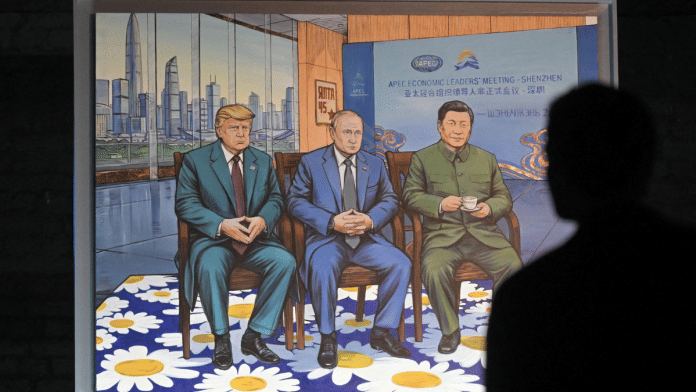
The meeting on 19 November between Presidents Donald Trump, Xi Jinping and Vladimir Putin—the first to bring together the leaders of all three superpowers—is being billed as a modern Yalta, after the historic summit of February 1945. The three great powers of their time had agreed, after a week of negotiations, that post-Nazi Europe would be governed by democratic principles. They also agreed to dismember occupied Germany and to manage future crises through a new global institution, the United Nations.
Nearly 81 years later, the three leaders—said to have been brought together by Brazil’s left-wing President Luiz Inácio Lula da Silva—won’t have to fight for the toilet or fend off insect swarms. Their talks will be no easier than those at Yalta at the end of the war, though. The meeting, on the sidelines of the Asia-Pacific Economic Cooperation Summit, is meant to bring some order to an increasingly anarchic world by working toward an end to the wars in Ukraine and the Middle East, managing access to resources from rare earths to microchips, and making it harder for states to acquire nuclear weapons.
Yalta-on-Shenzhen will face the same challenges as the original. Far from ushering in a new age of peace, the 1945 summit raised the curtain on the Cold War. The world continued to be shaped by industrial capacity and military power, not the fine-sounding principles set out at Yalta. Great-power rivalry regularly flared into war.
Trump, the peacenik?
Trump’s disdain for such middle-class fetishes as coherence and consistency makes unpacking his ideas a hazardous business. This much is clear, though: the President values American pre-eminence, but is less than eager to commit either his soldiers’ blood or the nation’s treasure to uphold it. Even as he has used economic sanctions to press China to end its state-sponsored theft of intellectual property and its market-distorting policies targeting foreign competitors, Trump is less than convinced of the case for containing the country through technology denial. Instead, he has sought to insulate against accidental war along the so-called First Island Chain—the string of Pacific archipelagos running from the Kurils through the Ryukyus and Taiwan to the northern Philippines—by negotiating a binding crisis-prevention protocol.
A second element of Trump’s China diplomacy has been an effort to enmesh the People’s Liberation Army, together with Russia, in a nuclear arms-control agreement. Beijing has long pointed out that its comparatively small arsenal, of about 600 warheads, compared with the 3,700-plus held by the US and the 4,400-plus held by Russia. China, like Russia, might consider limiting its arsenal; however, only if the US scaled back its planned Golden Dome ballistic missile defence system.
Third, Trump has been seeking to keep the race over advanced computer chips from becoming a wider trade crisis. After he imposed tariffs and technology sanctions in 2025, China retaliated with controls on seven rare-earth elements. American companies—from carmakers and electronics firms to defence manufacturers—saw their supply chains crumble. After talks in Busan last year, the US announced that all export restrictions would be lifted. China made no similar announcement, and American imports of rare earths remain far below their 2023 levels.
As the mathematician and pro-democracy activist Jianli Yang writes, there is no small irony in the situation.
“Russia seeks to overturn an order from which it believes itself excluded. China seeks to reshape an order from which it has benefited enormously. The United States, which created and sustained that order, increasingly regards its maintenance as an excessive burden. The revolutionary, the reformer, and the reluctant guardian have become, in different ways, revisionists.”
Also Read: Beijing is bringing Trump and Putin together. The Chinese say it’s a major diplomatic milestone
Lessons from Yalta
From the first hours of the Second World War, it was clear that Europe’s big powers were unwilling to shed blood to uphold the system they had built. France had given firm guarantees that its air force would join the war if Nazi Germany attacked Poland, and that a major land offensive would follow within a fortnight. Instead, the French retreated behind the Maginot Line, the chain of fortifications stretching from Switzerland to Luxembourg. The United Kingdom, which had also promised air action, watched as Germany and the Soviet Union dismembered Poland. As a result, the Poles paid the price for forgetting that great powers look after their own interests first.
As historian Fraser Harbutt has shown, the UK hedged its bets between 1941 and 1943 as it grappled with the uncertainties of a world at war. Fearful of American pressure to dismantle the empire, and seeing the United Nations as a means to that end, Churchill sought a concord with the Soviet Union. America, Churchill argued, would be unwilling to police Europe for long; Europeans would have to work with the Soviet Union.
Facing the prospect of America being sidelined in post-war Europe, Roosevelt made the Soviets a counter-offer. At Tehran in late 1943, he promised a second front against Nazi Germany in 1944. The American leader, his aide Charles Bohlen recorded, made clear that “Germany is to be broken up and kept broken up.”
“The states of eastern, south-eastern and central Europe will not be permitted to group themselves into any federations or associations. France is to be stripped of her colonies and strategic bases beyond her borders. The result would be that the Soviet Union would be the only important military and political force on the continent of Europe. The rest of Europe would be reduced to military and political impotence,” Bohlen wrote.
By the time the leaders met at Yalta in 1945, the situation had crystallised further. Stalin had twice as many soldiers in Europe as the US and UK combined. Like Churchill, Roosevelt knew he had no real option but to let the Soviets keep the Polish territory they had seized in 1939, in return for compensating Poland with captured German land.
After Roosevelt’s death, President Harry Truman ushered in a new policy, pushing back against what many had come to see as America’s excessive deference to Soviet expansionism in Eastern Europe. In 1946, Stalin’s troops stayed on in northern Iran, even as he pressed Türkiye for a base on the Bosphorus. American power began to push up against powerful Communist parties in Italy, Greece and even France.
The Cold War had begun.
Whose world order?
Less than a year after Yalta, the green shoots of understanding between the US and the Soviet Union had withered. Roosevelt had seen economic and technological assistance as a means of influencing the Russians; his successors chose containment. Nazi Germany had devastated Soviet industry, and Roosevelt believed Germany should make good the damage, even if its citizens’ living standards fell. His successors, historian Frank Costigliola noted, saw German economic revival as the key to prosperity across western Europe, and thus to pushing back Soviet influence.
For years, American foreign-policy experts have mirrored similar debates: Is China to be contained or engaged? Is its economic malpractice better met with carrots or sticks? And is it serious about war?
Large numbers of countries across Asia, Africa and South America, meanwhile, have long criticised what came to be known as the “liberal international order”. The rules, many leaders have argued, were designed to favour the rich; the benefits of prosperity were unevenly shared; and powerful actors considered themselves bound by no norms.
There is only one thing worse than the old status quo: a new one in whose making just three nations have had a say.
Praveen Swami is a Contributing Editor at ThePrint. His X handle is @praveenswami. Views are personal.
(Edited by Insha Jalil Waziri)