



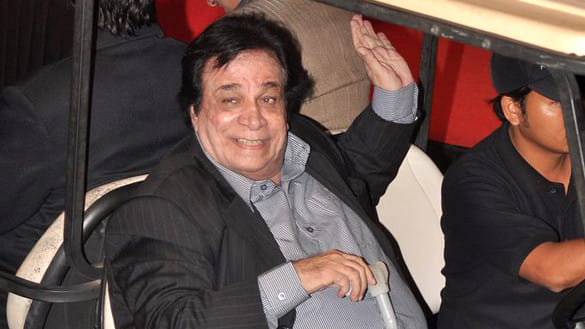
In 1974, director Manmohan Desai was working on the Rajesh Khanna starrer Roti, and the writers in Bombay were not delivering what he wanted. A common friend told him about Kader Khan, and the next day Khan was on the sets.
Khan’s son, Sarfaraz Khan, recounted to ThePrint that when his father arrived, the frustrated Desai refused to narrate the whole film. “I won’t narrate the whole story, I don’t have time. I’ll just give you one scene, go write it,” Desai told him.
“My dad felt a bit insulted by the tone,” Sarfaraz said. But Khan wanted to make his name in the industry and needed work, so he listened to the scene, went to Juhu Chowpatty, sat in a quiet corner and wrote it.
“My dad had a God-given gift; his pen never stopped when he wrote,” Sarfaraz said.
Khan wrote the scene in two to three hours and went straight to Desai’s bungalow, where the director was playing cricket. Desai was confused to see him back, Sarfaraz said. “Are you back already? Didn’t you understand the scene?” he asked.
Khan told him he had returned with the scene. Coming from the theatre world, he did not just narrate it but enacted it. Desai listened to it twice and called his wife in to hear it as well.
After nearly 12 listenings, Desai went into his bungalow and returned with a portable black-and-white Toshiba television set, a gold bracelet and a signing amount of Rs 20,000.
“My friend, how much did you write your previous film for?” he asked. Khan had written the dialogues for Jawani Diwani for Rs 1,500. “For my film, you will get Rs 1.2 lakh,” Desai told him.
Roti became an instant hit. Made on a budget of Rs 90 lakh, the film collected nearly Rs 4 crore worldwide, and the success launched Khan’s film career.
Khan, who died in 2018, wrote nearly 200 films and acted in more than 300. On what would have been his 89th birthday, Sarfaraz says the industry has not valued his father’s name enough.
Written on the floor
Khan’s career spanned three decades, from the 1970s to the 1990s. He worked with stars such as Rajesh Khanna (Maha Chor, Dharam Kanta, Masterji) and Jeetendra (Himmatwala, Jaani Dost, Haisiyat).
He also revealed another side of Amitabh Bachchan, beyond his angry young man image, through films such as Mr Natwarlal, Khoon Pasina, Do Aur Do Paanch and Giraftaar. Khan’s association with Bachchan began with Khoon Pasina and Manmohan Desai’s Parvarish, and the two stayed in touch over the years until the relationship soured. Khan recounted the rift in an interview with Rediff.
Khan said he had always addressed Bachchan by his first name, Amit, but that changed after the actor’s stint in politics. Recalling an encounter with a producer from the South, Khan said he was asked whether he had met “Sirji,” referring to Bachchan. When Khan replied that he called the actor Amit because they were friends, the producer advised him to say “Sirji” instead.
Bachchan was approaching during the conversation, and Khan recalled that the actor appeared to expect the same honorific as everyone else. Khan refused to change how he addressed his friend.
“From that day, I never called out to him and he never spoke to me,” he said in the interview.
Khan’s contribution to Bachchan’s screen persona outlasted the rift. Bachchan went on to win the National Film Award for Best Actor for Agneepath, a film Khan co-wrote the screenplay of with Santosh Saroj.
The film also won two Filmfare Awards, with Mithun Chakraborty winning Best Supporting Actor and Rohini Hattangadi winning Best Supporting Actress. Made on a budget of Rs 5 crore, it grossed nearly Rs 10 crore at the box office.
Khan wrote it in a setting far from anyone’s idea of a writer’s workspace. He had a table, chair and office, Sarfaraz recalled, but he could write anywhere and often did so lying on the floor.
“When Agneepath was released, my younger brother didn’t even know. He asked him, ‘Dad, did you write Agneepath?’ He had no idea,” Sarfaraz said.
Khan was fond of sleeping on the floor and would often write on a sheet and mattress with the family sitting around him.
“He actually wrote the entirety of Agneepath just lying there on the floor,” Sarfaraz said, adding that his father’s focus was so strong that he was not easily distracted.
A graveyard, then the stage
Khan had begun acting well before Agneepath. His debut came with Daag (1973), and over the next three decades he appeared in more than 300 films. But his acting journey began in a graveyard.
When his family migrated from Afghanistan to Bombay in 1942, they lived in a refugee camp in Kamathipura, Sarfaraz said. He recalled that his father, speaking about his childhood, often said he had no friends and was an introverted child. He would visit a nearby kabristan and loudly speak whatever came to his mind. One day, a theatre director noticed him.
“He asked, ‘What are you doing?’ Dad replied, ‘Nothing, I just talk like this.’ The director said, ‘Show me… come, let me take you with me,'” Sarfaraz said.
The encounter introduced young Khan to theatre and set him on his acting journey. His passion for the stage continued at Ismail Yusuf College in Bombay, where he also started a theatre group called Kal Ke Kalaakaar. Some even called it Kader Ke Kalaakaar. The group staged plays such as Local Train and Humare Bhi Hai Mehrab Kehte Kehte, satirising the municipal corporation and corporators. His sons later revived the group.
“For the actors in this revived group, working alongside a living legend was an exercise in pure devotion,” Sarfaraz said. For all his stature in cinema, Khan never brought a superstar’s arrogance to the stage and kept a simple guru-shishya relationship with the actors.
“My father used to work in a lot of detail — not only on how you act but also how you say the words,” Sarfaraz said.
‘This is my award’
Khan wrote for several films that won National Film Awards but never received one himself. He won three Filmfare Awards: Best Dialogue for Meri Awaaz Suno (1981), Best Comedian for Baap Numbri Beta Dus Numbri (1991) and Best Dialogue for Angaar (1993). After his death in 2018, he was posthumously awarded the Padma Shri in 2019, the country’s fourth-highest civilian award.
Sarfaraz said his father defined an era of Hindi cinema across hundreds of films, and that the industry is forgetting his contribution.
“If you talk about the industry… they probably couldn’t carry his legacy forward; they perhaps didn’t value his name enough,” he said.
He added that the industry needed to respect its veterans, who had laid the foundation for the generations that followed.
“The seniors who are the reason our industry has reached this height… they built it from the ground level to the 100th floor. When the new generation arrived, they got to build from the 101st floor,” he said.
Awards and recognition, however, never mattered much to Kader Khan.
“If none of you support me, I have so many admirers in the world that someone will definitely support me,” Sarfaraz recalled his father saying. “The stories, the dialogues he wrote… it is the audience’s love that has kept him alive,” Sarfaraz added.
Sarfaraz once asked his father why he never attended award shows. The answer came after the release of Jaise Karni Waisi Bharni (1989), when Khan received a letter from an elderly woman whose sons had abandoned her in an orphanage.
“You used to ask me why I don’t go to awards, let me show you what an award is for me. Read this. This is my award,” Khan told his son.
The woman wrote that after watching the film, her sons realised their own children might treat them the same way and brought her back home the next day.
Khan used to say that if his writing could change even one person’s perspective, it was a victory.
“Out of a hundred, if even one person understands the point, that is our victory,” Sarfaraz recalled him saying.
Khan came to India as a refugee, learned his craft here and worked in the film industry for three decades. In the final years of his life, he moved to Canada to live with Sarfaraz, his daughter-in-law and grandchildren. According to Sarfaraz, the writer of nearly 200 films was diagnosed with progressive supranuclear palsy (PSP), a rare degenerative disease that affected his speech, movement and memory. He began forgetting the characters he had written and played and struggled even to remember his own name. He rarely spoke and spent most of his days in bed, keeping company with his grandchildren.
Yet his wit and comic timing never entirely left him. Sarfaraz recalled that when a physiotherapist visited to help Khan with exercises, the therapist would ask him to lift his arm, but Khan would not respond. When Sarfaraz asked him to do the same, he would raise his hand.
“He is my son, who are you?” Khan would tell the physiotherapist, Sarfaraz recalled. “He was very cute, like a cute baby. He had become like a child.”
Kader Khan may have spent his final years losing his memories, but the dialogues he wrote and the characters he brought to life live on in Hindi cinema. The industry may have moved on, but generations of audiences continue to speak his words, often without realising who wrote them.
(Edited by Prashant Dixit)