



New Delhi: Uttar Pradesh presents a significant paradox within the Indian economy. According to NITI Aayog estimates, 5.94 crore people in the state emerged from multidimensional poverty between 2013-14 and 2022-23—the highest number among all states and greater than the population of most countries. Yet the state’s per capita income remains about half the national average, ranking second-lowest among all states.
This suggests that while Uttar Pradesh has made substantial progress in improving living conditions, income convergence remains incomplete. Understanding the mechanisms behind this transformation—and why these gains cannot be sustained without broader economic growth—is crucial to achieving the Viksit Bharat 2047 vision, particularly given that one in every six Indians lives in Uttar Pradesh.
Better lives, built by the state
The first part of this paradox lies in how poverty is measured. Nobel laureate Amartya Sen argued that poverty should be understood as a deprivation of capabilities rather than merely an income deficit. The Multidimensional Poverty Index (MPI), developed at Oxford University by Sabina Alkire and James Foster, operationalises this approach.
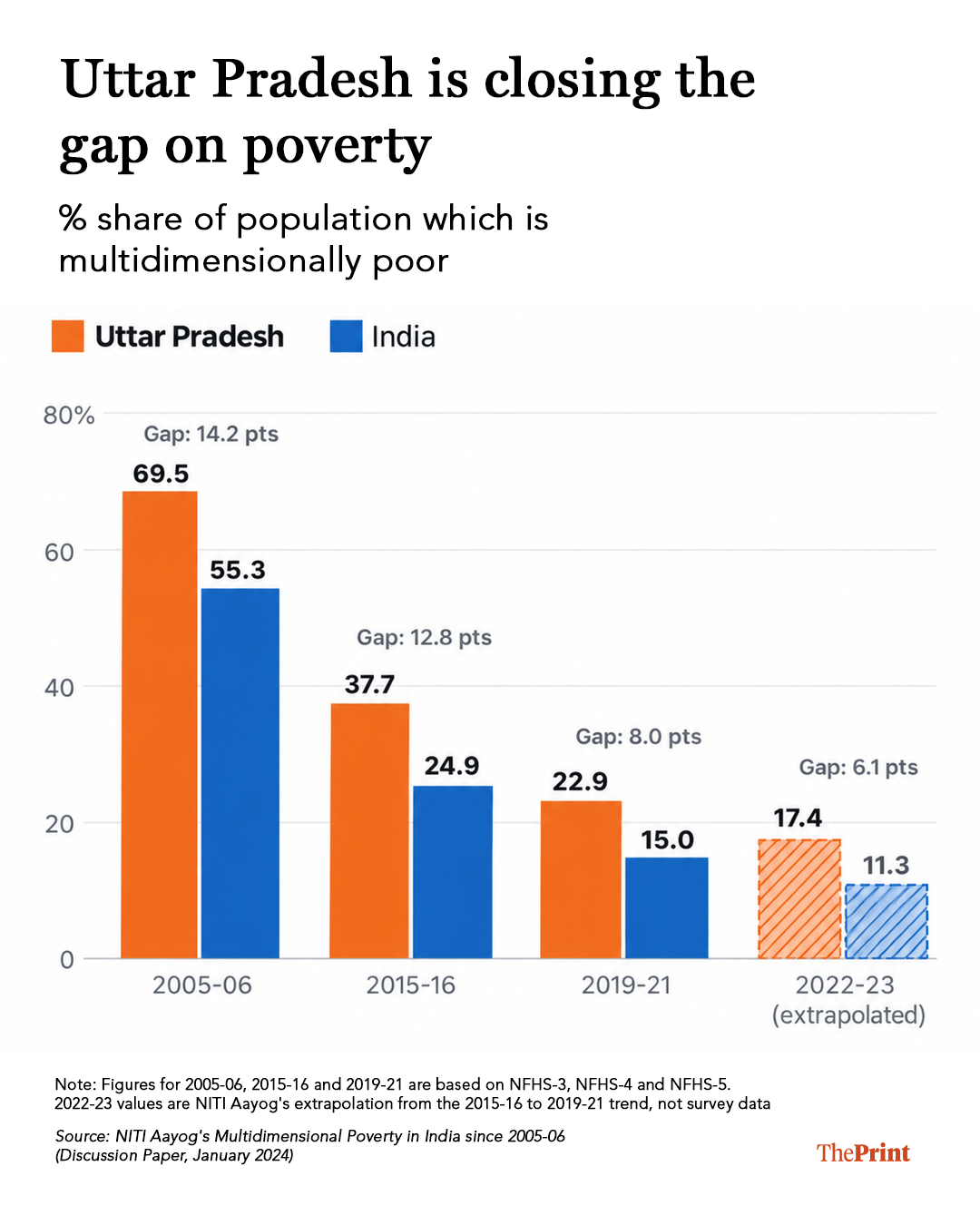
By this measure, Uttar Pradesh has made significant progress. The state’s poverty rate fell from 69.5 percent in 2005-06 to 22.9 percent in 2019-21, while the gap with the national average narrowed from 14.2 percentage points to 8.0 percentage points.
NITI Aayog attributes much of India’s poverty reduction to improvements in nutrition, education, sanitation and cooking fuel, supported by initiatives such as Swachh Bharat, PM Ujjwala Yojana and POSHAN Abhiyaan. This reflects the concept of “support-led security” developed by Sen and Jean Drèze in their 1989 book Hunger and Public Action. They distinguished between “growth-mediated security”, in which rising incomes enable households to improve their living conditions, and “support-led security”, in which public provision of essential goods improves lives even before incomes rise as was the case in Sri Lanka, Costa Rica and Kerala.
Uttar Pradesh’s experience demonstrates the potential of support-led security on a remarkable scale. However, its achievements must be considered alongside its limitations.
Measured as a ratio rather than an absolute gap, Uttar Pradesh’s poverty rate rose from about 1.3 times the national rate in 2005-06 to about 1.5 times in 2019-21, indicating that the rest of India reduced poverty relatively faster. The subsequent data point, for 2022-23, is a projection by NITI Aayog rather than an estimate based on a new empirical survey. The apex think tank’s MPI calculations rely on the National Family Health Survey (NFHS), with NFHS-5 (2019-21) providing the latest survey-based poverty estimates.
Although NFHS-6 (2023-24) released its fact sheets on 29 May this year, they lack essential MPI indicators, including child mortality, sanitation and access to clean cooking fuel, according to OpenCity, an open urban data platform. Household-level data also remain pending.
The available NFHS-6 indicators present a mixed picture. Child stunting in Uttar Pradesh declined from 39.7 percent to 31.5 percent, outperforming the national decline from 35.5 percent to 29.3 percent. However, wasting rose from 17.3 percent to 19.2 percent, while the proportion of underweight children increased from 32.1 percent to 34.5 percent. Both indicators declined nationally.
These trends suggest that the initial gains from support-led security need to be complemented by stronger household incomes. Sustaining improvements in a child’s diet or ensuring that a household can afford a refill of its cooking-gas cylinder increasingly depends on reliable livelihoods.
Livelihoods still waiting
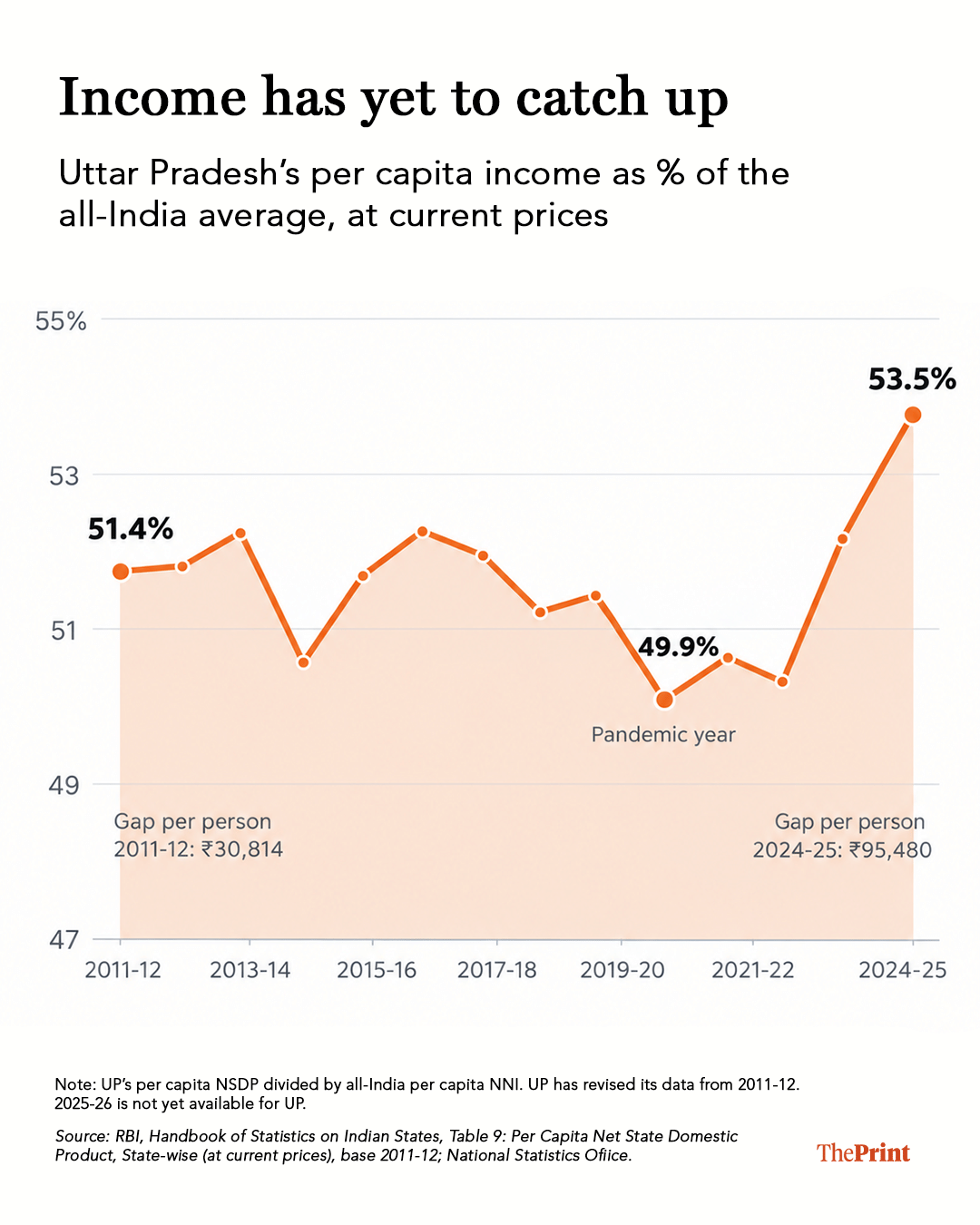
According to Reserve Bank of India data, Uttar Pradesh’s per capita income stood at 51.4 percent of the national average in 2011-12. Over the following decade, the ratio fluctuated between 50 and 52 percent, falling to 49.9 percent during the pandemic year. In the past two years, it rose to 53.5 percent, its highest level in the current series. If the state’s projected per capita income of Rs 1.2 lakh for 2025-26 materialises, the ratio could reach about 55 percent of the national average. Meanwhile, the absolute per capita income gap has tripled to Rs 95,480, partly reflecting inflation.
Welfare measures alone cannot close this economic gap. W. Arthur Lewis, the 1979 Nobel laureate, argued in his 1954 dual-economy model that sustained income convergence requires labour to move from low-productivity agriculture to higher-productivity industry and services.
In an earlier Economix column, ‘There’s a problem with UP’s trillion-dollar economy dream’, I argued that Uttar Pradesh was experiencing growth without convergence because its structural economic transition remained incomplete.
Recent labour-market data reinforce this argument. The Periodic Labour Force Survey for October-December 2025 shows that 50.3 percent of Uttar Pradesh’s workforce is engaged in agriculture, compared with 43.2 percent nationally. Only 26.8 percent work in services, against 32.8 percent nationally. The state’s Economic Survey also indicates that agriculture’s share of the economy has edged up from 24 percent in 2017-18 to 24.9 percent in 2024-25.
The labour survey reveals another, less frequently discussed constraint: low labour force participation, particularly among women. Uttar Pradesh’s unemployment rate stands at 5.0 percent, close to the national rate of 4.8 percent. Youth unemployment is also relatively similar, at 15.1 percent against 14.3 percent nationally. The more pressing concern is the proportion of people participating in the labour market.
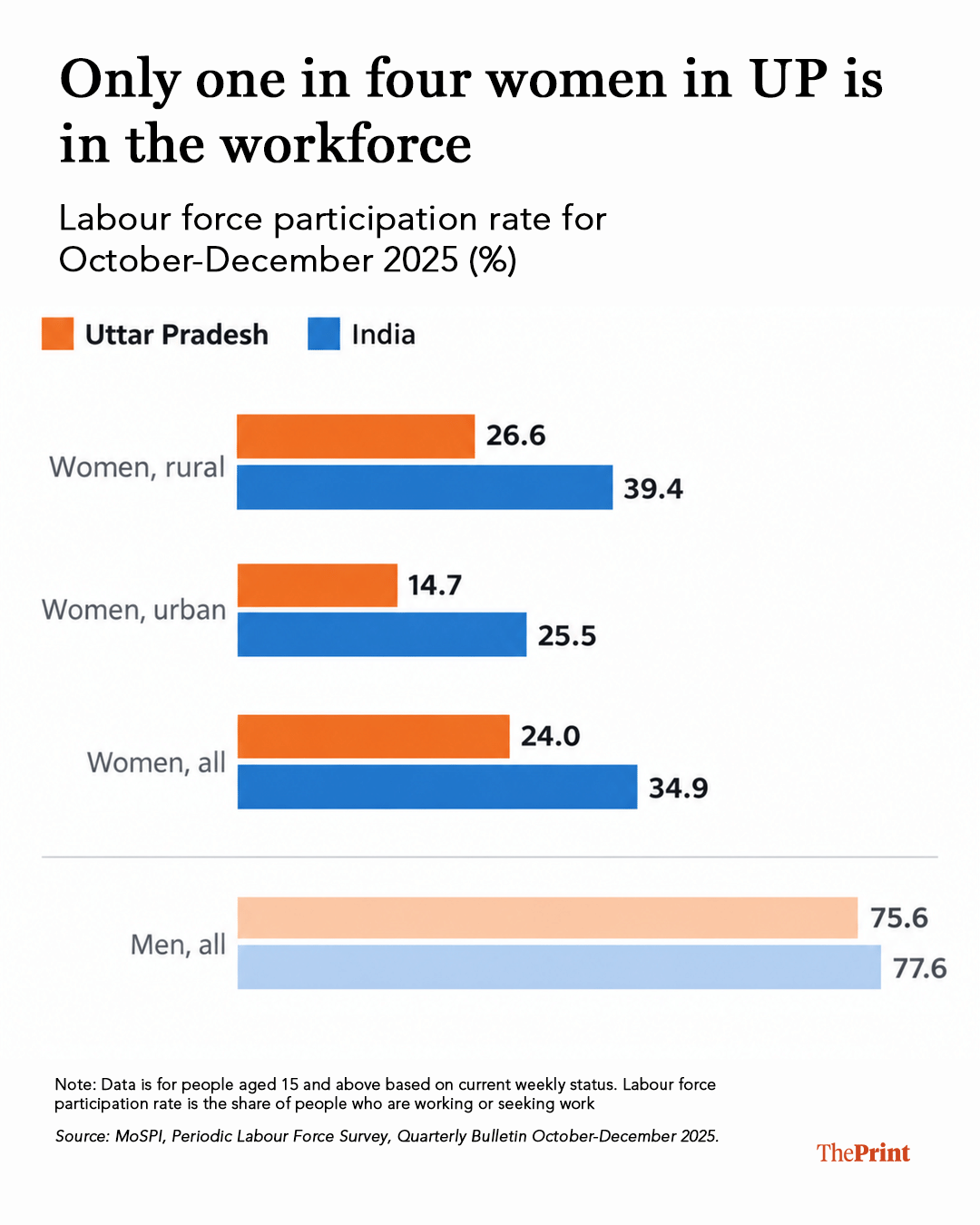
Only 24.0 percent of women aged 15 and above in Uttar Pradesh are employed or seeking employment, compared with 34.9 percent nationally. Male participation is nearly at the national level, leaving the gender gap—particularly in urban areas—as a major constraint. In urban Uttar Pradesh, only 14.7 percent of women participate in the labour force.
Claudia Goldin, the 2023 Nobel laureate in economics, offers a useful framework for understanding this pattern. Her research on the U-shaped relationship between economic development and women’s employment shows that female participation may initially decline as economies move away from agriculture and women’s involvement in family farming diminishes. Participation rises later as education expands and suitable jobs, particularly in services, become available.
Urban women in Uttar Pradesh appear to be positioned at the nadir of this U-shaped curve, awaiting the emergence of sufficient employment opportunities. The transition described by Lewis will remain incomplete as long as a large share of women remain excluded from productive economic activity.
Turning better lives into better livelihoods
The paradox is therefore not a contradiction but a progression. Support-led security has delivered substantial gains, but the next phase must rely increasingly on productivity, employment and income growth. Five strategic shifts are needed.
First, turn welfare gains into human capital. The decline in stunting is encouraging, while the rise in wasting is concerning. Better nutrition must translate into stronger educational outcomes and employable skills. This requires assessing children’s learning, not merely counting school enrolments.
Second, bring more women into paid work. Safe transport, childcare facilities, working-women’s hostels and employment opportunities closer to home could expand women’s participation and raise household incomes. Such measures can complement direct financial transfers by enabling women to earn more independently.
Third, promote labour-intensive manufacturing at the district level. Industries such as agro-processing, textiles, leather and electronics assembly could absorb workers leaving agriculture without requiring long-distance migration. Industrial policy should be assessed by the formal jobs created and installed capacity rather than investment announcements alone.
Fourth, recognise towns as part of the modern sector. With projections suggesting that 35.8 percent of the population will be urban by 2046, investment in small and medium-sized towns should be treated as employment policy, not merely urban policy.
Fifth, improve the timeliness of data. NITI Aayog should release state-level MPI estimates promptly after the NFHS-6 household data become available. Uttar Pradesh should also monitor quarterly labour-market indicators with the same diligence it applies to investment summits.
Uttar Pradesh has demonstrated that it can improve the quality of life for its citizens. The challenge over the next two decades is to translate these social gains into higher household incomes, a task which will be critical to the promise of Viksit Bharat 2047.
(Edited by Chingkheinganbi Mayengbam)