





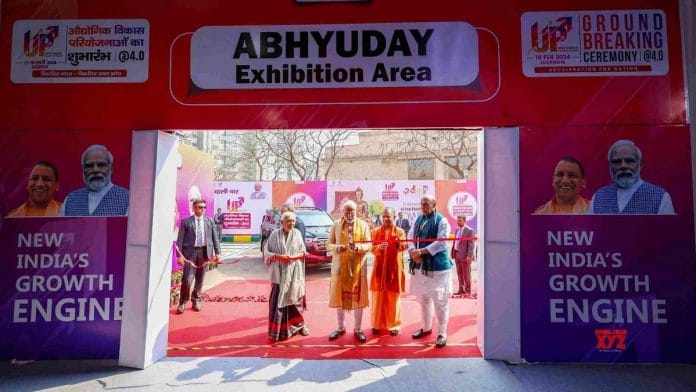


Uttar Pradesh’s official economic narrative has become increasingly compelling. Since 2016-17, the state’s economy has expanded at a compound annual growth rate of 10.8 per cent, and per capita income has doubled. Investment proposals amounting to Rs 50 lakh crore are currently in progress, and the state has published its inaugural Economic Survey this year, which forecasts Uttar Pradesh achieving a one trillion-dollar economy in the medium term.
Chief Minister Yogi Adityanath has described it as India’s growth engine. The Prime Minister has participated in three of the four groundbreaking ceremonies linked to the state’s investor summits, and global investors have signed Memoranda of Understanding in Lucknow with the enthusiasm of individuals who have discovered a new continent.
But compelling as it is, this narrative is also, in significant ways, selectively presented.
The distinction often overlooked in headline figures is what we economists call the difference between growth and structural transformation.
Growth is an aggregate measure, indicating that the economy is expanding. Structural transformation, however, is more complex and consequential, as it assesses whether the composition of the economy is evolving in ways that genuinely enhance the material conditions of its inhabitants. By the first measure, Uttar Pradesh is performing reasonably well. By the second measure, the situation is considerably more concerning.
Also Read: The rupee does not need a defender. It needs an economy worth defending
The numbers that the growth story doesn’t want you to see
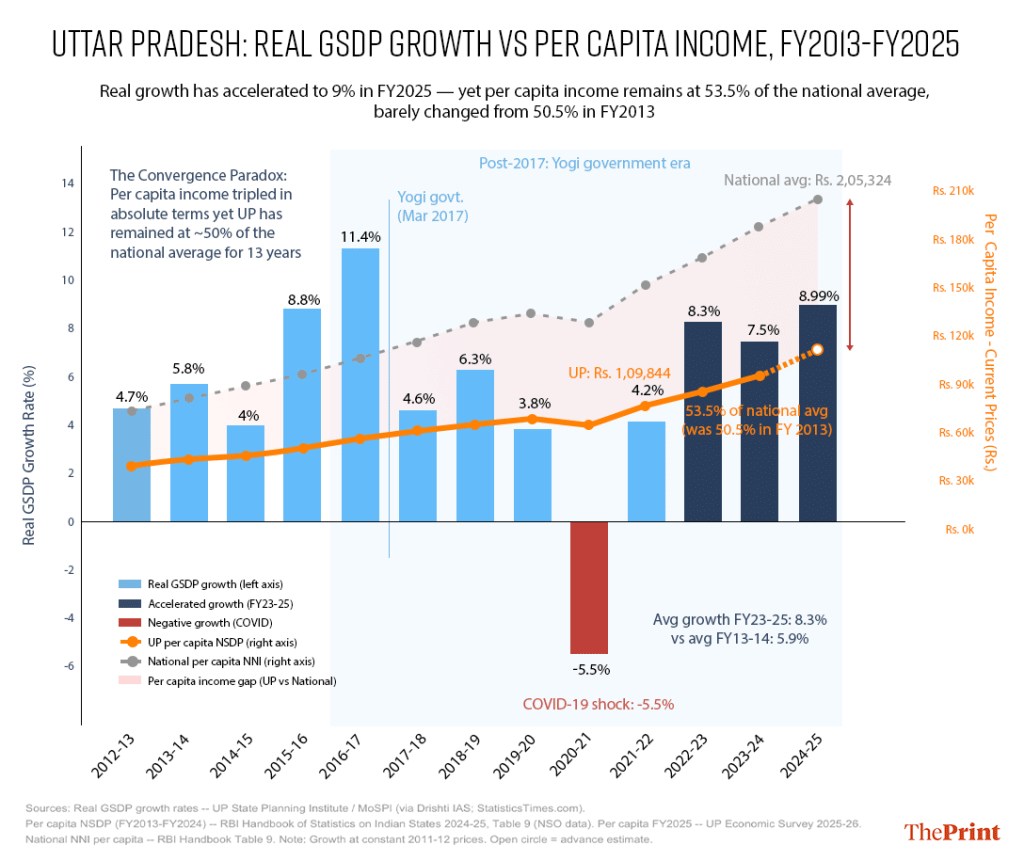
Between FY2013 and FY2024, the average real Gross State Domestic Product (GSDP) growth in Uttar Pradesh was 5.9 per cent, which is marginally below the national average of approximately 6 per cent for the same period.
This figure contrasts sharply with the 10.8 per cent growth rate advertised by the UP government, which is calculated at current prices and includes the inflationary effect. In FY2024-25, real growth achieved a notable 8.99 per cent, ranking as the fourth-highest among Indian states. However, UP’s per capita income stands at Rs 1,09,844, representing only 53.5 per cent of the national average, a modest increase from 50.5 per cent in FY2013. Over twelve years of economic growth, the per capita income gap with the national average has widened in absolute terms, from approximately Rs 35,000 per person to Rs 95,480.
While UP is experiencing growth, it is not converging with the national average. This phenomenon can be attributed to the dual economy problem, as conceptualised by W Arthur Lewis in 1954, a theory that later earned him the Nobel Prize in 1979. According to Lewis’s model, a developing economy comprises two sectors: a traditional agricultural sector characterised by surplus labour and low productivity, and a modern industrial sector that absorbs this labour and enhances productivity. Genuine development transpires when labour transitions from the former to the latter at sufficient scale and pace. The transformation is deemed complete when wage and productivity disparities between sectors diminish, rendering the economy structurally modern. UP is currently in the middle of this transition, but data indicate that progress is occurring at a perilously slow rate.
Half the workforce, one-quarter of the output
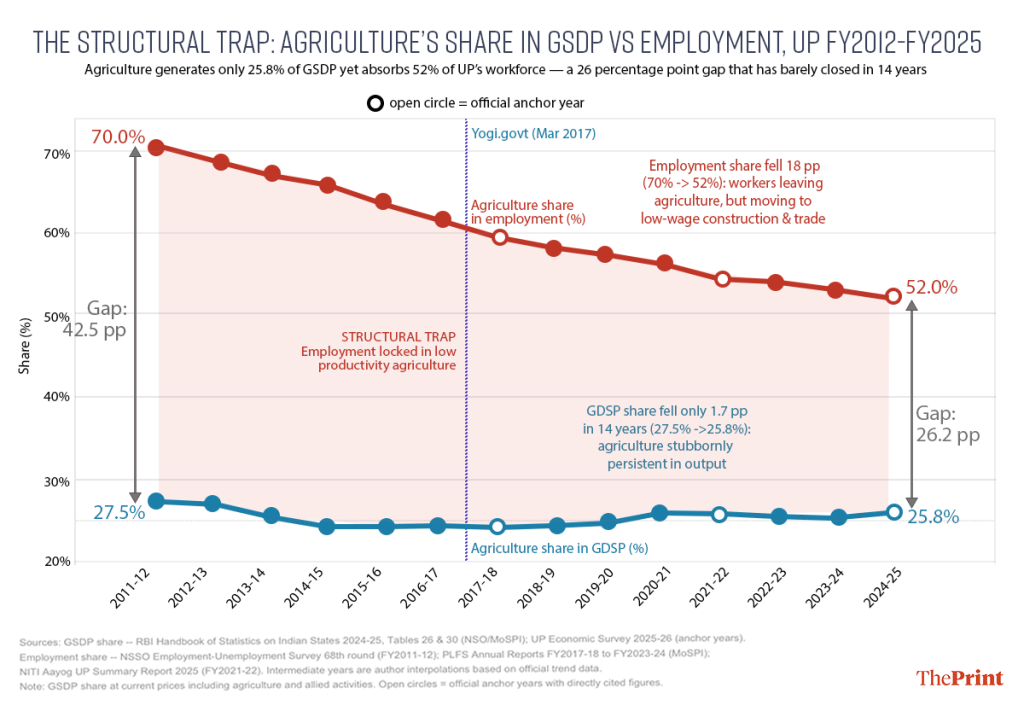
Agriculture contributes 25.8 per cent of UP’s GSDP while employing 52 per cent of its workforce. This 26-percentage-point discrepancy highlights a structural challenge.
An analysis of data spanning fourteen years reveals this issue with stark clarity. The proportion of employment in agriculture has decreased from 70 per cent in 2011-12 to 52 per cent currently, indicating a shift of workers away from the sector. However, these workers are not transitioning into high-productivity manufacturing or formal services. According to Periodic Labour Force Survey (PLFS) data, they are predominantly moving into construction and informal trade, sectors that offer slightly higher wages than subsistence farming but do not provide a pathway to the productivity improvements necessary to bridge the convergence gap with the rest of India.
This situation represents a stalled Lewis transition, occurring in an undesirable context. It is not merely a result of geographical or historical factors, but directly linked to the nature of growth in Uttar Pradesh, which remains capital-light and infrastructure-heavy, rather than centred on deep manufacturing clusters, formal employment at scale, and the agglomeration effects that transform a large economy into a productive one.
The agriculture sector’s share of GSDP has declined by only 1.7 percentage points over 14 years. At this rate, it will still constitute approximately 20 per cent of output by 2040. Meanwhile, expressways will connect cities where the majority of the population cannot afford the tolls.
Rs 37 lakh crore promised, Rs 17,000 crore delivered
The investment narrative is where selective storytelling becomes particularly pronounced.
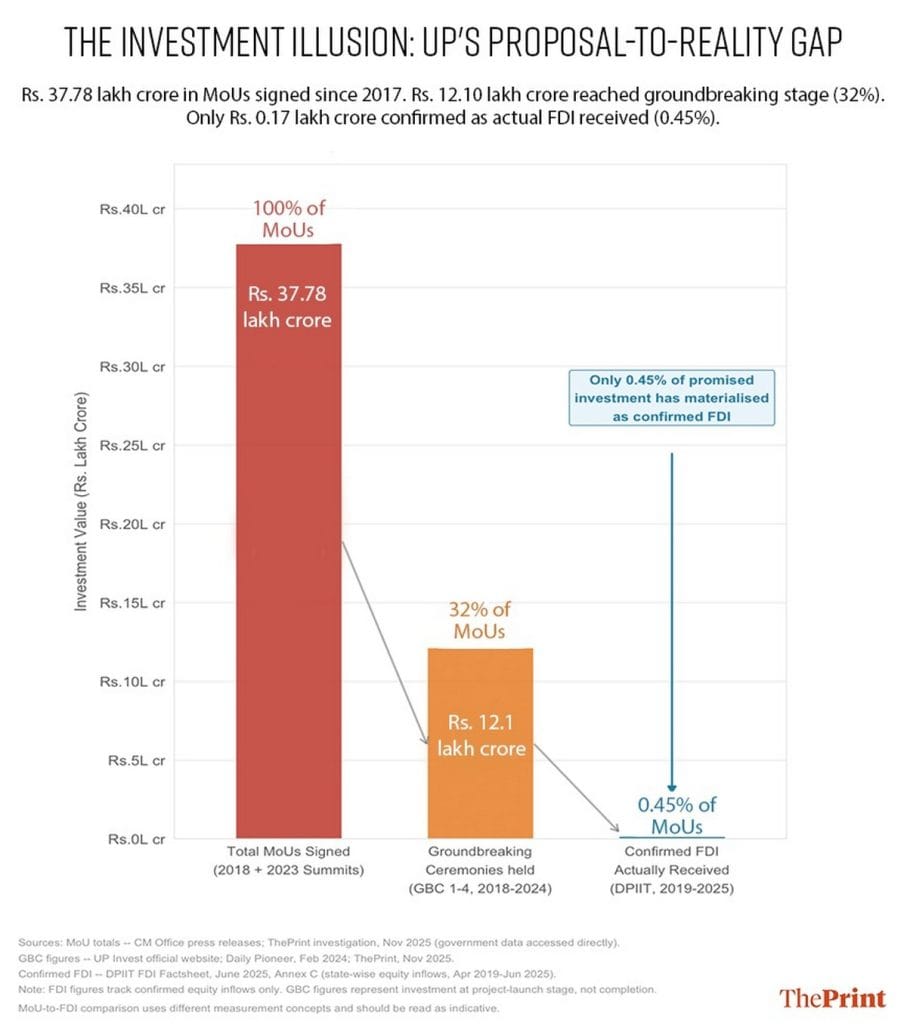
Since 2017, Uttar Pradesh has secured MoUs amounting to Rs 37.78 lakh crore in two investor summits. Four groundbreaking ceremonies (GBCs) — political events where foundation stones are laid and project launches are announced — have accounted for projects valued at Rs 12.10 lakh crore, which the government considers as investment “on the ground”. Against this, DPIIT recorded confirmed FDI of Rs 17,003 crore between 2019 and 2025. While the MoU figure includes domestic commitments, joint ventures, and other investment categories, not only FDI, even then the overarching observation can be made that confirmed capital deployment is only a fraction of announced investment intentions.
This discrepancy is not a minor accounting detail. MoUs represent intentions, groundbreaking ceremonies are events, and FDI inflows constitute capital that has been mobilised, deployed, and recorded. The disparity among these elements highlights the difference between a political narrative and a productive economy.
An investigation conducted by ThePrint in November 2025, utilising direct access to government data, revealed that, across all four groundbreaking ceremonies, actual work commenced on projects valued at approximately Rs 3.09 lakh crore. This is in contrast to the Rs 12.10 lakh crore worth of projects for which ceremonies were conducted and the Rs 37.78 lakh crore in total MoU commitments. The discrepancy between the announced figures, the ceremonially launched projects, and those that actually commenced highlights the divergence between political narratives and economic productivity. This situation does not reflect a conducive investment climate; rather, it resembles a press release.
The argument presented does not suggest that progress in Uttar Pradesh is illusory. The reduction in poverty is both genuine and significant, as evidenced by NITI Aayog’s estimation that nearly six crore individuals have emerged from multidimensional poverty since 2013-14, marking the largest decline among all Indian states. Improvements in law and order have tangible economic impacts that, while challenging to quantify, are readily perceptible. The infrastructure initiatives, including the development of 22 expressways, airport expansions, and enhanced connectivity drive into Purvanchal and Bundelkhand, establish productive foundations that yield cumulative benefits over time. These accomplishments are legitimate and warrant recognition.
However, it is important to distinguish between achievements and transformation. The current political climate poses the risk that UP’s narrative may become dominated by growth, potentially overshadowing the more challenging and less visible efforts required for structural change.
Also Read: Growth, inflation & the gaps in between: What latest RBI annual report says about where India stands
The real question
Three critical actions are necessary.
First, industrial policy should transition from summit-driven to sector-specific, with a state-level PLI-equivalent targeting sectors such as agri-processing, defence manufacturing, and leather clusters, where UP already possesses productive capabilities but lacks depth in the formal sector.
Second, investment tracking should shift focus from MoUs and GBCs to operational capacity, including installed machinery, formal wages, and Goods and Services Tax (GST) returns.
Third, the quality of employment transitioning from agriculture is as significant as its quantity. Of the 18 percentage points that have already exited farming, the majority have moved into construction and informal trade. Directing the next wave towards higher-productivity sectors would contribute more to economic convergence than any investors’ summit.
Uttar Pradesh is home to one-sixth of India’s population. Whether it achieves genuine structural transformation and completes the Lewis transition is not solely a concern for UP; it is indicative of India’s future trajectory. If the state succeeds in transitioning millions of workers from low-productivity agriculture to more productive manufacturing and modern services, it would significantly impact India’s development path. Conversely, failure in this endeavour would render India’s aspiration of achieving developed nation status by 2047 considerably more challenging.
With 52 per cent of workers engaged in low-productivity agriculture, UP does not yet look like a trillion-dollar economy in the making. This is a structural issue that cannot be circumvented by infrastructure developments, regardless of their scale.
Thus, the critical inquiry is not whether Uttar Pradesh can build additional expressways, host larger investment summits, or announce bigger numbers. Rather, it is whether the state can generate productive employment opportunities on a scale commensurate with what the country needs from its most populous state.
Bidisha Bhattacharya is ThePrint Consulting Editor (Economics) and an Associate Fellow, Chintan Research Foundation. She tweets @Bidishabh. Views are personal.
(Edited by Asavari Singh)
$ 1 billion of actual FDI in six years does not sound like an awful lot.
Whatever the economy, if the state has the bulldozer cutter with othering of communities, it’s a tinderbox for religious/cultural violence at some point. It’s not healthy