


New Delhi: Prime Minister Narendra Modi, addressing the FICCI annual general meeting (AGM) last Thursday, put a pointed question to business leaders: “Did you increase the salaries of your employees [despite the reduction in basic corporate tax]?”
In doing so, he directly addressed the stagnation in wage growth in the private sector. And the data corroborates his concerns.
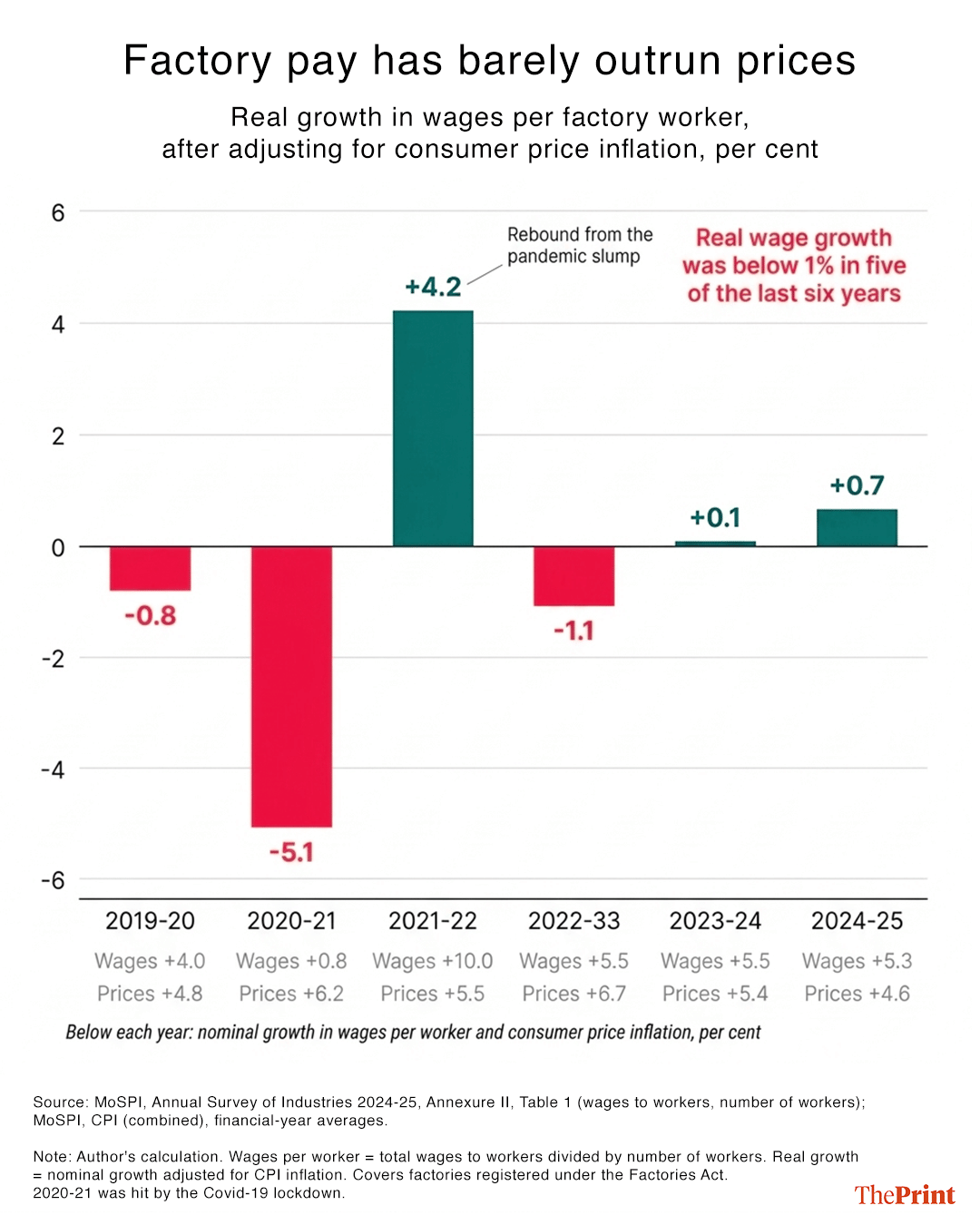
In the fiscal year 2024-25, the average factory worker’s earnings were approximately Rs 2.28 lakh, reflecting a 5.3 percent increase over the previous year, the latest Annual Survey of Industries shows.
However, with consumer prices rising by 4.6 percent year-on-year, the real wage increase was a mere 0.7 percent. In FY 2023-24, real wage growth was 0.1 percent, and in FY 2022-23, real wages declined.
Excluding the recovery from the pandemic-induced downturn, real wage growth has remained below 1 percent in five of the past six years.
The political discourse over stagnation in wage growth has predominantly focused on the developments of the past two to three years. But the same survey has been monitoring India’s manufacturing sector since 1981-82. Analysing this data over four decades reveals that the stagnation in wage growth is not merely a consequence of the pandemic or a temporary anomaly; rather, it represents the latest phase in a prolonged, gradual transformation in how benefits are distributed within Indian manufacturing.
This disparity can be illustrated with a simple comparison: the garment worker and the oil refinery worker.
Also Read: Real wages grew just 0.01% over the last 5 years and contracted in Haryana & UP, Ind-Ra report finds
Four decades of a shrinking slice
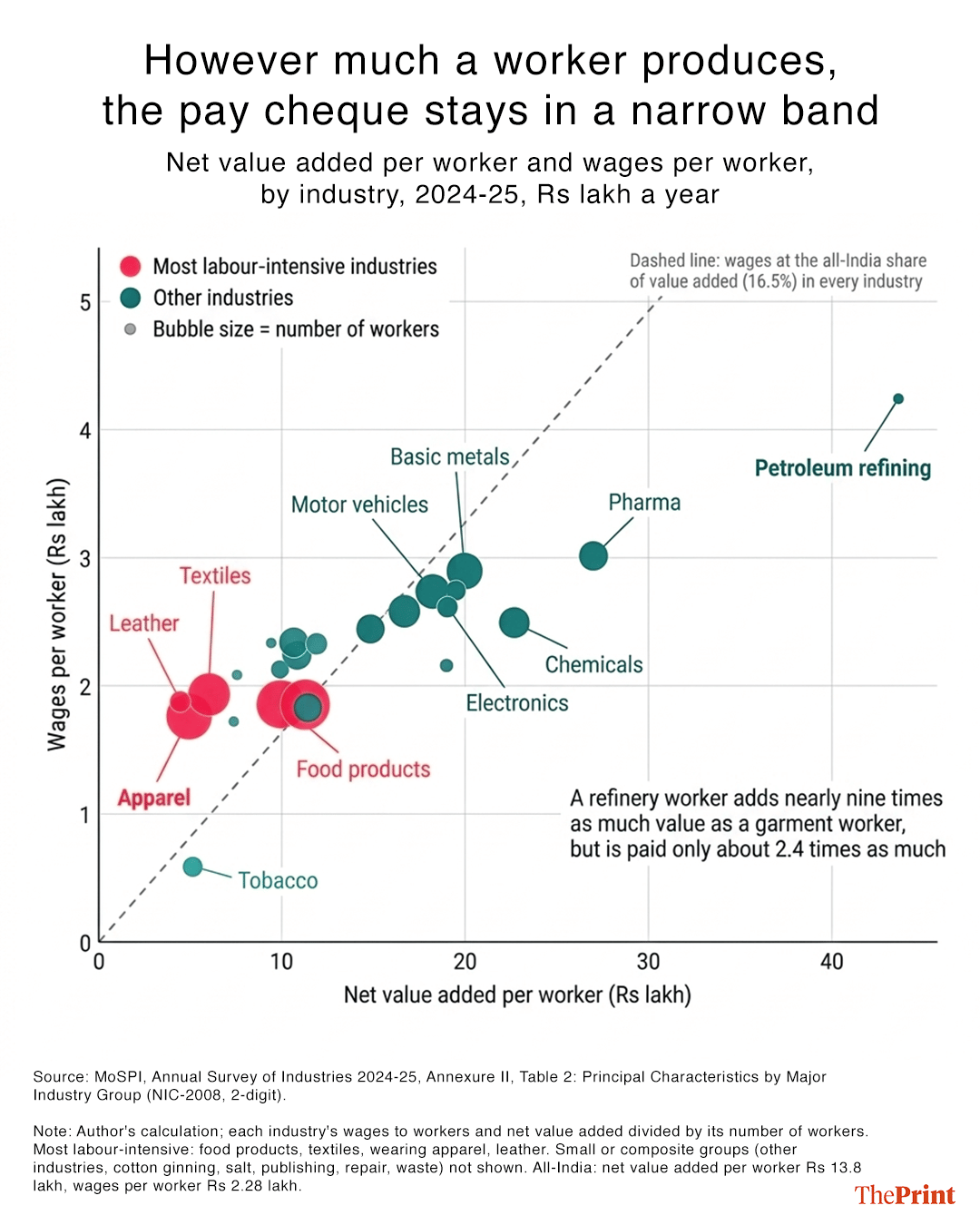
In the Indian economy, a worker employed in an oil refinery contributes approximately Rs 43.6 lakh in value annually. In contrast, a garment worker in factories located in Tiruppur or Noida contributes around Rs 5 lakh. Despite the refinery worker generating nearly nine times the economic value, their remuneration is only about two and a half times greater than that of the garment worker, with earnings of Rs 4.25 lakh compared to Rs 1.76 lakh of the refinery worker.
Every manufacturing facility generates value, defined as the difference between its sales revenue and its expenditures on raw materials, fuel, and machinery depreciation. Economists refer to this as net value added, and the allocation of this value between labour and capital has long been a central inquiry in the field.
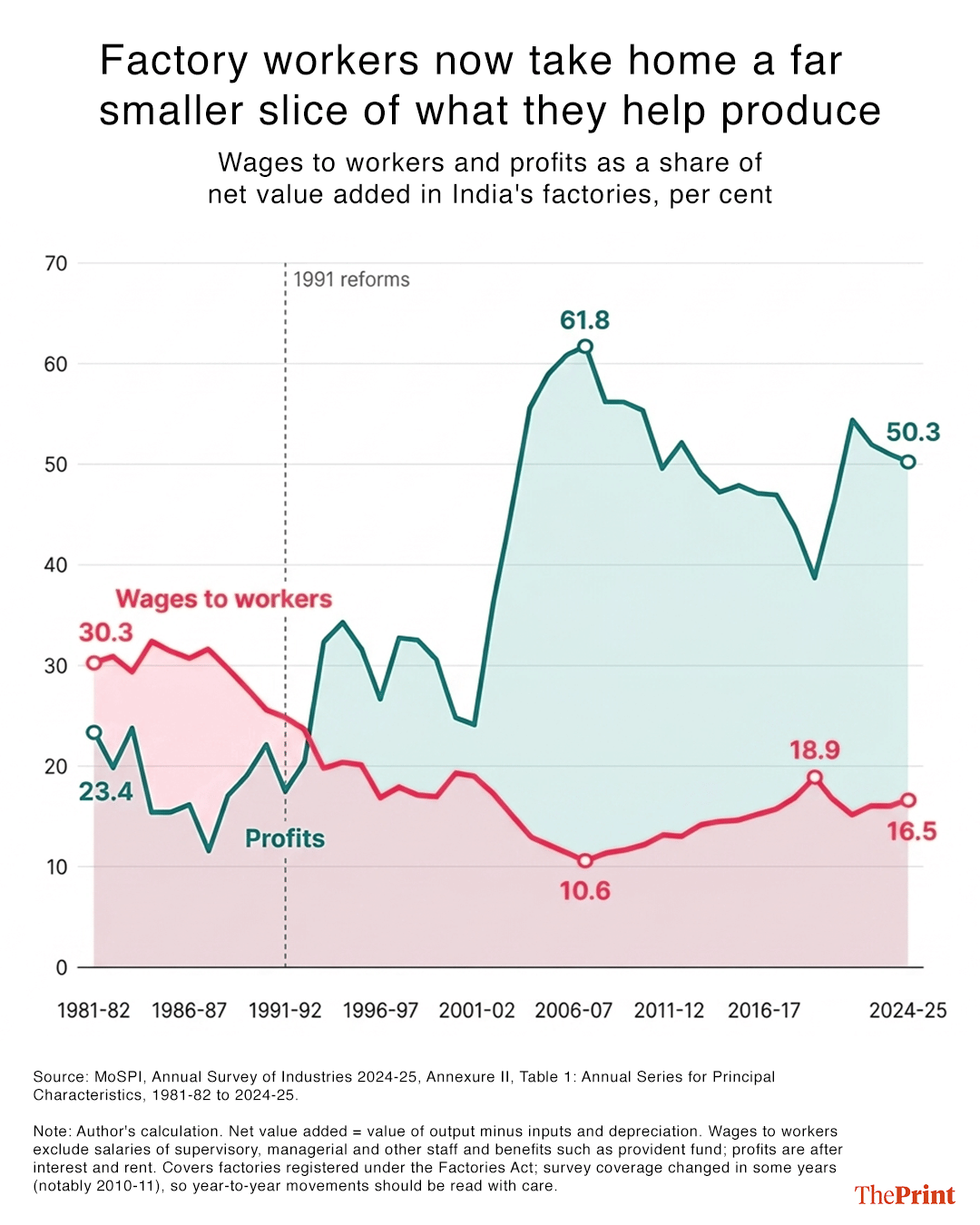
In the early 1980s, wages for factory workers in India constituted approximately 30 percent of this value. Following the 1991 economic reforms, this proportion slipped into a prolonged decline, reaching a nadir of 10.6 percent in FY 2007-08. Subsequently, it recovered steadily over the next decade, reaching 18.9 percent in FY 2019-20, before declining again post-pandemic. In 2024-25, it stood at 16.5 percent. Over the same four decades, the share of net value added going to profits rose from about 23 percent to around 50 percent, according to calculations based on the Annual Survey of Industries.
The transformation observed is partly attributable to modernisation. Indian factories have become significantly more capital-intensive than in 1981, with machinery now commanding a larger share of returns. This trend also illustrates the evolution of factory work.
In the fiscal year 2019-20, 38 percent of factory workers in India were employed through contractors rather than directly by firms. By FY 2024-25, this proportion increased to 42 percent.
Contract workers generally receive lower wages, get fewer benefits, and possess limited bargaining power. This dynamic explains how factories were able to increase their workforce by approximately 30 lakh workers between FY 2021-22 and FY 2024-25 without substantially increasing individual wages.
Why productivity doesn’t reach the pay packet
Returning to the context of the refinery and garment factory, standard economic theory posits that a worker’s compensation is approximately equivalent to their contribution to output. As a result, industries with higher worker productivity should ideally offer higher wages.
However, Indian factories only partially adhere to this principle. The value added per worker across industries ranges from approximately Rs 5 lakh to over Rs 40 lakh, yet annual wages remain within a narrower range of approximately Rs 1.8 lakh to Rs 4.3 lakh. Notably, the industries employing the largest workforce, such as food processing, textiles, and apparel, offer wages below the national average.
What accounts for the lack of responsiveness of wages to productivity?
Arthur Lewis, who was later awarded the Nobel Memorial Prize in Economic Sciences, provided a definitive explanation in 1954. In his influential paper on “economic development with unlimited supplies of labour,” Lewis explained that in nations where a significant portion of the population remains engaged in low-productivity agricultural work, wages in modern industry are determined not by the output of a factory worker but by the potential earnings from agricultural work, supplemented by a modest premium to incentivise the transition. As long as this labour reserve persists, factories can continue hiring at approximately the same wage level, with the benefits of increased productivity accruing primarily to capital.
Wages begin to rise significantly only when this labour reserve is depleted, a phenomenon economists now refer to as the Lewis turning point.
India, with nearly half of its workforce still employed in agriculture, exemplifies Lewis’s model. This explains why wages in the refinery and garment sectors are comparable despite substantial differences in productivity: both sectors recruit from the same extensive pool of individuals whose alternative employment is small-scale farming or casual labour.
Lifting the floor and the ladder
The Lewis model provides a pathway for economic advancement. The primary strategy involves accelerating the transition of workers from low-productivity agriculture to manufacturing and service sectors, which can accommodate them on a large scale. This shift tightens the labour market for those remaining in agriculture, thereby exerting upward pressure on wages. Labour-intensive sectors such as apparel, footwear, and food processing, where India holds a comparative advantage, are expected to generate the majority of these employment opportunities.
The second strategy focuses on enhancing productivity within industries that currently employ the largest workforce. If workers in the garment and food-processing sectors could achieve productivity levels closer to the national average, there would be greater potential for wage increases.
This requires investment in advanced machinery, expansion of factory capacity, and stronger export market linkages, all of which can be facilitated by India’s recent trade agreements.
The third strategy is to establish a minimum wage. The four labour codes, effective since 21 November, 2025, provide for a national floor wage to reduce the disparity between contract workers and directly employed workers. If set judiciously, this can raise the lower end of the pay scale without causing job losses. Additionally, the codes’ provisions on contract labour aim to reduce the disparity between contract workers and directly employed workers. A year on, implementation is still catching up. By October this year, only six states and Union Territories had notified rules under all four codes, and the national floor wage itself is yet to be notified.
Furthermore, the Ministry of Statistics’ inaugural household income survey, currently underway, will provide comprehensive data on income trends across various employment types, addressing a longstanding gap in policymaking.
India’s economic narrative has traditionally focused on output, investment, and exports. Historical data spanning four decades indicates that increased productivity does not inherently lead to higher wages. The critical factor is a labour market characterised by worker scarcity, which enhances their value. Achieving this condition is the pivotal challenge India now confronts.
(Edited by Amrtansh Arora)
Also Read: India’s new wage code could raise pay without hurting jobs. Here’s how