










Only about 23.6% of workers in India are in regular wage or salaried employment, while the majority remain in self-employment or casual work (Periodic Labour Force Survey (PLFS), 2025). As a result, much of the workforce operates outside effective wage regulation. Real earnings have shown limited improvement as casual wages have stagnated, regular wages remain flat, and self-employment earnings have declined (PLFS, various years). This weak earnings growth reflects broader productivity challenges as about 43% of the workforce remains concentrated in agriculture but the sector contributes only about 15.3% to the GVA (gross value added) (PLFS, 2025). Economic growth has therefore not translated into broad-based improvements in wage regulation and worker incomes.
It is against this backdrop that the Code on Wages, 2019, emerges as a key institutional reform aimed at strengthening wage regulation, improving employment quality, and supporting labour productivity. The Code on Wages, 2019, consolidates four existing labour laws: the Payment of Wages Act, 1936; the Minimum Wages Act, 1948; the Payment of Bonus Act, 1965; and the Equal Remuneration Act, 1976, into a single unified code (Government of India, 2019).
Key legislative changes under the Code on Wages
First, it harmonises definitions across wage-related provisions, introducing a uniform definition of “wages” with a 50% cap on exclusions of total remuneration, thereby preventing the artificial suppression of the base (pre-tax) wages. The cap on in-kind remuneration at 15% further standardises the composition of wages.
Second, it universalises minimum wage coverage by establishing a statutory right to minimum wages for all employees across organised and unorganised sectors, removing the earlier restriction to scheduled employments, covering roughly 30% of the workforce.
Third, while the core components of minimum wages (basic wages, variable dearness allowance, and the cash value of concessional supplies) remain unchanged, the Code strengthens the wage-setting framework by introducing consumption-based criteria based on a standard working-class family, including norms for food, clothing, housing, and other essential expenditures. It also introduces a statutory national floor wage to limit excessive variation across states and sectors.
Beyond these, the Code standardises wage fixation across time and piece-rate work through uniform conversion factors, ensuring consistency across states, sectors, and forms of employment. It also rationalises wage-related working conditions, including uniform overtime provisions (at twice the normal wage rate), a weekly rest day, and limits on consecutive working days.
It further standardises wage payment systems, including formal recognition of digital wage payments, mandatory issuance of wage slips, clearly defined wage periods and timelines, and a uniform ceiling of 50% on deductions, thereby promoting formalisation.
The Code modernises bonus provisions while retaining the core framework of minimum and maximum limits, introducing flexibility through a government-notified eligibility threshold and encouraging payment through bank transfers.
In addition, it strengthens the principle of equal remuneration by making it gender-neutral and broadening the definition of “same or similar work” to include experience alongside skill, effort, and responsibility.
Finally, the Code seeks to improve enforcement and compliance through institutional reforms, including a unified adjudication mechanism, technology-enabled inspections, an Inspector-cum-Facilitator system, stricter penalties and simplified procedures for recovery of dues.
State-level implementation
The effectiveness of the provisions of the Code ultimately depends on their implementation at the state level. Figure 1 shows that a large number of states/union territories (UT) issued draft or final rules relatively early, particularly during 2020-2021 following the enactment of the Code in 2019 and the release of draft central rules in 2020. A smaller group of states adopted the framework later, including Andhra Pradesh, Arunachal Pradesh, Sikkim, Tamil Nadu, and Ladakh in 2022, while Meghalaya and Nagaland notified rules in 2024 and 2025 respectively. A few states such as West Bengal and Lakshadweep are yet to issue the rules.
Figure 1. State-wise adoption of rules under the Code
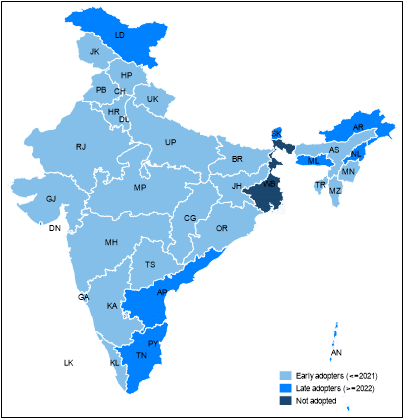
Notes: Where both draft and final rules were notified, the year of the first notification is reported. As of April 2026, final rules have been notified by Arunachal Pradesh and Gujarat
Literature review
The Code on Wages may raise real market wages through the introduction of a national minimum. Wider coverage of the minimum wage across industries may limit wage undercutting by employers, thereby reducing wage dispersion.
Potential impact on employment
Theoretically, the impact of the Code on employment varies, depending on the structure of the labour market.
Table 1. Theoretical impact of the Code on employment

Empirically, the impact of the Code on employment in India is likely to be positive or neutral. Many segments of the Indian labour market are characterised by employer monopsony, that is, with wage-setting power, where workers are often paid below their productivity. In such settings, a minimum wage floor can correct this imbalance by setting a uniform wage that has to be paid to all workers. Firms can hire additional workers at this fixed wage without having to increase wages for their existing workforce (Soundararajan 2019). This may reduce the cost of hiring and may even increase employment.
Beyond the structure of the labour market, the impact on employment may depend on other key factors:
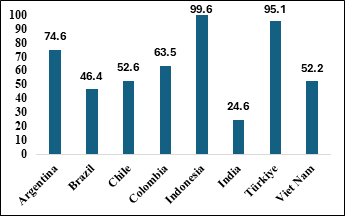
Level of national floor: The magnitude of the employment effect may depend on the size of the wage increase, which in turn is determined by the level of the national floor. Figure 2 shows that if the national floor is set at the level recommended by the Expert Committee on Determining the Methodology for Fixation of the National Minimum Wage (Government of India, 2019), it would be binding in several states where existing minimum wages are below this threshold, while having a limited impact in states where wages are already higher. Figure 3 shows that India’s minimum wage relative to average wages remains low compared to other developing countries, suggesting that the scope for wage increases is relatively high.
Figure 2. State minimum wages for unskilled workers compared with the recommended national floor wage (Rs. 375 per day)
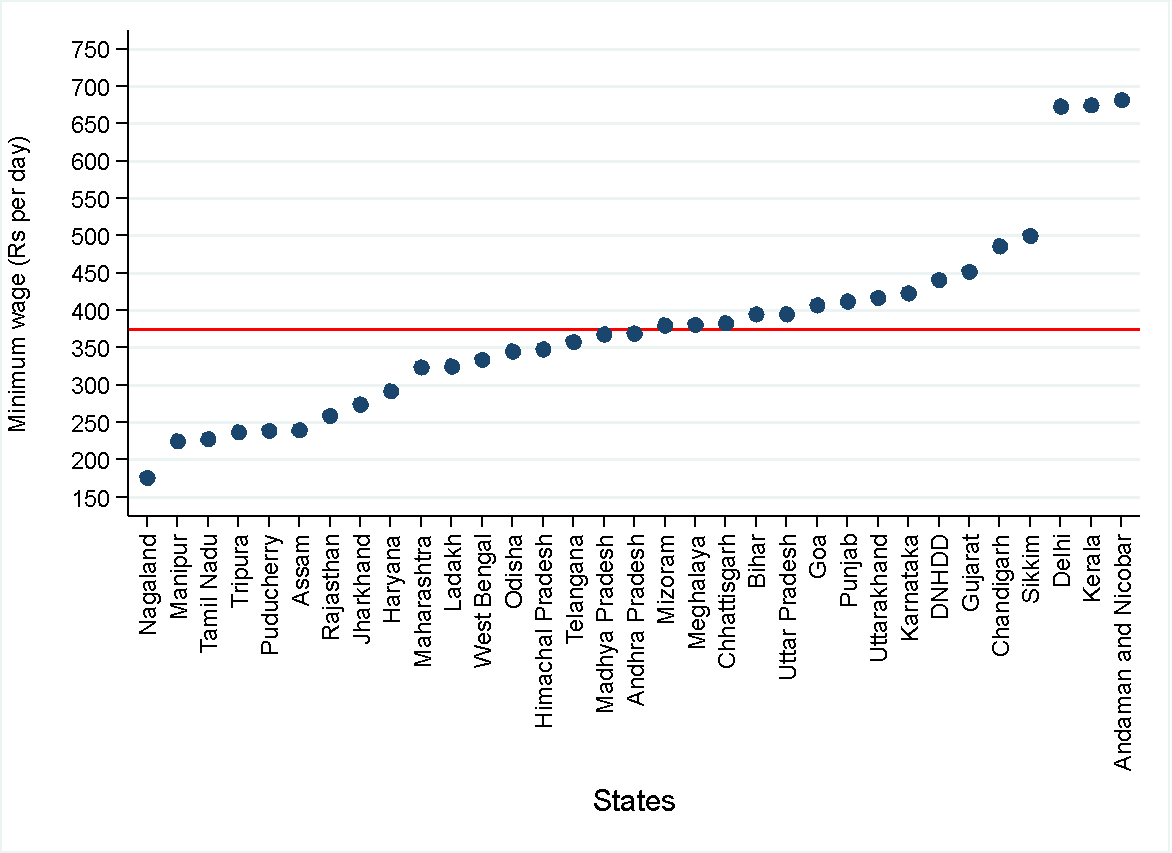
Figure 3. Minimum wage relative to average wages across developing countries in 2022 (%)
Worker heterogeneity: Employment effects may differ by worker productivity. Lower-productivity workers may face adverse outcomes, while aggregate employment effects may remain neutral or even positive. Evidence suggests that any negative impacts are more likely to be concentrated among lower-productivity women (Sharma and Viswanathan 2025).
Degree of enforcement: The impact also depends on the extent of enforcement. Menon and Rodgers (2017) find that the effects are more pronounced for rural workers, where programmes such as the Mahatma Gandhi National Rural Employment Guarantee Act (MNREGA) strengthen workers’ outside options, thereby improving enforcement. In contrast, weak compliance in the informal sector may mute the overall impact.
Potential impact on labour productivity
The impact of Code on wages and productivity may differ according to the underlying theory.
Table 2. Theoretical impact of the Code on productivity

Empirically, the Code may lead to improvements in labour productivity by linking wage determination to skill levels, creating incentives for skill upgrading, as well as better monitoring of worker productivity. The other key factors that will determine the impact of the Code on productivity are:
Size of the wage increase: Moderate increases in wages can induce firms to adopt tighter management practices. Larger increases may create stronger cost pressures, leading firms to adopt capital substitution.
Firm heterogeneity: Wage increase can raise aggregate productivity by driving the exit of low-productivity firms and enabling more productive firms to expand. The impact at the firm level may remain heterogeneous.
Also read: India’s workforce is stuck in low productivity. Here’s what must change
Summary of potential impacts
The Code on Wages, 2019 represents a structural reform aimed at strengthening wage regulation, with potential implications for labour market outcomes. Based on economic theory and existing empirical evidence, market wages are likely to rise following the introduction of a national floor wage. Wage dispersion is also expected to narrow, particularly at the lower end, following a broader coverage of minimum wages across industries. The impact on employment is likely to be neutral to positive, especially in labour market segments characterised by monopsony power, where a wage floor can reduce employer market power and support employment by allowing firms to hire additional workers without raising wages for existing workers. Labour productivity is also likely to improve, as linking wages to productivity strengthens worker incentives.
However, these outcomes depend critically on the level at which the national floor wage is set, heterogeneity across workers and firms, and the extent of enforcement, particularly in the informal sector. Since the final rules under the Code on Wages, 2019 are yet to be notified in most states, realised impacts will hinge on the manner in which States operationalise key provisions, particularly:
Minimum wage setting: Translation of consumption-based norms into wage levels, including whether they are aligned with poverty lines and adjusted for regional cost-of-living differences.
Skill and occupational mapping: Classification of workers across skill categories within the framework set by the central government.
Enforcement systems: Design of inspection regimes, adoption of digital wage payments, and effectiveness of grievance redressal mechanisms.
These implementation choices will ultimately shape the Code’s labour market impact.
Farzana Afridi is Associate Professor, Economics and Planning Unit, Indian Statistical Institute. She has a PhD in Economics from the University of Michigan, US. Arjita Chandna is an Associate Fellow at the National Council of Applied Economic Research in New Delhi. Views are personal.
Over the next five weeks, based on their new NCAER working paper, Farzana Afridi and
other authors will review the new labour law reforms.
This article was originally published on the Ideas for India website.