





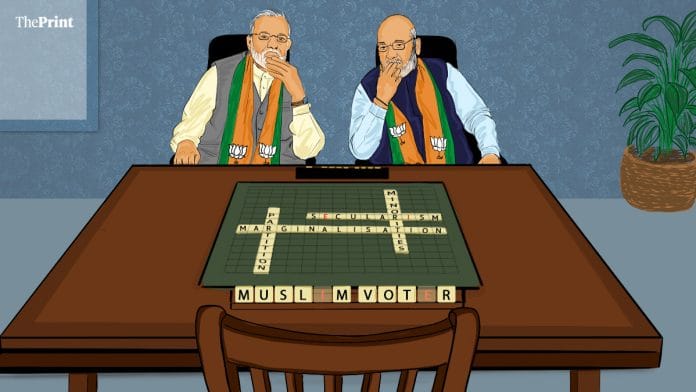

Nearly seven years ago, I wrote this National Interest under the headline: “Do Muslims matter for Modi-Shah BJP, or India?” This is an important time to raise that question again.
On the evidence of the latest state elections, especially in West Bengal and Assam where Muslims constitute upwards of 30 percent of the electorate, the issue remains the same, if more compounded. The answers are more vexed. And politically, the conclusion would be, Muslims today matter even less to the Modi-Shah BJP than they did in 2019.
In West Bengal and Assam the BJP won two-thirds of the seats this time without fielding even one Muslim. Conversely, of the 24 opposition candidates who won in Assam, 22 are Muslim. This includes 18 out of the Congress tally of 19.
In West Bengal 40 of the 293 newly elected MLAs are Muslim. Of these, 34 are from TMC, about 45 percent of the party’s tally of 80. In effect then, in the two states (J&K isn’t a state) where Muslims have their largest population, they’re out of the power structure, cleansed out, and effectively forming the only opposition to the BJP. Irony or paradox, their leaders are still Hindus. And they’re all the losers in the fight with the BJP.
These elections mark the completion of the BJP-secular party divide purely on Hindu-Muslim basis. In Kerala, for example, of the UDF’s 102 newly elected MLAs 30 are Muslims and 29 Christians. The secular relief at knowing that the Muslims having their place at least in the Kerala sun needs to be tempered by the realisation that the BJP will now exploit this as evidence of minority rule, work on the Hindu vote and divide the Kerala Christians.
Nationally, this Lok Sabha, the 18th, has 24 Muslim MPs, or a mere 4.42 percent, while the community’s proportion in the national electorate is more than 15 percent. In the 16th and 17th Lok Sabha, there were 22 and 27 Muslim MPs, respectively. This, however, isn’t as big a surprise as it might seem from a first reading. Except 1980 and 1984 when Muslims won 49 and 45 seats, accounting for 9 and 8.3 percent, respectively, the percentage of Muslim MPs in the Lok Sabha has stayed around the 5-percent mark. But they were always represented significantly in the Union Cabinet—even Vajpayee had Sikander Bakht.
They were present in significant constitutional positions like President, Vice President, Lok Sabha Deputy Speaker, and occasional heads of armed forces and intelligence agencies. Today, there’s none. There’s no Muslim chief minister; J&K is a Union Territory. There’s one Muslim Governor, in Bihar, Lt General Syed Ata Hasnain. Among the nearly 100-strong list of central government secretaries, Kamran Rizvi (Heavy Industries) is the only Muslim. Justice Ahsanuddin Amanullah is the only Muslim among the 32 Supreme Court judges today. The last Muslim CJI, Justice Altamas Kabir, retired on 19 July, 2013.
While on the one hand this list would give the impression of marginalisation of Indian Muslims, it needs qualification. More Muslims are entering the key professions: medicine, law, academia, science, software, banking, and of course entertainment and news media. The civil services and armed forces (including officers’ academies) are seeing Muslim selections rise. The qualification, therefore, has to be that this loss of representation is specific to politics.
The headline of that first column on the same theme in 2019 was drawn from a 1999 conversation with then BJP leader, intellectual/ideological spokesperson, and former Rajya Sabha MP Balbir Punj. He was also briefly my colleague at the Indian Express Group where he wrote for The Financial Express. Punj passed away last month.
He was furious after the second Vajpayee government lost its majority in Lok Sabha by one vote in 1999, after the 13-day government in 1996.
He was frustrated because no party that counted on the Muslim vote was willing to accept the BJP. This was the veto the Muslims had on who would rule India, and who wouldn’t. The Modi-Shah era has changed all of that.
These facts lead to three important outcomes:
● BJP’s rivals, or the so-called secular parties, are increasingly looking like ‘Muslim’ parties though their leaders are all Hindus. This is exactly where the BJP would want its opposition to be. A Hindu versus the rest equation is 80:20 in their favour. And they will keep working on the Christians in chosen geographies.
They’ve already conquered Goa and Kerala is a work in progress. The BJP has patience and time. In the Northeast they’ve built a comfortable compact with the Christian tribes. In none of these states has the BJP demanded a beef ban. That’s why Asaduddin Owaisi mocks their hypocrisy by taunting them with “UP mein gai mummy, Goa mein gai yummy”.
(In Uttar Pradesh the cow is mother, in Goa it’s yummy)
Some ‘secular’ parties, which still count on the Muslim vote, have become wary of even seeming to be speaking for them. Like the previous AAP government in Delhi during Shaheen Bagh protests and the communal riots that followed. The fear of being seen as ‘pro-Muslim’ kept them away.
● This puts the burden of saving Indian secularism squarely on the backs of Muslims. This is onerous, unrealistic and unfair. It’s the logic of Partition that the Muslim community is scattered and doesn’t have majorities in significant electoral geographies.
Today they’re being persuaded to vote for the candidate most likely to defeat the BJP merely on the hope that it might protect them physically. This is hopelessly minimalistic in a robust secular democracy. As the Sachar Committee showed, it’s done nothing for them. In fact, the report became Mamata Banerjee’s rallying call because it showed how miserably the Muslims had done under the Left in West Bengal. It’s for the ‘secular’ parties to build large enough coalitions with the Hindus to reach winning vote shares. In the past, the Hindi heartland parties did so by dividing the Hindus among castes and signing up large enough caste groups. That fortress has now been breached by Modi and Shah. Who has any new ideas here? Certainly, this Congress looks far from it. It has the bewildered look of a confused hare on a highway, frozen in the headlights of an onrushing truck.
● Owaisi has floated another idea. The Muslims form their own parties, choose their own leaders. This is unsustainable because all of India isn’t old Hyderabad. If Muslims float their own parties, they’ll be the BJP’s biggest force-multipliers. The remarkable fact is, after Jinnah, Indian Muslims have never trusted a Muslim as their leader. They’ve counted on Hindu leaders, from the Nehru-Gandhi family to the Yadavs of UP and Bihar, Mamata Banerjee, and the Left where it matters. Did it work for them? Not perfectly. But they were never as out of of the power structure as now.
Also Read: INDIA has a Congress-sized hole. And the fix begins with a little humility
India’s Muslims, Hindus, and secularists all need to think afresh. The fear of being an outnumbered minority goes back to the era of Sir Syed Ahmed and ultimately led to the creation of Pakistan. Who it benefited or didn’t is a debate for another day.
It’s odd to put them in one category but just for our understanding, think Pakistan and Israel. One is an Islamic Republic and the other a Zionist one. Both have proportionate representation and though it works differently, it guarantees some seats for the minorities. A little bit of ‘jitni aabaadi, utna haq’.
(to each according to their absolute numbers)
India, a secular Republic, follows the first-past-the-post system and to expect any proportionality in elected representation is unrealistic. But, there’s a gap and an imbalance.
The only way of addressing it is for another enlightened leadership to rise and build a new coalition with a large enough section of the Hindus. Indian Hindus chose constitutional secularism and the responsibility of preserving it lies with them. Any credible challenger of the BJP will need to build trust with them.
Note: An earlier version of this column referred to Justice A.M. Ahmadi as the last Muslim CJI. The error has been rectified.
Also Read: RSS chief Bhagwat draws the line at 75. India’s politics stares at the Modi Exception
For every party nation comes first on paper. But do they really work like that? BJP is as good as other parties in this matter. If you truly care about nation , you will not induct corrupt and criminal politicians from other parties into your party. Power comes first for everyone. Nation is secondary
If this is the end of Minority Appeasement, it should be considered a welcome development.
UCC as mandated by Supreme court can become a reality only of Minority Appeasement ends.
The fact that SG gives special attention to “Muslim voters” reveals a skewed and wrong assumption. The correct assumption should be that all are citizens of India and that is the only thing that matters. This is I believe is held by most Indians, including the Muslims. It is only the politicians who use the religion card to win elections, to gain political power. That’s it. And journos then publish articles like this as if this is a serious matter.
A spurious and even a very divisive argument that Mr.Shekhar is making here. How have Muslims fared in states ruled by BJP and how about the past decade or so since Mr.Mod is in power? The so called secular parties did little to nothing for the average Muslim while vaxing eloquent about protecting them even while directly or indirectly promoting anti-social elements from these communities and “anointing” them as their representatives. The examples are all before us to see – UP, West Bengal, Kerala to name some states. Commentators and senior journalists ought to have some level of humility – how often did they call these out, in ample strength when these “secular” parties were in the government? If even after a decade or more out of power parties like Congress are still talking about “Vote chori” instead of true introspection and corrective action, why are journalists jumping to the fray to help push dubious arguments unless they want to contribute to their increasing irrelevance ? If BJP is governing better and people vote them to power time after time, what is wrong in that?
If Muslims are entering middle class professions in larger numbers than earlier, then clearly they are doing much better in BJP-led India than they were under so-called secular parties. So, BJP and Hindus are not discriminating against them. Yet, they refuse to vote for BJP and will only vote for parties that want to divide Hindus and pander to their extremism.
Are Indian Muslims truly secular themselves? Ask them why they don’t vote for BJP even when BJP has not denied them any benefits and treats them exactly like other citizens. Is it because they have been led to believe- by their leaders and journalists like yourself- that Hindus are big, bad wolves who will eat them if they let go of their victim card?
Increasingly, Indian Muslims see themselves as Muslims first and Indians second. They are becoming increasingly radicalized. This is true all over the world for all Muslims.
So instead of seeing BJP as the problem, maybe you need to risk your secular credentials and ask Muslims why they don’t vote for the party that says that the nation comes first, not caste or religion.
Since the author is so keen to ask about representation of a community by comparing their representation across the spectrum and not just legislatures. So mulims form about 15 percent of the Indian population and the author is so worried about them. And there should be genuine concern around this because we want to be an egalitarian country. But why does the author never prsenets the representation of the OBCs , SCs and STs across the spectrum from politics to judiciary to bureaucracy to armed forces officers. I mean they form nearly 80-85% of the population. Is it not a bigger worry that people who form the majority have almost no representation compared to their population. I have rarely seen the author point these out, maybe it does not fit the author’s agenda or propaganda. Or maybe the definition of egalitarian society is very different for the author
Saath toh sab ko dena chahiye. Think of India’s microscopic community, the Parsis, least dependent on the government for their Vikas. Can any strand of India’s fascinating tapestry be disregarded merely because it lacks electoral salience. That can create an unfeeling, tungsten edged sensibility. Diminishes India.
Very happy to read that more Muslims are entering the learned professions. Even more, that their numbers in the civil service and the armed forces are growing. Clearly, hard won victories, because they do not enjoy the benefit of reservations, which help Dalits, Adivasis and now the other backward classes. 2. After the red wine, some black coffee. Politics is about power. Empowerment. Ensuring that the electoral process shares out benefits to different sections in the government structure, which still matters so much in a developing country. So, if over the last three general elections, not a single Muslim has entered the Lok Sabha from the BJP, that causes concern. Not a single Muslim minister in the Bengal Cabinet ( although expansion will take place in due course ), despite their being almost one third of the population. 3. Going beyond electoral politics, or even the fraternal spirit of the Constitution. India aspires to join the First World. What is the sort of society we should create which takes us there. Singapore decided at birth that social cohesion and communal harmony were essential building blocks, has made a success of them while essaying its stunning economic rise. We should think deeply about the sort of society we are becoming.
This has ‘problematic’ written all over it. If, going by the author’s previous article here, a ‘Muslim veto’ — real or imagined — was an issue, the situation now is one where the voice of Muslims (non-Hindus actually; the article says ‘Hindu’) has been vetoed and rendered irrelevant entirely.
Think about this way: One side is the rabid Hindu nationalist behemoth, devouring state after state relentlessly.
If the other side must necessarily be a ‘Hindu-led coalition’, where does that leave the interests of non-Hindus? ‘Go to Pakistan’ (as a Congress leader recently snubbed a critic of a certain propaganda film), I guess?
Let’s be clear of one aspect. Present day Muslims in india are not ” Bechare ” like in earlier period Hindus were under Muslims rule. They are what they are because they decided to NOT be part of Secular India by always voting as a block on religious lines instead of economic or policy issues. Present day Success of Modi is due to reaction of Hindus to Muslims consolidation in earlier elections. To make Muslims also ( like Hindus) Secular it is necessary to remove tag of MINORITY from Muslims community. No where in the world any community of 150 millions strong members is designated as MINORITY. Then Muslims should stop voting as a block on religious lines. Then Hindus will automatically offer them share in power.
PS: Hindus should learn experience of other countries specially European liberal democratic like Denmark, Sweden etc and steps taken by them treating Muslims.
BJP MLA Dilip Ghosh put it perfectly when he said that Muslims of West Bengal should ask themselves what have the secular political parties done for them. For 50 years the Left Front and TMC ruled over Bengal – yet, Muslims remain at the bottom of the pyramid in every aspect of social and economic life.
Muslims must introspect as to what caused this. They voted en masse for these political parties and were primarily responsible for keeping them in power for half a century. In return, what did the Muslim masses get?
Unless Bengali Muslims introspect and course correct, a bleak future awaits them.
You did not mention that APJ Abdul Kalam was made president of India by BJP government. BJP honors Muslims who put India first and integrate in to India culture. They despise Muslims who want to make India an Islamic country and try to control the Hindu population. Hindu’s have realized that their civilization is at stake and they have to save what their forefathers have fought for thousand’s of years.
Relations between BJP and Muslims needs to improve. And Congress should also focus on development, to build it’s credentials.
Secularism ? That word is why BJP wins. There is no secularism only psudeo secularism. The only community which has to follow secularism are the Hindus (which includes Sikhs, Buddhist and Jains)
But guess who doesn’t actually have to follow secularism ? There is the answer. People sick and tired of these words which don’t matter anymore. Muslims get away with any bad idea in their community and if anyone chooses to reform it then they are called bigots or anti Muslim.
Just look at the reaction when BJP banned triple talaq ? You can also gauge the early reaction of UCC even before it has been implemented.
Unfortunately Hindus feel threatened when the demographics are changing. It’s literally becomes about survival. Why do you think the bhadraloks voted for BJP this time ? They were scared.
All of a sudden in the last few years I have seen so many burqas in my quaint little town. So clearly Muslims are becoming less Indian and more Arabic. Obviously it’s their right to wear anything but people can see it and will claim that this is an alien culture.