



New Delhi: The last day of the autumn session exposed a contradiction at the heart of how Jammu and Kashmir defines poverty. It also put a spotlight on a question that has long divided the two regions: who is poor, and by whose definition. The definition alone has the power to reshape UT’s reservation and recruitment architecture.
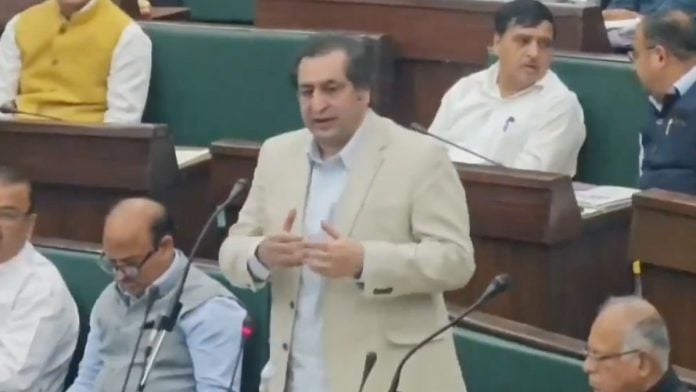
On 30 September, Handwara MLA Sajad Lone raised the question before the Assembly. “What is the definition of a poor person? We need a uniform definition of poor and poverty,” he said.
Lone made his point by citing the regional distribution of EWS (Economically Weaker Sections) certificates.
“As per the current definition of poverty, 92 per cent of certificates issued for EWS are from the Jammu region and 8 per cent from the Kashmir region. This almost means that 92 per cent of poor people in J&K reside in the Jammu region and only 8 per cent reside in the Kashmir region,” Lone said.
Scheduled Caste and Scheduled Tribe populations are heavily concentrated in Jammu, shrinking the general category pool. In contrast, Kashmir has a large general category population. According to the revenue department, 99.2 per cent of all SC certificates are issued in the Jammu division compared to 1 per cent in Kashmir.
But the EWS certificates, which cite Jammu at 92 per cent vs Kashmir at 8 per cent as the poorer region, tell only one side of the story.
Lone cited another government measure used to identify economically weaker households. It was by identifying households eligible for subsidised food under the National Food Security Act (NFSA). The beneficiaries of two categories, Priority Household (PHH) and Antyodaya Anna Yojana (AAY) ration cards under NFSA, receive foodgrains at heavily subsidised rates. These ration cards are a lifeline for the poorest of the poor.
Lone quoted 37.71 lakh PHH/AAY ration cards in Kashmir region, compared with 29.81 lakh in Jammu. Using this as the basis for determining the regional share of EWS jobs, he said, would mean 417 of the 758 posts going to Kashmir and 341 to Jammu.
“According to this definition, 55 per cent of the poor live in Kashmir and 45 per cent in Jammu. But according to the definition of the EWS criteria, 92 per cent of the poor reside in the Jammu region, and 8 per cent in Kashmir. How can the government spend crores in subsidies for the poor and then deny their poverty when they apply for a job,” Lone said.
Also read: 5 cheetah cubs born at Kuno, India’s cheetah population rises to 60
Why is it important
The question raised by Lone strikes at the root of the reservation rationalisation protests rocking Jammu and Kashmir since Omar Abdullah’s National Conference came to power in 2024.
In March 2024, after Parliament brought more communities under the Scheduled Tribe (ST) list in J&K, the LT Governor administration amended J&K Reservation Rules, 2005. The amendment increased overall reservation in government jobs from 43 per cent to 70 per cent, leaving only 30 per cent for the general (open) merit category.
Before the amendments, total reservations in government jobs and educational seats were around 43 per cent, leaving roughly 57 per cent for open merit.
Since then, open-merit (general category) students from Jammu and Kashmir have been protesting against the amendment, claiming it has squeezed the open-merit share. Political parties such as PDP have lent support to these protests.
The protesters have been asking for rationalisation of reservation, asking the administration to rebalance the quota structure. In December 2024, the Jammu and Kashmir cabinet constituted a three-member Cabinet sub-committee to look into the grievances over the reservation rules.
After six months of deliberations, the committee recommended a 50:50 split between reserved and open-merit categories, while proposing reductions in the quotas of Residents of Backwards Areas (RBA) and EWS. But the report left SC and ST allocations untouched.
However, the report is still under consideration by the competent authorities.
Answering Lone’s question in the Assembly, it was said that the government has filled 7,580 job vacancies in the last two years. Of these, 758 posts under the 10 per cent EWS quota were reserved for EWS. Based on certificate distribution, 697 of these went to Jammu and 61 to Kashmir.
(Edited by Saptak Datta)