



Chandigarh: On 28 October 2025, a relationship manager of IDFC First Bank walked into the office of the Haryana Labour Welfare Board in Panchkula. What he told the officials there was shocking.
The man, Chirag Gulati, had checked his bank’s records. The Board did not have any fixed deposit with the bank. It had only a savings account, with a balance of Rs 7,619.24.
The Board had been under the impression it held a Rs 50-crore deposit in IDFC First Bank made with workers’ money.
Gulati also told officials that Abhay Kumar, the banker the Board had been dealing with all along, no longer worked for IDFC First Bank.
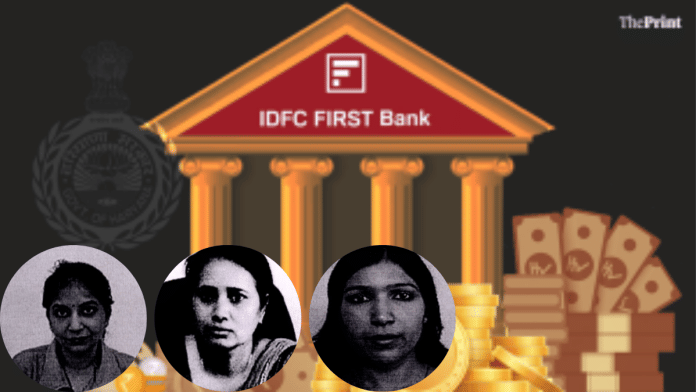
Surinder Kaur, the Deputy Labour Commissioner (Welfare), who held a responsible position in the labour welfare department, heard what Gulati had to say. Surinder Kaur is now one of three women named as accused in the CBI’s supplementary chargesheet.
Surinder Kaur is now one of three women accused in the CBI’s supplementary charge sheet. The case against Kaur and two others is part of the Rs 645-crore fraud in IDFC First Bank’s Sector-32 branch in Chandigarh involving siphoning off of public money belonging to Haryana government departments and municipal bodies, Haryana and Chandigarh Administration through fixed deposits that did not exist and cheques and debit notes they the departments never issued.
The CBI says the money went to entities controlled by the main accused, Ribhav Rishi, manager at IDFC First Bank in Sector 32, Chandigarh, and his associates. The agency filed its supplementary charge sheet before the Special Judge, CBI, Panchkula, on 2 September 2026, accusing 19, among them IAS officers, finance officials, bankers and private persons.
Three of the government officials mentioned in the charge sheet are women.
Besides Surinder Kaur, the other two women are Deepti Kaushik, a Senior Accounts Officer at the Haryana Power Generation Corporation Limited (HPGCL), and Sudha Goyal, then a Deputy Branch Manager and later Branch Manager at IDFC First Bank’s Sector-32 branch in Chandigarh.
None of the three is accused of walking away with the money. CBI names Ribhav Rishi and Abhay Kumar, the bankers who ran the Sector-32 branch, as the people who did that.
But, the CBI says, each of these three women, at a different point and in a different way, allowed siphoning off money to happen or helped hide it.
All three are listed as “not arrested”. The charge sheet says sanction for prosecution under Section 19 of the Prevention of Corruption Act is awaited.
Deepti Kaushik: Note that was moved same day
Kaushik, 45, is a Chartered Accountant by profession. The charge sheet stresses this repeatedly.
Her part in the story begins 19 February 2024. That day, main accused Ribhav Rishi, then Sector-32 branch manager, sent an offer letter to Haryana Power Generation Corporation Limited’s (HPGCL) Managing Director, Mohammed Shayin, an IAS officer, also an accused in the charge sheet.
The letter said IDFC First Bank was empanelled with government departments. CBI says that was incorrect. The bank was empanelled by the Haryana Government only on 12 July 2024.
The same day (19 February 2024), Kaushik moved a note proposing a new savings account with IDFC First Bank in the name of the Dry Fly Ash Fund. The note said the account could be used “to avail future opportunities”. The Director (Finance) Amit Dewan, agreed the same day. Shayin wrote “May be opened” the next day.
CBI says the file travelled from proposal to approval in about a day. It also says HPGCL already had ten savings accounts and ten cash credit limits with empanelled banks, and that no need for another account was recorded anywhere.
The account lay empty for about eight months.
Then came 6 November 2024. According to the charge sheet, Shayin called Chief Accounts Officer Bahadur Singh Gosain to his chamber. Rishi was already there. Gosain was told to put funds into the Dry Fly Ash account.
CBI says the decision to break an existing fixed deposit with IndusInd Bank was then taken by Shayin, Dewan and Kaushik, without mentioning in the file and before any note existed.
Kaushik’s role, as CBI puts it, was the paperwork. She prepared a calculation of the interest HPGCL would lose by breaking the deposit early and what it would gain from IDFC First Bank’s promised 14 percent. The working showed a loss of Rs 1.65 crore, a gain of Rs 2.70 crore and a net benefit of Rs 1.04 crore.
CBI’s argument is that the sum was not the basis of the decision. It says the sum was written to fit a decision already taken. It points out that the amount (Rs 50 crore), the period (11 November 2024 to 28 March 2025) and the rate (14 percent) had all been fixed beforehand.
The charge sheet also says 14 percent on a savings account was not a banking offer at all. The repo rate then was 6.50 percent. Rs 50 crore was moved on 11 November 2024 by prematurely breaking part of HPGCL’s Rs 108.47-crore deposit with IndusInd Bank.
Pursuing a private promise
In January 2025, Kaushik wrote to the bank, because the promised interest was not arriving as it should have. She emailed Rishi and the bank’s authoriser Seema Dhiman on 7 January 2025, with reminders on 21 and 24 January. Abhay Kumar replied on 24 January that “some internal issue” had held up the credit, and it would be made.
The charge sheet frames this as an allegation. It says no officer chases a named banker month after month for a credit that a bank’s system generates by itself. It says she was pursuing a private promise.
The interest, CBI says, was paid through demand drafts funded from accounts of entities controlled by the accused. The money was itself siphoned from other government bodies. On 29 March 2025, Kaushik transferred Rs 51,55,59,059 out of the account to HPGCL’s account with HDFC Bank in Panchkula. CBI says she did this without approval and without bringing it on file.
The note of 27 March 2025
Another Rs 50 crore was to go to IDFC First Bank, this time from a maturing Canara Bank deposit. Dewan asked Kaushik to examine it “from a legal point of view”. She reported “revenue neutrality” and that it served HPGCL’s financial interest.
CBI says four facts were kept out of the note. One, the bank had not paid the promised interest on the earlier deposit. Two, about Rs 87 lakh was still outstanding. Three, the Rs 50-crore limit per bank was already used up. And four, Kaushik had herself moved funds out of the account.
On 5 May 2025, Rs 50 crore was debited on a cheque, that HPGCL had never issued. The cheque has now been seized. The money went out via nine demand drafts to Municipal Corporation Chandigarh and an entity called CREST (Chandigarh Renewable Energy and Science & Technology Promotion Society).
The debit voucher carries what CBI calls a forged signature of Kaushik. It also carries a stamp and claims a confirmation call was made to her number. But, CBI says no such call was actually made before the money left.
Kaushik, “on being examined”, said Rishi called her five or six times that day (5 May 2025) about the fixed deposit receipt. She said the amount to be debited was for the FDR and not for any other purpose.
Did Kaushik raise an alarm
On 6 July 2025, Kaushik got the June statement. It showed debits on cheques that HPGCL had never issued and which were lying with the department. She emailed Rishi on 6 July. A copy to Abhay Kumar bounced, because his email had been deactivated. She wrote two more mails on 8 July.
So, she did raise the alarm? CBI’s case is that she stopped short.
The bank’s reply came on 28 July. It was signed by Rishi’s own signature ID, so the complaint was answered by the man it was about.
CBI says three problems were visible on the face of it. One, a deposit supposedly created on 5 May carried a value date of 28 March. Two, debits on cheques never written were put down to “erroneous” entries. And, three, only Rs 1.48 crore had been credited back against debits of crores.
The charge sheet says she put the reply on record. She called for no deposit advice from the bank’s core system and sought no word from an other bank officer. She marked the file to an Accounts Officer, the late Balwant Singh, whose comments said all debits had been credited back and that a Rs 50-crore FDR was available. CBI says both statements were false and that the file never went to the Managing Director.
It is pertinent to mention that Balwant Singh committed suicide by jumping off the 8th floor of the Punjab and Haryana Civil Secretariat on 4 May this year, a day after his first round of questioning by the CBI team.
CBI puts the money misappropriated from HPGCL’s Dry Fly Ash account at Rs 59,46,00,892. It adds Rs 1,66,44,453 lost on the premature withdrawal. It has invoked provisions of the Bharatiya Nyaya Sanhita and the Prevention of Corruption Act, including Sections 316(5) BNS and 12, 13(2) read with 13(1)(a) of the PC Act.
Surinder Kaur: Two words on a file
Kaur, 57, took charge of the Labour Welfare Board’s welfare wing in June 2025, as an additional charge. By then, the money was long gone.
Here is what the charge sheet says happened before she came. The Board had about Rs 200 crore of surplus, the cess collected from employers for workers’ schemes such as marriage assistance and scholarships. It invited rates from banks. On 3 March 2025, the Welfare Commissioner approved Rs 50 crore for IDFC First Bank among five banks.
Four other banks received deposits in the normal way. With IDFC First Bank alone, a savings account was opened on 5 March 2025. The account-opening form was signed in blank, and Abhay Kumar filled in the details afterwards.
The Rs 50 crore arrived on 6 March. It went out within nine days through twelve transactions to Capco Fintech Services, SRR Planning Gurus and Swastik Desh Projects. By 15 March, the balance was Rs 74,000.
The charge sheet says plainly that no part in the taking of the money is attributed to Kaur.
Her case is about what came after Gulati’s visit on 28 October. CBI says she kept the file from 6 November to 1 December. On 14 November she marked it back with two words, “Please speak”. She recorded her order on 27 November. The letter to the bank went out only on 2 December, more than a month after the Board was told its money was gone.
CBI says she did not send the file to the Welfare Commissioner, D. K. Behera, although the note itself carried the level “WC”. The head of the office, it says, never found out.
The bank’s reply, dated 4 December, was brought to the office by Abhay Kumar himself, months after he had left the bank and after Kaur had been told so. CBI says it recovered the draft of that reply from his phone, along with a photograph of a computer screen on which it was being typed at 2.01 pm that day.
On 14 November, the Board was asked by the Finance Department to list its savings accounts. The list that went up named two accounts with IDBI Bank and one with HDFC Bank. The IDFC account was not on it. The note passed to Kaur and was marked down the same day. CBI calls this a deliberate attempt to hide the account, by Amit Kumar (a contractual clerk), Jugal Kishor (Accounts Officer in the Labour Welfare Board) and Kaur. Amit Kumar and Jugal Kishor have also been named in the charge sheet.
Then there are the phone records. The charge sheet says Kaur’s WhatsApp calls and messages with Abhay Kumar have been deleted, and that he visited her house in Baltana on 12 January 2026. CBI relies on a forensic extraction from her phone. It has added a charge of causing electronic records to disappear, with Section 49 read with 316(5) BNS among the offences.
The charge sheet itself records the argument in her favour. She held three charges at the time, and the delay may have been bona fide. CBI says this “does not meet the case”. Its reasoning is that a month’s delay on Rs 50 crore, with the head of the office kept out, cannot be explained by pressure of work.
Sudha Goyal: The approving signature
Goyal, 41, joined IDFC First Bank in February 2023 as a Banker Authoriser at the Mohali Phase-10 branch. On 13 August 2025 she was promoted to Deputy Branch Manager at Sector-32, Chandigarh. She stayed until February 2026, and the charge sheet also refers to her as Branch Manager.
The timing is central to the CBI’s case. When she arrived, the fraud in government accounts at that branch had already surfaced, and Rishi and Abhay Kumar had been made to leave the bank. CBI says that even with the knowledge, she kept approving.
On 25 September 2025, she marked “OK to proceed” on the account-opening form of the Director Panchayat’s MMGAY 2.0 account. The form carried the mobile number of Prince Sharma, a Panchayat department superintendent also named as an accused, and a false email ID. Neither belonged to the department or its signatory.
CBI then counts her approvals. It says she approved 12 fraudulent debits in one account of the Haryana State Pollution Control Board and one in another, together Rs 75,55,65,392. It says she approved 11 more in the Director Panchayat account, totalling Rs 75,26,52,302. All of them were on cheques or debit notes carrying what CBI calls the forged signature of D. K. Behera. And it says she approved at least three high-value debits from Panchkula Municipal Corporation’s account, of Rs 10 crore, Rs 20 crore and Rs 20 crore.
On CBI’s own figures, that adds up to more than Rs 200 crore. In all, at least 27 debits.
One of them is the debit of 4 November 2025, on cheque number 000011. The department’s inquiry committee had noted that the cheque carried Rs 2,50,00,000 in figures but “Twenty-Five Crores” in words. The bank honoured it, for Rs 25 crore. The charge sheet lists this debit among those approved by Goyal.
The CBI also says she did the “six-eye verification” on these transactions. “Six eye verification” is a control in which three officials, not one or two, must separately check and approve a transaction before money moves. This is the check meant to bring an independent officer to look at a large transaction, separate from the person who keys it in and the person who checks it. In her hands, CBI says, it became a formality.
Her other recorded moment was on 6 November 2025. Jugal Kishor of the Labour Welfare Board came to the branch to check whether the Board’s fixed deposit existed. The charge sheet says she told him the position could not be confirmed that day because of a server problem. It records that she told the CBI that she gave Kishor her number and tried to reach him several times, and that he did not take her calls. CBI treats her answer as one of her overt acts.
The Panchkula Municipal Corporation wrote to the branch several times, copying her in the mail, asking for the FDRs and statements of its account. CBI says she did not respond to these emails. Seema Dhiman gave the department a false excuse of technical trouble.
The bank has suspended Goyal, after its own internal enquiry. CBI says she did not stop further fraud despite knowing that fraud in government accounts had already surfaced at the branch. It has invoked Section 316(5) BNS and Sections 13(2) read with 13(1)(a) of the PC Act, among others.
Section 316(5) of the Bharatiya Nyaya Sanhita deals with criminal breach of trust by a public servant, banker, merchant or agent. It carries imprisonment for life, or up to 10 years in jail, and a fine. It replaces Section 409 of the Indian Penal Code. Section 13(1)(a) of the Prevention of Corruption Act, 1988, makes it criminal misconduct for a public servant to dishonestly or fraudulently misappropriate property entrusted to them, or let someone else do so. Section 13(2) prescribes the punishment: A jail term of four to 10 years, and a fine.
One more thing from the charge sheet cuts the other way. In a WhatsApp exchange of 2 February 2026, Shamim Dar, an area head in the bank’s government banking group, tells Abhay Kumar he will “tell Sudha” about a department’s request for a statement. CBI itself notes that there is no direct communication with Goyal on this.
Where case stands
Deepti Kaushik, Surinder Kaur and Sudha Goyal are among 19 accused in this supplementary charge sheet, which also names IAS officers and finance officials. The CBI says further investigation stays open, including into other government servants, other private persons, and the money trail.
(Edited by Viny Mishra)