



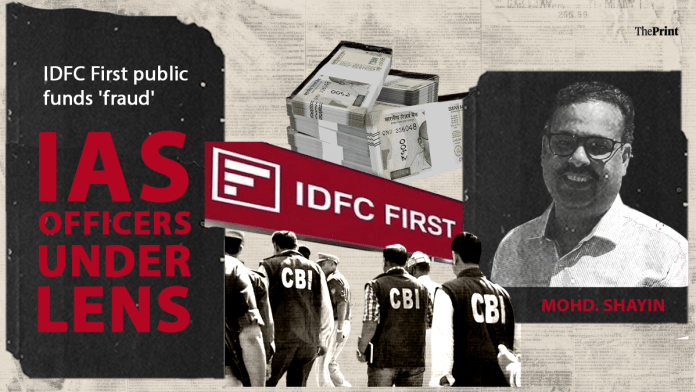
Gurugram: On 19 February 2024, two senior officers of the Haryana Power Generation Corporation Limited (HPGCL) had a short chat on their phones. Managing Director Mohammed Shayin sent his Director (Finance), Amit Dewan a mobile number, writing, “Ribhav from IDFC bank wants to meet.”
A second message followed. “If u are there pls meet or ask CAO to meet.”
Dewan replied that he would fix a time. No note had been moved. No file had been opened. Nobody at HPGCL had recorded a need for a new bank account.
The Central Bureau of Investigation (CBI) says the HPGCL strand of the IDFC First Bank fraud, the embezzlement of about Rs 645 crore of public funds from the Haryana government and Chandigarh Municipal Corporation, begins with this chat.
In its chargesheet of 2 September 2026, the agency says Shayin personally brought Ribhav Rishi, then manager of the bank’s Sector 32 branch in Chandigarh, into the corporation’s banking affairs. Twenty months later, it says, Shayin sat in the Finance Department and removed the ceiling on how much government money a department could place with the same bank.
The CBI calls his position the “originating position” in the HPGCL part of the conspiracy.
These are the agency’s allegations. None has been presented in court. Shayin’s side is not on record in the chargesheet. He is listed as accused No. 19, and the column on his arrest status reads “not arrested”.
ThePrint reached Shayin through a message on his WhatsApp. The story will be updated if and when he responds.
An IAS officer of 2002 batch of Haryana cadre, Shayin was managing director of HPGCL from 8 July 2019 to 3 December 2024. He then moved to the finance department as director-general of the Institutional Finance and Credit Control office, called the IFCC. The IFCC frames the rules on which banks government departments can use and how much they can place there. The accused-details page of the chargesheet describes him as commissioner and secretary, Housing for All.
The CBI has invoked criminal conspiracy, criminal breach of trust by a public servant, cheating, forgery, falsification of accounts and taking undue advantage under various sections of the Bharatiya Nyaya Sanhita and the Prevention of Corruption Act.
Also Read: IDFC FIRST Bank fraud: CBI arrests IAS officer who oversaw Assembly, Rajya Sabha polls in Haryana
Whose money was it?
The chargesheet begins its HPGCL chapter with a point on ownership. HPGCL is a government company. The Governor of Haryana holds 95.91 percent of its shares. In 2024-25, the state put in Rs 205.07 crore of fresh equity. The CBI says every rupee the corporation’s officers handled was public money, held in trust.
There were rules for handling it. The finance department’s policy for dealing with banks, dated 13 March 2018, required prior approval from the IFCC before a new account was opened. A memo of 12 July 2024 added limits. It brought two new banks onto the state’s list for the first time, IDFC First Bank and AU Small Finance Bank. It said a department could place no more than Rs 50 crore with a first-time bank that was not a small finance bank. For small finance banks, the limit was Rs 25 crore. It also said due diligence must be done every time a deposit was placed.
HPGCL did not lack banks. On 19 February 2024, the CBI says, it kept its money in 10 savings accounts spread over IndusInd, Yes Bank, Canara, Indian Overseas, HDFC and Union Bank of India. It also had 10 cash credit limits.
An account cleared in a day
Rishi’s offer letter reached HPGCL on the same day as the chat, 19 February 2024. It was addressed to the Managing Director.
The letter said IDFC First Bank was “empanelled across various government departments and PSUs”. The CBI says this was false. The state empanelled the bank only on 12 July 2024, almost five months later.
Senior Accounts Officer Deepti Kaushik moved a note the same day. She proposed a savings account with IDFC First Bank in the name of the Dry Fly Ash Fund, which she said could be used “to avail the future opportunities by observing financial prudence”. Dewan agreed and sent the file up. On 20 February, Shayin wrote two words on it: “May be opened.”
The file went from start to approval in about a day.
The chargesheet says the 2018 policy was bypassed. No approval was taken from the IFCC, then or later. No quotations were invited from empanelled banks. The file did not record why one more account was needed. The CBI adds that Shayin did not check Rishi’s claim about empanelment with the finance department or with the bank’s own records.
The account was opened on 27 February 2024. It was not opened near the corporation’s headquarters at Urja Bhawan in Panchkula. It was opened at Rishi’s own branch in Sector 32, Chandigarh.
Then it lay empty. No money went in between 27 February and 10 November 2024, a gap of about eight months. The CBI describes the account as “a part of the preparation for the offence which was to follow”.
The 6 November meet
On 6 November 2024, Chief Accounts Officer Bahadur Singh Gosain was called to the managing director’s chamber.
Rishi was already sitting there, the chargesheet says, in the middle of a discussion. Shayin told Gosain to give some funds to him in the Dry Fly Ash account.
Gosain went to Dewan and told him what the MD had said. The CBI says the decision that followed was taken by Shayin, Dewan and Kaushik “outside the file”. Before any note existed, they decided to break a running fixed deposit at IndusInd Bank to raise the money.
HPGCL held Rs 108.47 crore. It was earning interest. Kaushik then prepared a working of loss and gain. The CBI says she prepared it after the decision was made, to make the file look regular. It showed a loss of Rs 1.65 crore in interest on premature withdrawal. It showed Rs 2.70 crore earned from IDFC First Bank at 14 per cent. The net gain to HPGCL was shown as Rs 1.04 crore.
The working ran from 11 November 2024 to 28 March 2025. The end date was the day the IndusInd deposit was due to mature. Only two working days remained before the weekend, so the calculation began on Monday. The CBI says the amount, the period and the rate had all been settled beforehand. The calculation, it says, “was prepared to fit a decision already taken”.
On 11 November, Rishi gave the managing director a letter offering 14 per cent a year on the account for that period. Gosain wrote on it, “As directed, please transfer the amount of Rs. 50.00 crore to IDFC Bank by partially premature withdrawal of funds from FD with IndusInd Bank.”
The CBI says “as directed” meant directed by Shayin. Rs 50 crore went by Real Time Gross Settlement (RTGS) the same day.
The chargesheet adds a point about how the file should have moved. In an ordinary case, it says, the bank’s letter would come in first. It would go down the hierarchy. Each level would weigh the loss on breaking the deposit against the gain offered. The decision would follow that discussion. Here the endorsement on the letter shows, on its own terms, that the file was not the source of the decision.
Also Read: CBI alleges civil servant-bank nexus in Rs 661 cr IDFC First Bank fraud; 3 IAS, 1 IFS under scanner
The 14 per cent offer
The chargesheet spends many pages on this rate. On 11 November 2024, the RBI repo rate was 6.50 per cent. It came down to 6.25 per cent only in February 2025. The CBI says the rate on a savings account is a published rate. It is not bargained with one depositor for a fixed and odd window of time. A rate more than double the repo rate, it says, should have alerted any officer that the offer was not a banking offer.
The letter carried the signature of Abhay Kumar and the stamp of the Sector-32 branch. IDFC First Bank has told the CBI that the letter was never genuine, was not part of its records and was issued by branch employees without authority. The bank says it never offered such a rate on this account.
The CBI reads the offer as bait. In its view, Rishi was not acting as a branch manager securing a deposit for his bank. A 14 per cent return on a savings account was, for the bank, a loss-making promise. It says the deposit was meant to bring the funds under Rishi’s personal control, “the promised interest being no more than the bait”.
How the interest was paid
The CBI then looked at how the promised interest was actually paid.
A bank, it says, credits interest by a system entry that appears in the statement with an interest narration. The genuine interest in this account came that way, at the ordinary savings rate. The difference came through demand drafts. The drafts were funded from the accounts of private entities.
The chargesheet says the money in those accounts came from funds taken from other government bodies. It names the Haryana State Pollution Control Board, the Welfare Board and the Panchayat Department, among others. HPGCL was thus paid, the CBI says, with public money taken from elsewhere. In its words, what HPGCL received as interest “was in law stolen property”.
Kaushik chased Abhay Kumar and Rishi for the shortfall for months. She wrote on 7 January 2025, and sent reminders on 21 and 24 January. On 24 January, Kumar replied that an “internal issue” had held up the credit and that it would be credited. The CBI reads that reply as the two bankers owning the 14 per cent promise. An officer does not chase a person for a credit that a bank makes automatically, it says.
On 29 March 2025, Rs 51,55,59,059 was moved out of the account to HPGCL’s account with HDFC Bank in Panchkula.
The chargesheet says the interest entries in HPGCL’s books were false. It says the interest certificates were forged. The asset of interest receivable at 14 per cent from the bank never existed at any point, it says. The books, in the CBI’s words, “were made to carry a fictitious entitlement”.
The black tick
The chargesheet turns next to the HPGCL Employees Pension Fund Trust. Shayin was its chairman and a trustee, besides being MD.
On 16 July 2024, Shamim Dar, Area Head of IDFC First Bank’s Government Banking Group, sent a proposal to open a trust account. HPGCL received it on 18 July. On 2 August, a divisional accountant moved a note proposing accounts with four banks shortlisted on interest rates. They were IDFC First Bank (Sector 8, Panchkula), Bandhan Bank, Jana Small Finance Bank and Ujjivan Small Finance Bank.
The note went through several officers and trustees. All of them forwarded it in the same spirit, the CBI says. Shayin ticked one bank, IDFC First Bank, in black ink. He recorded no reason.
The approval was for the Sector 8 branch in Panchkula, near Urja Bhawan. The account was opened on 14 August 2024 at Sector 32, Chandigarh. The bank’s representatives who collected the account-opening form also came from Sector 32.
The CBI says Shayin did not read the concluding part of the note closely and had a “preference for IDFC First Bank”, ticking it “without considering its merit”. It says that, given his closeness with the officials of the Sector-32 branch, the opening of the account there “is attributable to him”.
Money did not flow in at first. The trust allocated funds by interest rate, and IDFC’s rate was not competitive. On 26 September 2024, a letter offering 8.6 per cent for a week reached the trust by email. Three transfers followed on 26 and 27 September, totalling about Rs 12.25 crore.
The chargesheet then lists what went out. Between March and September 2025, nine debits took Rs 19,71,74,595 from this account. Most of the money went to two firms the CBI calls shell companies, Capco Fintech Services and Swastik Desh Projects. Part went to another Dry Fly Ash account at the same branch. The CBI says these debits went through on bogus debit notes carrying forged signatures. A second trust account, opened at AU Small Finance Bank in June 2025, lost a further Rs 25 crore in one debit.
The chargesheet lists these losses among those in the conspiracy in which it names Shayin. It does not say he made the debits.
The hospitality angle
The chargesheet lists three bills, together Rs 1,67,101. The CBI treats them as undue advantage given by Rishi.
The first is Rs 73,073 at Hyatt Centric, Sector 17, Chandigarh, dated 8 May 2025. It was Table No. 42, in Shayin’s name, and it was paid in cash. The CBI says Rishi supplied that cash after seven or eight days.
The second is Rs 35,629 at Koyo restaurant in the same hotel, dated 3 November 2025. The guest name was “Shayin” and the mobile number was given. The CBI says his companions sat in the outside area and Rishi paid for the party.
The third is Rs 58,399 at Corby’s restaurant on 10 January 2025. The food bill was Rs 35,444. The liquor bill was Rs 22,955. Both were settled in cash. The hotel’s assistant food and beverages manager told the CBI that after the party he informed Shayin that “everything was taken care of by Mr. Ribhav Rishi”. He meant that Rishi had paid. The hotel’s general manager produced a WhatsApp chat in which he asked how the party went. Shayin replied that everything was good.
All three dates fall after Shayin left HPGCL. The first is five weeks after. The CBI says this does not weaken its case. The advantage, it says, was accepted while the HPGCL transactions were still running, and it went on after he moved to the finance department. The chargesheet says he neither refused it nor paid it back nor reported it.
It also relies on Hemraj, who drove Rishi for years. Hemraj told the CBI he dropped Rishi outside Shayin’s house, a corner house in Sector 16A, Chandigarh, on eight to nine occasions. He recalled Rishi telling Kumar on the phone, “Shayin Sahab ke ghar chalna hai, meeting hai (Let’s go to Shayin’s house, there’s a meeting).” Rishi’s tone changed when he spoke to Shayin, Hemraj said, and he called him “Shayin Sir”.
Hemraj also said Rishi sometimes left his own car near the Sector 32 branch and went to the house in another vehicle with Vikram Wadhwa, accused No. 18. Rishi had told him, Hemraj said, that Wadhwa introduced him to senior officials, including Shayin. The CBI says leaving the car behind shows the visits were kept free of any trail.
The cap
The last part of the case concerns the finance department.
On 12 July 2024, the department had fixed the ceiling. No department could place more than Rs 50 crore with a bank empanelled for the first time.
In September 2025, a file on deposit limits went up to the Chief Minister. On 23 September, he approved three things, the CBI says. DCB Bank would be empanelled. The Rs 50-crore limit would be removed for Bandhan Bank. AU Small Finance Bank and Jana Small Finance Bank would be raised to Rs 50 crore. The approval did not name IDFC First Bank.
When the file came back down, Shayin, now DG, IFCC, marked it with a remark: “Show draft before issue.”
On 26 September, banking associate Ajay Sharma put up the draft. Chief Financial Advisor Kiran Lekha Walia noted that Bandhan and IDFC were the two banks, other than small finance banks, empanelled for the first time. She wrote that the limit needed to be raised for both “in accordance with the policy”. She said the remaining points would be taken up with a second draft, DFA-II, which would be amended “after due approval”.
The CBI reads “due approval” as approval from the same authority, the chief minister. It says Shayin read it as his own approval, widened the chief minister’s limited decision into a general removal of the ceiling, and let the notification go out.
The CBI makes several points about this.
It says no further approval was sought, though a route was open. The point could have gone in the original proposal, or been approved after the fact, or put up in a fresh note. The file had gone up to the chief minister only days before. It says the policy of 12 July 2024 says nothing about removing the ceiling and has no rule that a relaxation for one bank must pass to all. The plea of uniformity, in its words, is “an afterthought dressed up as policy”.
It says the applications on the file came from Bandhan, AU and Jana. IDFC First Bank had not applied. Karnataka Bank and Capital Small Finance Bank applied and got nothing, for want of eligibility. Yet the bank that had asked for nothing got the largest benefit.
The notification also named Equitas, Ujjivan and Utkarsh Small Finance Banks. The CBI says they held little or no state deposits. That gave the measure “the appearance of a general measure of policy”. The effect on the ground, it says, was felt by IDFC First Bank alone, and within it the Sector-32 branch.
The chargesheet says Municipal Corporation, Panchkula, placed more than Rs 100 crore with IDFC First Bank after the notification. It says the pollution control board’s earlier crossing of the ceiling, until then a breach, was cured by it.
The CBI also points to a circular. In July 2025, weeks before, the Finance Department had written to all departments about serious and continued non-compliance in dealing with banks. It spoke of accounts opened without proximity norms, banks chosen on personal preference and “indications of favouritism”. It gave the example of offices in Panchkula opening accounts in Chandigarh with no justification. The CBI says Shayin’s own office, the IFCC, was the one issuing such circulars. It says he was fully aware that the deviations related in large measure to IDFC First Bank and its Sector 32 branch.
The chargesheet does not question the merit of higher limits. It calls that “a matter of financial policy”. Its objection is to the way the change was brought about, and to the fact that Shayin recorded no reason for it.
It expects Shayin to say that a note on the file called the DG, IFCC competent. The CBI says his competence was to turn the chief minister’s approval into a notification, and no more.
What the bank has said
The bank has said something on this point too. Anish Kapur, the regional head for government banking, told the CBI on 14 May 2026 that IDFC First Bank never sent any proposal to remove the Rs 50-crore cap. The bank was “surprised”, he said, when it was removed. He said he did not know who had submitted such a proposal, if one had been submitted on the bank’s behalf.
The chargesheet itself records the bank’s position on the 14 per cent letter. The bank told the CBI it never offered that rate.
What the CBI says it has
The agency lists its evidence against Shayin. It includes the WhatsApp chat of 19 February 2024 and call records, the offer letter and the notes of 19 and 20 February, and the empanelment memo of 12 July 2024. It includes the 11 November 2024 letter and the bank’s reply that it never made the offer. It includes the black-ink note in the Pension Fund file, the IFCC file and the memo of 9 October 2025, the hotel records, and the statements of Walia, Gosain and Hemraj.
It puts the losses it links to the conspiracy at Rs 59.46 crore in the Dry Fly Ash account and Rs 19.71 crore in the Pension Fund Trust account at IDFC First Bank. It adds Rs 25 crore at AU Small Finance Bank and Rs 1.66 crore lost by HPGCL on the premature withdrawal of the IndusInd deposit.
The chargesheet says Shayin conspired with Rishi, Dewan, Kaushik, Rajesh Goyal and others. It lists breach of trust, cheating, forgery of valuable security, falsification of accounts, dealing in misappropriated property, causing documents needed as evidence to be kept away, and taking undue advantage.
The case is before the Special Judge, CBI, Panchkula.
(Edited by Nardeep Singh Dahiya)