




This week, China is on holiday as Golden Week coincides with the Mid-Autumn Festival, resulting in a 13-day break. Hotel bookings for stays of a week or longer have more than doubled compared with the previous year. Meanwhile, Beijing has launched a month-long campaign to encourage holidaymakers to spend more. But the underlying statistics tell a more cautious story: during last year’s Golden Week, average spending per trip fell to a three-year low of about 911 yuan. Although the Chinese are travelling, they are not spending as much. And it’s becoming a big problem in the world’s second-largest economy.
This expenditure gap is also the focus of the International Monetary Fund’s recent publication, Toward a New Economic Growth Model for China, edited by Thomas Helbling, Sonali Jain-Chandra, Siddharth Kothari, and Krishna Srinivasan. The book’s eleven chapters address topics ranging from household savings to bankruptcy law. Together, they examine an economy that has undergone one of history’s most dramatic transformations but is now creaking under three key issues: local governments that keep building despite diminishing returns, the survival of weak firms, and households’ reluctance to spend.
This situation is immediately relevant to India. A China that does not spend enough at home must rely more on exports. How Beijing addresses these three challenges will influence India’s trade, manufacturing sector, and position in Asia for the foreseeable future.
Also Read: Why India’s autorickshaws went electric before its family cars
A country that cannot stop building
China’s economic achievement deserves acknowledgement. In 1978, its per capita income, measured in purchasing power terms, was approximately $900, less than 3 per cent of that of the United States. Over four decades, with an average growth rate nearing 9 per cent, the economy expanded nearly sixtyfold, facilitating the migration of more than 750 million people to cities.
But the Chinese model is now showing its limits.
In 1956, Robert Solow demonstrated that perpetual economic growth cannot be sustained solely through capital accumulation, as each successive addition of machinery or infrastructure yields diminishing returns. Paul Krugman’s 1994 essay, “The Myth of Asia’s Miracle,” also cautioned that growth driven by sheer effort rather than innovation eventually loses momentum.
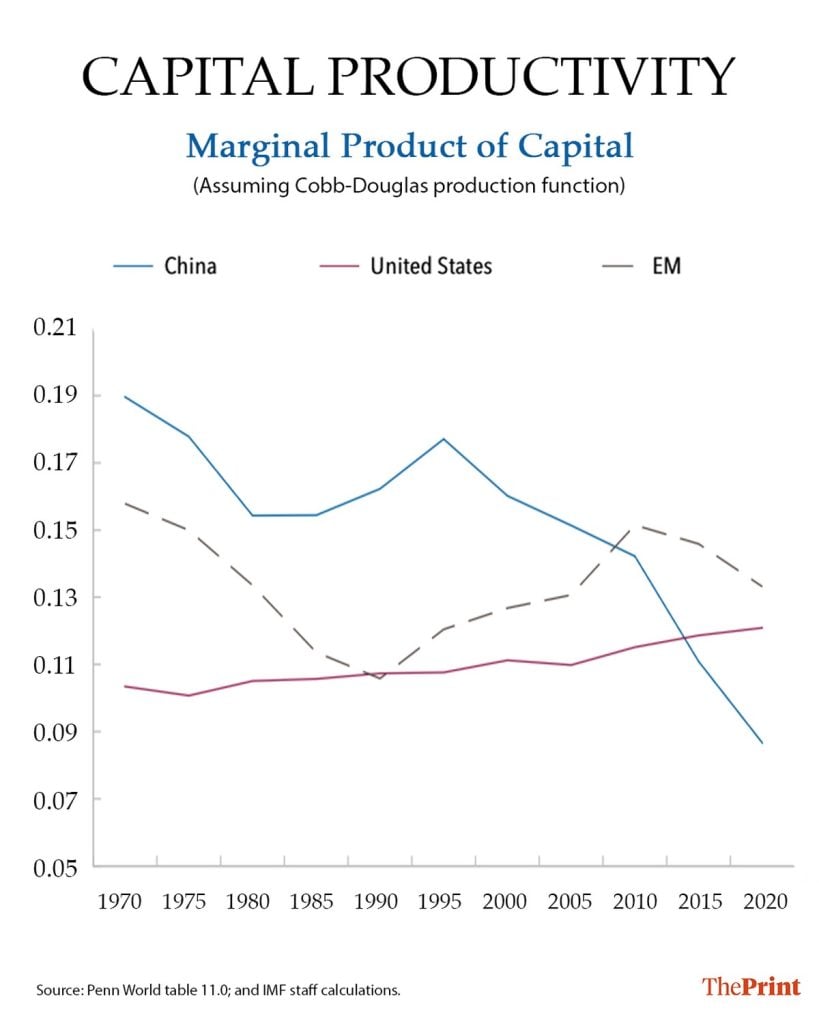
A particularly striking chart from the International Monetary Fund would have intrigued Robert Lucas, who in 1990 questioned why capital does not migrate from affluent nations to poorer ones, where it should theoretically yield higher returns. China’s situation has inverted this conundrum. According to the IMF, the return on an additional unit of capital in China has fallen by more than half since the 1970s and is now lower than in the United States. As a result, a nation with a fraction of America’s income now possesses, at the margin, more capital than it can effectively utilise.
Local governments account for about 85 per cent of general government expenditure, yet receive only about 50 per cent of the corresponding revenue. Economists call this discrepancy a vertical fiscal imbalance. To bridge this gap, Chinese local officials have resorted to land sales and off-budget borrowing. Their career advancement depended on meeting growth targets, incentivising continuous construction.
China’s experience with GDP targets validates Charles Goodhart’s 1975 assertion that a statistic loses reliability once it becomes a policy target. As the property market declined, on-budget local revenues, including those from land sales, fell from 17.9 per cent of GDP in the decade preceding the pandemic to 13.6 per cent in 2023-24.
Meanwhile, the aggregate debt of local governments and their financing vehicles has risen to over 80 per cent of GDP, up from about 10 per cent before the global financial crisis. In contrast, India addresses this issue through a constitutionally mandated Finance Commission, which redistributes central tax revenue to states every five years, providing a longstanding institutional solution to the fiscal challenges China is currently facing.
An economy where nothing is allowed to die
In his 1942 work Capitalism, Socialism and Democracy, Joseph Schumpeter argued that capitalism progresses through a process of creative destruction, in which innovative firms supplant outdated ones. The IMF has observed a decline in this Schumpeterian process within China.
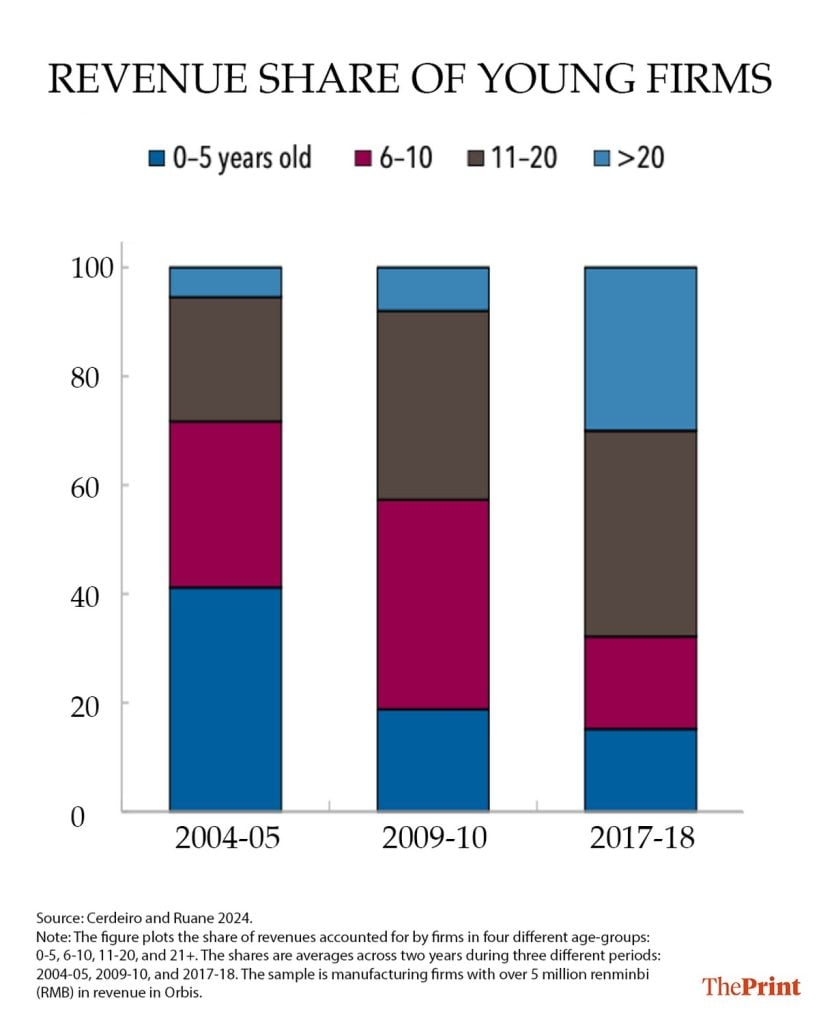
Specifically, among manufacturing firms, those established for less than a decade accounted for approximately 70 per cent of revenue in 2004-05, a figure that diminished to about 30 per cent by 2017-18. State-owned enterprises, on average, exhibit 31 per cent lower productivity than private firms, with capital productivity about half as high.
Despite this, these enterprises continue to receive preferential credit because they operate under what János Kornai described in Economics of Shortage (1980) as a “soft budget constraint”, allowing them to rely on state intervention for financial rescue.
In January 2024, a Hong Kong court ordered the liquidation of Evergrande, the parent company of a property conglomerate comprising approximately one hundred subsidiaries with liabilities of roughly $330 billion. This decision represented an exception that confirmed the prevailing norm.
Further, the IMF notes that the central bank’s credit-based policy tools disproportionately benefit large state-backed firms over smaller private enterprises.
This explains a paradox that confounds numerous analysts. In 2023, China was responsible for approximately 40 per cent of global patent filings, compared with 13 per cent for the United States. However, its total factor productivity growth has diminished by about half since 2007, falling to below 2 per cent.
A prior study by Antoine Dechezleprêtre and colleagues found that approximately 72 per cent of Chinese patents did not result in subsequent filings domestically or internationally, compared with 13 per cent of American patents. Nonetheless, the IMF suggests that this quality disparity may be narrowing.
Innovation requires an environment in which new firms can grow and unsuccessful ones are permitted to exit the market. As a result, the proposed amendments to China’s 2006 bankruptcy law, released in September 2025, which make it easier for failing firms to exit, represent some of the most significant reforms, despite receiving minimal attention.
The services sector provides a more optimistic picture. The IMF reports that China’s market services, including finance and information technology, show both high productivity and strong productivity growth. Nevertheless, services remain about 20 percentage points smaller as a share of the economy than in advanced economies, indicating growth potential once capital is no longer confined to inefficient firms.
A people too careful to spend
China’s households show a strong reluctance to spend. According to the life-cycle hypothesis proposed by Franco Modigliani and Richard Brumberg in 1954, people save during their working years to fund their retirement. Modigliani, with Larry Cao Shi in 2004, applied this hypothesis to explain China’s savings conundrum.
The dismantling of the “iron rice bowl”, which encompassed lifetime employment and enterprise-provided housing, healthcare, and pensions, occurred during the state-enterprise reforms of the late 1990s. This shift transferred risks to families, prompting Chinese households to save more, as predicted by Hayne Leland (1968) and Miles Kimball (1990) for individuals facing uncertainty.
Currently, household savings in China surpass one-fifth of GDP, a figure exceeding that of any OECD economy. Public expenditure on healthcare and social security constitutes about 3 per cent of GDP each, compared with OECD averages of 7.2 and 8.2 per cent, respectively. Urban households with rural hukou registrations save approximately 7 percentage points more than their counterparts with urban registration.
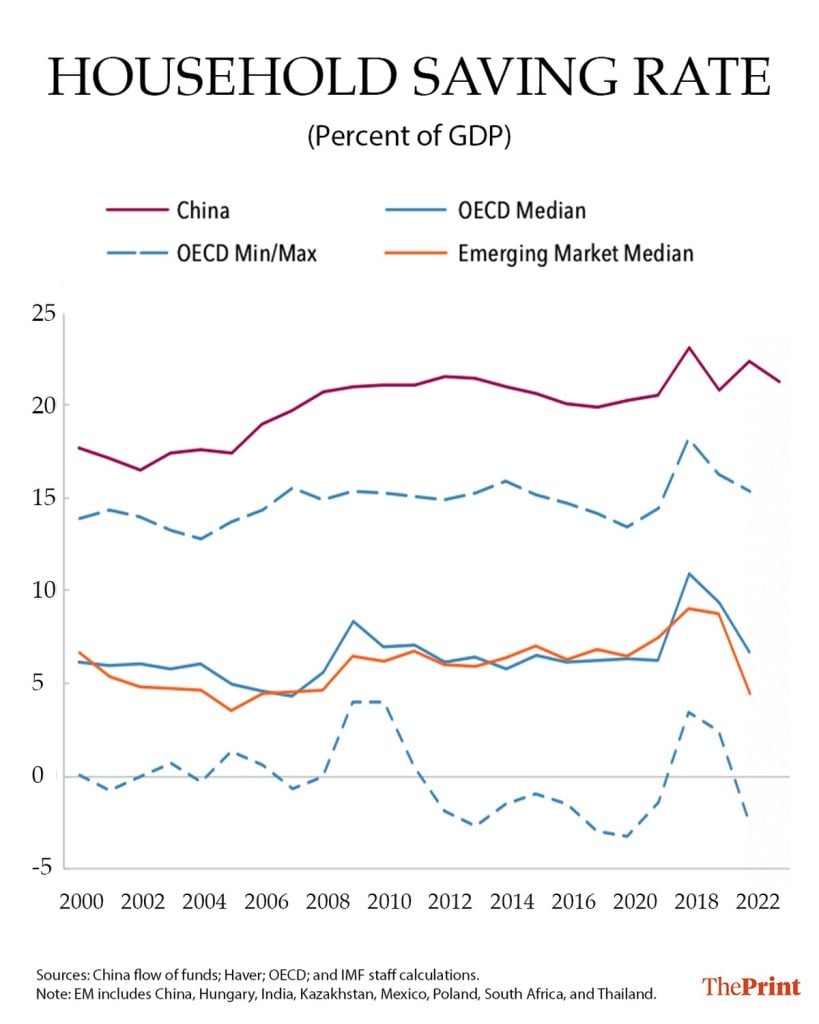
This is a phenomenon that Keynes identified as “the paradox of thrift”, in which the prudence that safeguards an individual household can harm the broader economy if universally adopted. From mid-2023 through 2025, consumer inflation in China remained below 1 per cent, illustrating how restrained spending has kept prices from rising much. This heightens the debt deflation risk described by Irving Fisher in 1933—where declining prices worsen debt burdens.
However, the solution is unexpectedly economical. Doubling the benefits of the Residents’ Pension Program, crucial for rural China, would incur an additional cost of 0.6 per cent of GDP by 2050 and potentially increase rural household consumption by approximately 4 per cent. This expenditure is a minor portion of the approximately 4 per cent of GDP that industrial policy consumed annually between 2013 and 2023, predominantly allocated to manufacturing, where capacity has expanded more rapidly than domestic demand.
Also Read: New India-US trade portal shows India is trying to liberalise and protect at the same time
What this means for India
This surplus capacity is where China’s decisions intersect with India’s interests. China’s current account surplus increased to 3.7 per cent of GDP in 2025, necessitating continued vigilance in Indian trade defence.
India has been actively developing alternative markets. The Comprehensive Economic and Trade Agreement (CETA) between India and the United Kingdom was implemented on 15 July 2026. Additionally, the Free Trade Agreement (FTA) between India and the European Union, finalised in January after nearly two decades of negotiations, is expected to be signed by year-end.
The broader trend favours India. Its economic growth is already driven by domestic demand and services, the very sectors the IMF is advocating for Beijing. The United Nations projects India’s working-age population to continue expanding through 2054, while China’s is expected to decline from 984 million in 2024 to 745 million by 2050.
In 1992, during Deng Xiaoping’s southern tour, he convinced a cautious China that pursuing wealth was safe. His successors face a more challenging situation, as China has inverted Lucas’s paradox and now experiences a scarcity of resources other than capital. The Chinese government must convince families that spending is secure, officials that halting construction is prudent, and banks that allowing failing firms to collapse is acceptable.
The crowded trains during this Golden Week indicate a continued desire for mobility among the Chinese populace, yet the empty cash registers suggest a lack of confidence in economic security. Regardless of how Beijing addresses this tension, India is strategically positioned to benefit.
Bidisha Bhattacharya is ThePrint Consulting Editor (Economics) and an Associate Fellow, Chintan Research Foundation. She tweets @Bidishabh. Views are personal.
(Edited by Asavari Singh)