




On 10 September, the Commerce Ministry directed Indian exporters to a government portal designed to facilitate connections with American buyers. This initiative is part of an articulated strategy to achieve $500 billion in bilateral trade with the United States by the decade’s end.
Although the announcement may appear modest and bureaucratic, it occurs at a significant juncture: merely six weeks following the imposition of a 10 per cent tariff by Washington on Indian goods, linked to a forced-labour investigation. This development follows a year in which Indian exports to the US experienced a marked slowdown, despite India having entered into five new free trade agreements over the past five years.
The introduction of a trade portal represents the government’s response to an unresolved strategic question: Is India aiming to increase its exports globally, or is it seeking to reduce its dependency on international markets? This question remains unanswered, even 35 years after the country nearly defaulted on its foreign loans. Historical data, extending back to the Second Five-Year Plan, illustrates the significant costs associated with this indecision.
From autarky to ambition
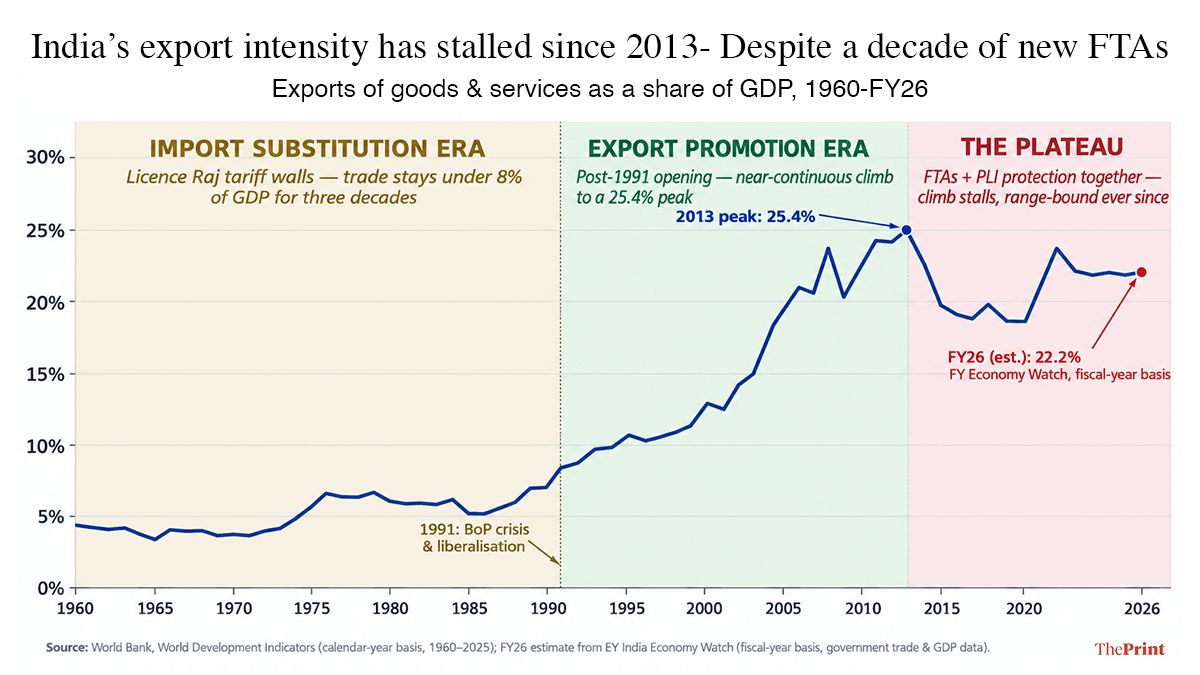
For nearly three decades following Independence, India structured its economy on a foundational principle: domestic production was prioritised, and foreign influence was minimised. This approach was intellectually supported by economist PC Mahalanobis, whose growth model, derived from Soviet economist Grigory Feldman, emphasised the importance of heavy industry over trade. This strategy was further bolstered by the Prebisch-Singer thesis, which asserted that commodity exporters faced a continual decline in terms of trade relative to manufactured imports, making self-sufficiency a logical choice. As a result, exports remained below 8 per cent of GDP for 30 years. This was not a policy failure, but rather a deliberate policy executed as intended.
The 1991 balance-of-payments crisis, during which India transported its gold reserves to the Bank of England to avoid default, necessitated a significant shift. This event marked the beginning of one of the most prosperous periods in Indian economic history: an almost uninterrupted 18-year growth trajectory. This trend aligned with economist Béla Balassa’s research on East Asia, which demonstrated that economies embracing openness experienced faster growth than those remaining closed. India’s exports increased from less than 8 per cent of GDP to a peak of 25.4 per cent in 2013. This period reflected India’s adoption of a successful strategy, which proved effective for two decades.
The plateau nobody talks about
Subsequently, the growth ceased, not through collapse, but rather a halt. Since 2013, exports as a percentage of GDP have remained largely stable. The latest estimate for the fiscal year 2026, which in India spans from April to March, indicates a figure of 22.2 per cent. Although this fiscal-year measure differs from the calendar-year basis used in the rest of the series, it conveys the same trend: remaining below the peak observed in 2013.
Both political factions partially acknowledge this. The Opposition accurately notes that trade openness has stagnated relative to the economy’s size. Conversely, the government correctly asserts that absolute export values and India’s share of global trade have continued to rise. This justifies the introduction of a new US-oriented trade portal as a significant development, despite the stagnant underlying ratio. Both perspectives hold validity because India’s economy has been expanding more rapidly than its trade sector, indicating a shift toward domestic demand rather than a withdrawal from global engagement.
The underlying cause of this stagnation is a subtle contradiction. Since 2014, India has simultaneously pursued export promotion and import substitution, albeit under new terminology. The Production Linked Incentive (PLI) scheme, a key component of India’s industrial policy, has directed over 64 per cent of its Rs 2.4 lakh crore cumulative investment into three primary sectors: solar modules, pharmaceuticals, and automobiles. Electronics and pharmaceuticals have utilised this support effectively; mobile phone production has increased approximately two and a half times, and India has transitioned from being a net importer to a net exporter of bulk drugs.
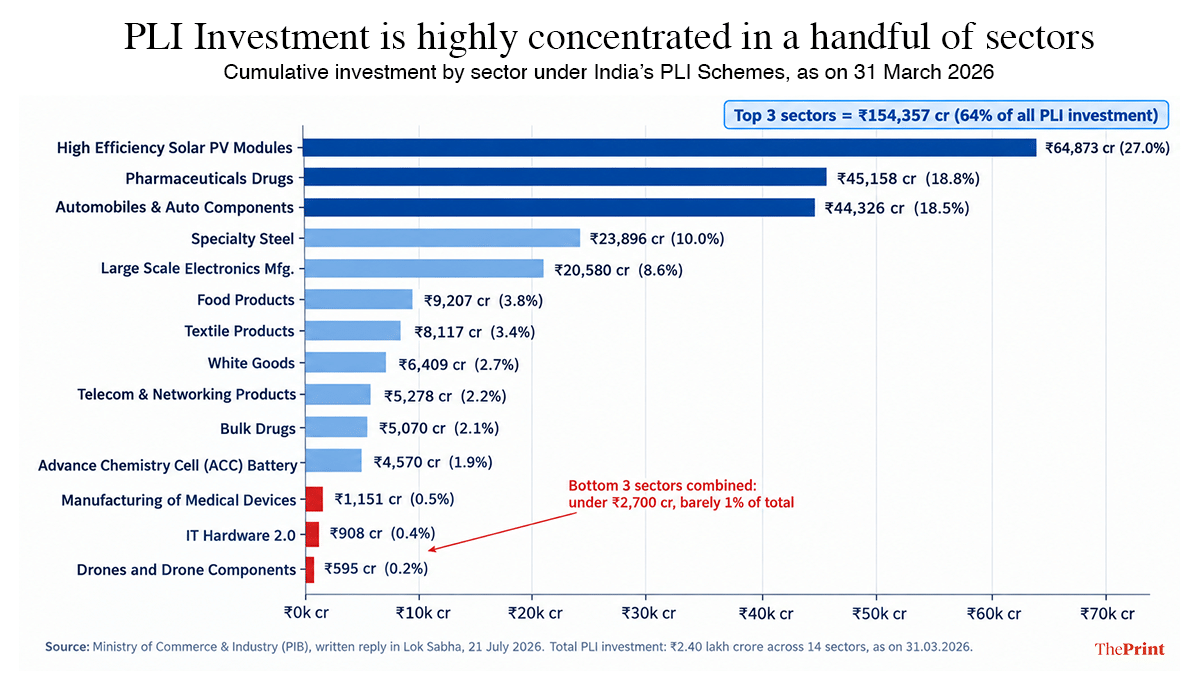
In sectors such as drones, IT hardware, and medical devices, which rank lowest in PLI investment, there has been minimal financial attraction. This situation does not signify failure. It aligns with what economist Dani Rodrik describes as the risk of premature deindustrialisation, wherein a developing economy’s manufacturing sector reaches its peak and stabilises before achieving the historically anticipated income level, unless protection measures are strategically calibrated and time-limited rather than indefinite.
At the same time, since 2022, India has entered into five significant trade agreements with Australia, Oman, the UK, the EU, and New Zealand. These agreements require the opposite approach: opening tariff lines to partner countries. Notably, the exclusion pattern across all five agreements is consistently evident. Dairy products are protected in each agreement, irrespective of the extent to which other tariff lines are opened, ranging from 7.9 per cent exclusion with the EU to nearly 30 per cent with Australia and New Zealand.
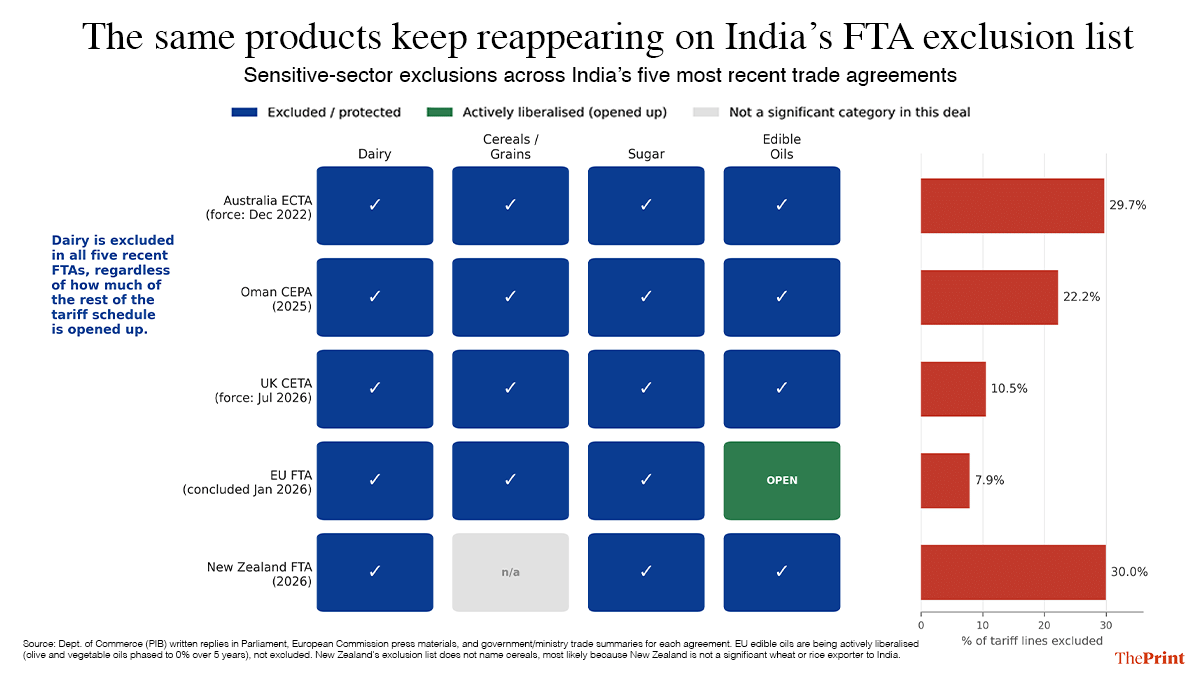
This argument is not incoherent; rather, it reflects the infant industry argument posited by Friedrich List and Alexander Hamilton. This argument is applied to 80 million dairy farming households, each with an average herd size of two to three cows, competing against New Zealand and European operations that manage approximately a thousand animals per farm, supported by substantial state subsidies. Economists describe the persistence of such protection, irrespective of the governing party, as a scenario of concentrated benefits and diffuse costs. In this context, a large, organised farming constituency advocates for a policy whose modest cost is imperceptibly distributed among a billion consumers.
Also read: India needs more buildings—and a fresh look at land acquisition financing
Growing up on schedule
The optimal approach is not to adopt either blanket protection or blanket liberalisation. Instead, it is essential to implement a readiness assessment on a sector-by-sector basis. Balassa, the economist who showed that outward-oriented economies grow faster than closed ones, also introduced a precise evaluation tool: Revealed Comparative Advantage.
This metric assesses whether a country’s share of global exports in a specific product surpasses its overall share of global exports. Currently, sectors such as electronics and pharmaceuticals meet this criterion. However, sectors like auto components, textiles beyond cotton, and IT hardware do not, with government data indicating a lukewarm response to incentives in these areas. These sectors present distinct challenges and should not be subjected to uniform policy measures indefinitely.
The distinction should take shape in three specific mechanisms rather than remain merely rhetorical. First, a numeric trigger should be established, employing Revealed Comparative Advantage or a similar competitiveness threshold, to ensure that sector protection is evaluated based on measurable performance rather than political convenience.
Second, apply a sunset clause to every PLI allocation and tariff protection, typically ranging from five to seven years, as suggested by most infant industry economists. This clause would ensure that support ceases automatically unless a new review justifies its renewal, rather than allowing it to continue by default.
Third, the government should establish a permanent institutional review body, potentially within the same Empowered Group of Secretaries that currently oversees PLI implementation. This body would publish sector-specific evaluations, thereby enhancing transparency in the process.
The concept of a trade portal linking exporters to American buyers is commendable, yet it addresses the symptom rather than the underlying pattern. India has spent three decades isolating itself and two decades dismantling those barriers. It now possesses the maturity and economic influence to undertake a task neither previous era required: to make deliberate decisions, sector by sector, regarding which industries are prepared to compete, which still require protection, and the precise timeline for phasing out such protection.
The 1991 crisis compelled India to act hastily. Currently, there is no such compulsion. As a result, the trajectory of the next economic indicator, whether it surpasses 25.4 per cent or remains stagnant, will reflect Indian economic judgement more profoundly than any crisis could.
Bidisha Bhattacharya is ThePrint Consulting Editor (Economics) and an Associate Fellow, Chintan Research Foundation. She tweets @Bidishabh. Views are personal.