




Hyderabad: Andhra Pradesh is doubling down to advance its sanitation protocol by integrating waste management and bringing all sanitation workers under one umbrella.
Taking a leaf out of the Clean Kerala Company Limited, a government-run initiative to holistically manage waste by involving communities, the Swachh Andhra Corporation (SAC) is looking to clear all its legacy waste, aiming for zero industrial cluster landfill dependency by 2030, Kommareddy Pattabhi Ram, Chairman of Swachh Andhra Corporation, told ThePrint.
The SAC is funded jointly by the Centre and the state.
There are three facets to Andhra’s plan to formalise its waste-management sector: First, clear its 1,500 kg of legacy waste by ensuring its dumpyards are cleansed; second, process all the waste through bio-mining to generate fuel; and finally, create a unified system to collect all waste through an app where citizens can directly have waste collected at their doorstep.
Waste-handling in Andhra and in India is fragmented and largely informal, with low accountability and efficiency, Telugu Desam Party (TDP) national spokesperson and chairperson Pattabhi Ram told ThePrint.
“Our initiatives through the Swachh Andhra Mission will not just institutionalise the sector through clear licensing, digital manifests, and dedicated collection networks, but also transform truck-by-truck, hand-to-hand transfers into an organised, auditable ecosystem that secures livelihoods and ensures no resource slips through the cracks.”
The larger policy directive comes from the state’s ‘Circular Economy Policy ’, which Andhra introduced in August 2025, to adopt a single, unified circular economy and waste recycling policy focused on all 11 industrial waste streams identified by NITI Aayog, including plastics, e-waste, used oil, ELVs, batteries, textiles, tyres, biomass, and metals.
Besides being the first state to introduce such a comprehensive policy, Andhra Pradesh localised it by incorporating state-relevant sectors such as animal husbandry and fisheries waste, the policy document released by the Industries and Commerce Department read.
Also Read: Andhra-bred non-Genetically Modified: New popcorn variety that could cut India’s corn kernel imports
Clearing legacy waste
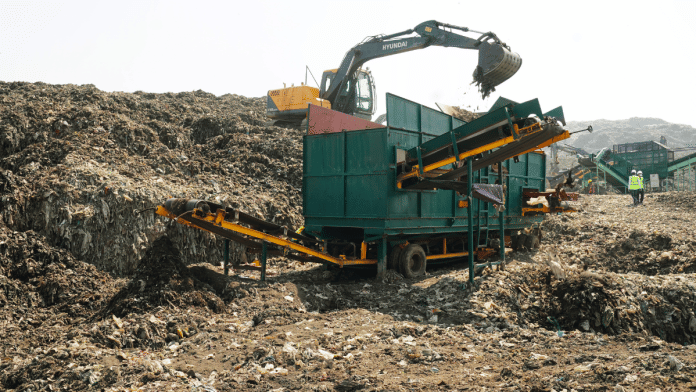
With more than 7,500 tonnes of waste generated a day across 125 urban local bodies and 660 mandals, the Swachh Andhra Corporation’s priority is to clear 1.5 tonnes of legacy waste in huge dumpyards outside major towns and cities, the chairperson said.
Unlike Bengaluru, Mumbai, and Pune, whose households already follow a clear waste-segregation method, Andhra cities have yet to catch up. Therefore, Andhra will spend about Rs 550 crore to set up waste segregation plants in all its municipalities and corporations, where waste collected from households is segregated and sent to different treatment plants based on its composition.
Once the waste is segregated into biodegradable and non-biodegradable, non-recyclable, dry refuse is transported to the two Waste-to-Energy plants in Guntur and Vizag, where more than 1,200 tons of waste can be processed per day. This waste is converted into refuse-derived fuel (RDF), which is used as an input for power plants, and the power is sold to the grid through Power Purchase Agreements (PPAs) signed with the private companies.
To speed up the process of clearing the dumpyards, the SAC would facilitate the setting up of four more waste treatment plants at Kadapa, Kurnool, Nellore, and Kakinada at Rs 300-350 crore per plant, SAC officials told ThePrint.
These plants would be set up by private players, with the state government contributing Rs 50-60 crore as viability gap funding (VGF), and the remaining amount being invested by the private company.
The wet waste generated is, in turn, converted to biofuel or enriched compost and then marketed to farmers through the MarkFed corporations. According to the officials, more than three lakh tonnes of bio-fertilisers can be generated annually through the waste stemming from Andhra’s households. The SAC has tied up with the Acharya NG Agricultural University seeking assistance in converting wet waste into compost.
“Even as industrialisation is the cornerstone of economic progress in Andhra, we want to be sure that we are the first to also deal with the critical environmental challenges it presents through waste generation. We aim to shift from a ‘use and throw’ model to a ‘use, recover, and reuse’ system,” Pattabhi Ram said.
App for waste collection
With the SAC’s larger goal also to ensure the scavengers, ragpickers, and sanitation workers are treated with dignity and are empowered financially, it is classifying their work under the organised sector. The first step is ensuring that the waste picked by these workers is directly sold to the municipalities, instead of traders and middlemen.
“The traders buy waste and plastic for Rs 10 per kilo from the ragpickers, and in turn, sell it to the recycling companies for Rs 40 per kilo. To eliminate the middlemen from the process, we are looking to form cooperatives for ragpickers, such as the Development of Women and Children in Rural Areas (DWCRA) or the Self-Help-Group (SHG) model. Once these groups become an entity, it would be easier to create bank accounts for workers at the bottom of the economic pyramid and transfer the gains to them,’’ a SAC official said.
A dashboard on the SAC website will reflect the quantity and category of waste collected and segregated at every municipality for the recyclers to directly buy it from the local bodies. According to Socio-Economic Caste Census (SECC) urban data reports, approximately 94,713 primary urban households or individuals were recorded with sanitation work as their main source of income in Andhra Pradesh.
In parallel, a mobile application for directly collecting paper, plastic, medical, and e-waste from households periodically is underway. Households or offices that have at least 10 kilos of waste to discard can place a request on the app, and the waste logistics professionals will collect the waste from homes. The app has been specifically designed to align with India’s new Solid Waste Management Rules, 2026 that came into effect on 1 April, replacing the older 2016 framework.
In addition to a four-stream waste segregation, the new rules call for an online portal where the lifecycle, collection, and processing of solid-waste is displayed.
Under the new rules, a Polluter-Pays-Principle has also been introduced where corporates and institutions who are found violating waste-segregation laws will attract strict fees by the Pollution Control Boards (PCBs).
“In such cases, the app could help large offices and gated communities that generate huge quantities of waste to collect and discard it on time through state-managed facilities,” the official told ThePrint.
(Edited by Tony Rai)
Also Read:Amaravati to get India’s first dedicated university for quantum tech, AI and other deep-tech fields