




New Delhi: The next round of Assembly elections, including in Uttar Pradesh, Punjab and Gujarat, is due in 2027, but political advertising on social media platforms such as Facebook and Instagram is already in top form.
An analysis by ThePrint of the political advertising targeted at the Uttar Pradesh voter on the two platforms showed that pages promoting the Bharatiya Janata Party (BJP) and Chief Minister Yogi Adityanath, or attacking the Opposition, cost about Rs 15 lakh between 4 August and 4 September, according to Meta’s Ad Library, the company’s public archive of political and issue advertising.
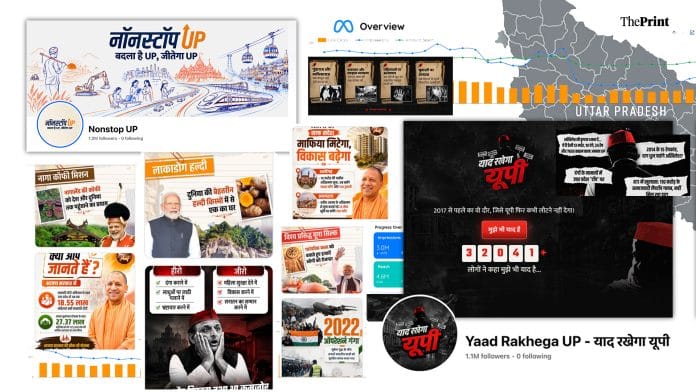
None of these pages names a party, yet each campaigns hard for the BJP. Three led the field. ‘Nonstop UP’ sold the state government’s record, spending about Rs 7.2 lakh. ‘Yaad Rakhega UP’ ran a campaign of roughly 200 ads against former chief minister and Samajwadi Party chief Akhilesh Yadav, at about Rs 5.63 lakh. ‘Bharat Todo Gang’ pushed Hindu-identity attacks on the Congress and the Aam Aadmi Party, for about Rs 1.53 lakh. A clutch of other BJP-branded pages followed.
Who runs these pages is not clear. Meta requires every political advertiser to carry a “paid for by” disclaimer, but on these pages that line names only the page itself. Two of the biggest, ‘Nonstop UP’ and ‘Yaad Rakhega UP’, run off their own websites, nonstopup.org and yaadrakhegaup.com, neither of which names an owner or operator.
No party has publicly claimed them, and nothing in the file ties them to a candidate, an agency or an office, which makes the money behind them hard to trace. Samajwadi Party spokesperson Naved Siddiqui said the pages, among them ‘Bharat Todo Gang’ and ‘Yaad Rakhega UP’, are BJP surrogates that run the party’s negative campaign at a remove.
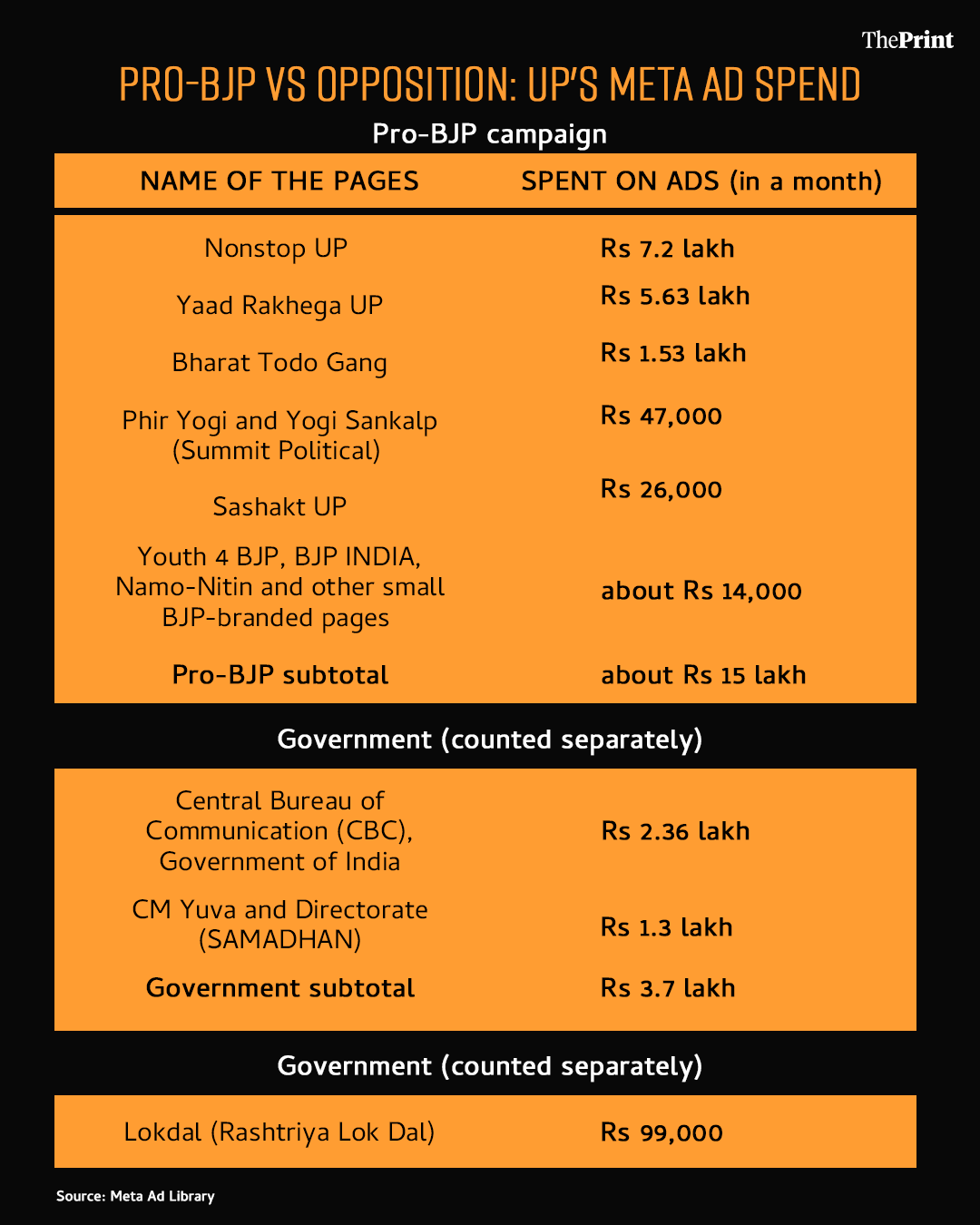
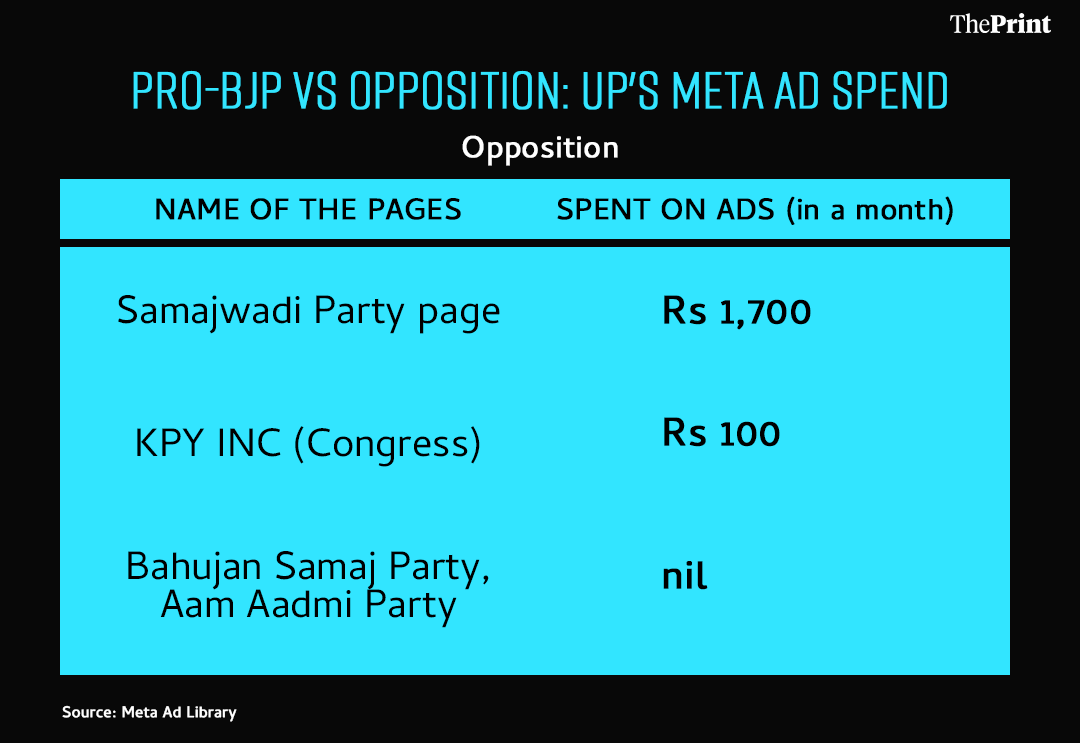
Pages that promote the Samajwadi Party or the Congress, by contrast, spent under Rs 2,000 between them. No page attacking the BJP or Adityanath appears at any comparable scale in the data. The Samajwadi Party page appears once, at about Rs 1,700, the Congress once, at Rs 100, and the Bahujan Samaj Party and the Aam Aadmi Party not at all.
The figures are a single month’s snapshot, and they cover a period well before the formal campaign-spending limits take effect.
This fits a pattern that recurs in Indian elections, said Kunal Purohit, a journalist and author of ‘H-Pop: The Secretive World of Hindutva Pop Stars’ Proxy advertising of this kind, he said, has become an integral part of the BJP’s campaigning against its political and ideological rivals.
Rhetoric the party cannot put out under its own name, because it is too polarising, is pushed instead through pages like these, which build a discourse that helps the BJP without being traced back to it. Such advertising, he said, surfaces “without exception” in every election cycle in the country, and Uttar Pradesh matters more than most, especially to the BJP.
What the pages post
The two biggest openly themed pages run the two halves of one campaign, each off its own website. Registered domains and steady output mark them as funded operations rather than one-off boosts.
‘Nonstop UP’ makes the positive case. Its ads set a “before 2017” scenario for Uttar Pradesh of hand-fans, power cuts and broken roads against a “today’s UP” of round-the-clock power and expressways. They claim nine lakh government jobs in nine years, “without a bribe, without a slip”, and a state economy that has grown from Rs 13 lakh crore to over Rs 30 lakh crore.
Others credit the government with replacing “gunda-raj” with the rule of law, and show a bulldozer, Adityanath’s signature symbol of demolition as enforcement, flattening the mafia’s fort. Still others sell the temple economy of Ayodhya, Mathura and Kashi.
Adityanath runs through all of it, under the hashtags #YogiAdityanath, #BulldozerBaba and “BJP Modi Yogi”.
The Samajwadi Party is jabbed in passing: Once the cycle, its symbol, “was punctured”, one ad says, “the arrogance deflated”. A recurring card asks viewers to sign up on the page’s website, which turns the ad into a way of collecting supporters’ data. The line that names the payer reads only “Nonstop UP”.
‘Yaad Rakhega UP’, or ‘UP will remember’, is the reverse case, and with about 200 ads the busier of the two. Its reels, set to trending audio, carry one message, that Uttar Pradesh under the Samajwadi Party before 2017 was a time of fear, riots and mafia rule. They invoke the 2013 Muzaffarnagar riots, which broke out under the previous SP government, and the slain gangster-politician Atiq Ahmed.
They allege a scam in the free laptop scheme that was a flagship of Yadav’s 2012-17 tenure, and they say women were unsafe. Yadav is “Tipu” a jibe the BJP has long thrown at him; his party the “red-cap looters” its rule “jungle raj”. The appeal is openly electoral. One card tells viewers to “save UP from returning to the era of misrule”. Even so, no party appears on the “paid for by” line.
‘Bharat Todo Gang’ carries the attack from the state opposition to the national one. Its ads are delivered in Uttar Pradesh but drawn from across the country. They ask why the Congress “hates Vande Mataram”, and one image card calls the party “Muslim League 2.0”.
Others go after the Aam Aadmi Party over the Delhi riots conviction of a former councillor; and over Punjab, and accuse the Opposition of mocking Hindu saints outside Parliament. Each ad ends by inviting a comment, which lifts engagement and, with it, reach. Every ad works against the BJP’s rivals, and none names a party.
Pages that campaign without a party
The three leading pages share a method rather than a badge. Each takes a clear electoral position, to lift the incumbent or sink the challenger, while the disclaimer that should reveal who is paying names only the page. This is the mark of a surrogate, or shadow, advertiser, a feature of recent Indian elections: Campaign money that never enters a candidate’s account, and so escapes the spending ceiling the Election Commission enforces once the code of conduct is in force.
In any case, for now there is no code and no ceiling, and the pages spend without limit. Two of them, with registered websites and hundreds of ads between them, read as managed operations rather than fan pages.
In the past, these pages have often exploited gaps in Meta’s enforcement: Advertisers are asked to share registration and address details, but many party-aligned pages do not, which lets fictitious entities spend on a party’s behalf with no accountability.
Meta also has a policy against what it calls coordinated inauthentic behaviour, meant to remove networks of pages that hide their links while pushing the same line. Pages that only ever run down the Opposition in UP are, in his view, fit cases for that rule, yet Meta does not act on them. He contrasted this with 2020, when Facebook removed hundreds of pages running such campaigns for the Congress, and said no comparable action has followed against pages working for the BJP.
ThePrint reached out to Meta but received no reply. This report will be revised if and when there is a response.
The imbalance is, as pointed out, in the method. Advertising that takes an identifiable side runs for the BJP, or against its rivals, by more than a hundred to one over anything the Opposition puts up. The parties are largely absent from their own contest. The pages that speak for them are not.
‘This is not our way’
The Samajwadi Party rejected any suggestion that it runs such pages, and turned the charge back on the BJP. Its spokesperson Naved Siddiqui said the surrogate and attack pages, among them ‘Bharat Todo Gang’ and ‘Yaad Rakhega UP’, work for the BJP and it was low for a party that calls itself the largest in the world to operate this way.
Siddiqui said no such “song ads” appear on any Samajwadi Party page, and that whatever circulates on WhatsApp in the party’s name does not come from it. A viral video by Yadav that national media read as the SP descending to the same tactics was, he said, only a reply, meant to show that if this could be done for the BJP, the party’s own youth and workers could do it too.
The SP’s own approach, he said, is different. For more than a year, since last July, the party has put out Yadav’s statements in full as daily audio, in the evening, under a tagline he rendered as “listen, don’t watch”, voiced by Siddiqui, who comes from radio, so that workers hear the complete statement rather than the single clip the press lifts from it. On the BJP’s spending, he said the party advertises so heavily that its posts reach even people who do not follow it, which can move undecided voters toward Adityanath.
The BJP’s social media head in Uttar Pradesh, Himanshu Raj, distanced the party from pages such as ‘Nonstop UP’, ‘Yaad Rakhega UP’ and ‘Bharat Todo Gang’. No one controls third-party pages, he said. Anyone could set one up in anyone’s name, and no one claims them.
Raj said the party’s own social media work runs along three lines. The first is promoting the government’s record through its beneficiaries and outreach programmes, using unscripted, raw footage of people whose lives, he said, have changed. The second is a before-and-after narrative that sets the state before the BJP came to power and since, particularly on policing and crime. The third is fact-checking, which he said works two ways: Showing the before-and-after of the government’s own work, and countering the fake and edited videos and news that spread in what he called the age of AI, pushed out by local YouTubers and others.
The party is now moving toward short videos, Raj said, 30-second clips built around a single clear message, and is putting together a new team of pro-BJP influencers. Instagram is the next focus, he added, citing the platform’s role in the recent Gen Z protests and the party’s drive to reach younger voters.
Government, and an ally
Two kinds of spending sit apart from the Rs 15 lakh because they are not party money. Government pages promoting official schemes spent about Rs 3.7 lakh. The largest is the Central Bureau of Communication, or CBC, the Union government’s advertising arm, at about Rs 2.36 lakh, with the state scheme pages “CM Yuva” and “Directorate” at about Rs 1.3 lakh.
A page for the Rashtriya Lok Dal, a partner in the National Democratic Alliance, spent about Rs 99,000. Government advertising is official expenditure rather than campaign spending, though it carries the ruling party’s record into the same feed in the months before a vote.
The money that names no side
The advertisers above are a fraction of the state total. The biggest spenders declare no affiliation, and the data assigns them none. The single largest is not a campaign at all. Inpix-App, at about Rs 15.7 lakh, more than a tenth of the state’s Rs 1.36 crore, is a mass-market personalisation app from the news company Inshorts.
It lets a user drop their own name and photo into ready-made cards: Good-morning messages, festival and devotional greetings, quotes laid over pictures of leaders and icons. It sits in the same category as the political-poster apps that party workers of every stripe use to make campaign graphics, and it is that festival-and-politics content, open to a supporter of any party, that pulls the app’s own promotions into Meta’s political archive.
Its spending says nothing about a side, because it serves all of them. The next tier is a business. Three linked advertisers, School of Politics, Political Academy Private Limited and Postly, pay for a set of near-identical pages, “Post Share”, “Share Post”, “Post Karo” and “PostKaro”, and spent about Rs 12.4 lakh in the state between them. What their ads say, and for whom, is not disclosed. Most of the money in this file moves in this way, through an app, a commercial network and news-style pages, and not through anyone who has to account for it.
Concentrated market, and a caste marker
The market is concentrated. Ten pages account for about 40 percent of the Rs 1.36 crore, and fifty pages for about 58 percent, while roughly 1,260 entries sit at the Rs 100 level.
The state’s caste arithmetic shows up in the file as well. Among 133 Hindi-named pages, together worth about Rs 4.85 lakh, one is titled ‘Pasi Ekta’ and carries the disclaimer “Jai Pasi Samaj”.
(Edited by Viny Mishra)
Also read: The BJP’s digital monolith has cracked. Will it collapse?