



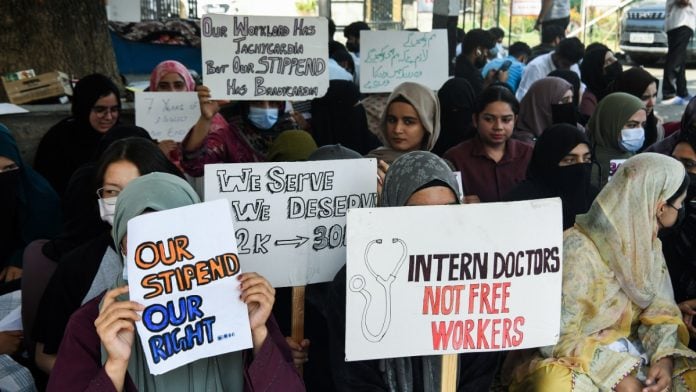
New Delhi: There cannot be a fixed pan India stipend amount for medical interns, but states can explore fixing a stipend amount, made uniformly applicable to all medical colleges in that state, a senior National Medical Commission (NMC) official told ThePrint, adding that the state policy will be subject to interpretation of the statutes and various judgments passed by the courts from time to time.
The proposal, pending with the NMC since December 2025, seeks to examine stipend parity and non-payment of stipends for undergraduate MBBS interns across government and private medical colleges.
Separately, resident doctors’ bodies and medical care activists have demanded a uniform minimum stipend across states and institutions under the broader “One Nation, One Stipend” campaign.
On the demand for nationwide stipend parity, the NMC official said, “One stipend cannot be given across the country. That is difficult because smaller states, whose financial allocations are lower, cannot give such a big stipend. The stipend amount has to be decided by the respective states only and it is exclusively within their regulatory domain.”
The NMC recognises the disparity in stipend payments to medical interns, the official said, adding, “The broader principle should be that no intern should be left without stipend, including foreign medical graduates (FMGs) undergoing compulsory internships in India.”
The comments come after the Ministry of Health & Family Welfare wrote to the NMC on 6 November 2025 and sent a reminder in December, asking it to examine the issue of stipend parity and reported non-payment of stipends to some FMGs. Concerns were also raised over large differences in payments between government and private medical colleges.
At present, the NMC’s Compulsory Rotating Medical Internship (CRMI) Regulations, 2021 say medical interns should be paid a stipend “as fixed by the appropriate authority applicable to the institution/University or State”.
Simply put, this means the NMC rules do not set one fixed amount for every medical intern. The amount can be decided by the state or the authority applicable to the medical college. However, the NMC official said the commission has issued clear-cut instructions that there cannot be any disparity in the stipend paid by an institution to an FMG and an Indian medical graduate (IMG).
The issue took on another layer of complication after the NMC’s Postgraduate Medical Education Regulations, 2023 included a provision saying junior residents (JRs) should receive a stipend on par with junior residents in a state government or central government medical institution in the state or Union Territory where their college is located. This meant that a junior resident in a private medical college would be entitled to the same stipend as a junior resident in a state-run medical college in the same state or Union Territory.
In February 2026, the NMC’s Undergraduate Medical Education Board (UGMEB) said any change to the 2021 regulations would require a statutory process and consultation with the concerned authorities. The issue has remained unresolved even as medical interns in several states have protested over low and varied stipends.
In Jammu and Kashmir, for instance, MBBS and BDS interns began an indefinite protest on 31 August, seeking that their stipend be hiked to Rs 30,000 from Rs 12,300. In Madhya Pradesh, medical interns demanded an increase from Rs 14,337 to Rs 30,000. The state subsequently raised the stipend to Rs 21,500.
Uttar Pradesh doubled the monthly stipend for MBBS and BDS interns in government medical colleges from Rs 12,000 to Rs 25,000, while Bihar increased it from Rs 20,000 to Rs 27,000. Uttarakhand also raised its stipend to Rs 25,000.
Apart from states paying different amounts, some interns have also complained of non-payment or much lower amounts than the applicable state rate.
NMC data for 2025 showed that 60 of 555 medical colleges had not paid stipends, while several others reported payments of less than Rs 5,000 a month.
The Supreme Court has also been examining the issue of unpaid stipends. In an October 2025 order, the court questioned the NMC over delays in taking action against colleges that had not complied with its directions on stipend information, observing that the regulator appeared to be “dragging its feet”.
The issue has also come up in cases involving FMGs, or doctors who obtained their medical degrees outside India and have to complete a compulsory internship in India to obtain registration to practise. In February 2026, the Supreme Court directed authorities to pay pending stipends to a group of FMGs who had completed their internships at Aligarh Muslim University, holding that similarly placed FMGs could not be treated differently from those who had received stipends.
The senior NMC official told ThePrint that only recently a monetary penalty was imposed on eight institutions by the Under-Graduate Medical Education Board (UGMEB) for failing to furnish stipend-related information. The Commission would be taking strict action against institutes that do not follow the applicable stipend rules, the official said.
Adding, “We are going to be more vigilant and more strict. We will be taking disciplinary action against institutes that violate the stipend rules, because there is a clear-cut direction from the Hon’ble Supreme Court. The penalty will not only be financial. If an institute does not comply, its accreditation may also be affected.”
(Edited by Amrtansh Arora)
Also Read: Why National Medical Commission is rethinking plan on 3-year rotation of medical college HoDs