



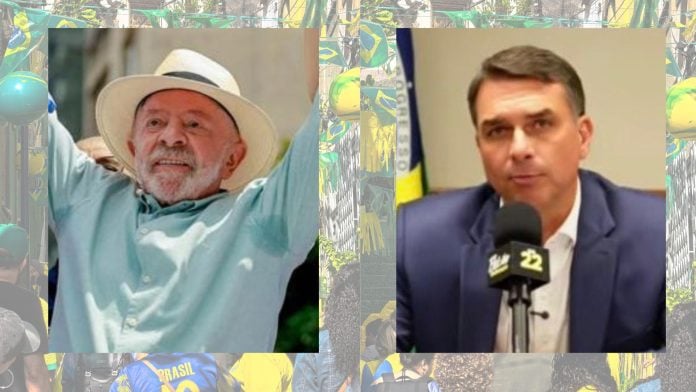
New Delhi: Brazil, the world’s fourth largest democracy, is set for a tightly-contested election Sunday, as incumbent President Luiz Inácio Lula da Silva (Lula) goes up against Flávio Bolsonaro, his predecessor’s son and a senator representing Rio, in a blazing Right-Vs-Left battle that will usher South America’s largest economy into its next chapter.
Lula, 80, who is seeking a second consecutive and fourth overall term as President, maintains a narrow lead over Bolsonaro, 45, in the latest opinion polls conducted across the country. Datafolha, the polling institute that belongs to the same group of companies as the newspaper Folha de S.Paulo, indicates that 45 per cent of voters are likely to vote for Lula, and 40 per cent for Bolsonaro in the first round of elections Sunday. If no one wins over 50 per cent of the vote, the election will proceed to a second run-off round on October 25.
Flávio is the son of former Brazilian President Jair Bolsonaro, who lost the last election, in 2022, to Lula, and was eventually tried and convicted, and sentenced to 27 years imprisonment for attempting a coup d’etat following his loss (he is currently under house arrest). The younger Bolsonaro is currently a member of the Brazilian Senate, the upper house of the country’s bicameral federal legislature.
Other polls show a neck-to-neck race between Lula and Bolsonaro. There are an estimated 160 million eligible voters in Brazil.
Also Read: BRICS Summit 2026: 13 world leaders in town. A look at who and why this matters
The different planks
The two leading candidates are diametrically opposite to one another in every realm: be it foreign policy, domestic policy, or support for President Donald J. Trump’s administration in Washington.
Lula, who led the polls till at least July, has been locked in a back-and-forth with Trump since the US President imposed tariffs of 50 per cent last year, partly due to the conviction of Jair Bolsonaro, with whom the American President maintained a close relationship.
However, Lula’s lead has been cut down by the younger Bolsonaro following a scandal involving Supreme Court Justice Alexandre de Moraes, who jailed Jair, and took on rioters who tried to overturn the 2022 election results as well as the world’s richest individual—Elon Musk—and his micro-blogging platform.
Justice Moraes is seen in Brazil as closely linked to Lula. The race is further complicated as, apart from the presidential election, the Brazilian voters will also be electing two-thirds of the Senate, all of the seats of the Chamber of Deputies (lower house), governors, vice-governors and all legislative seats to the federative legislatures.
ThePrint explains where the race stands, and what’s at stake for South America’s leading economy, and one of India’s closest partner countries in the region, one that is a member of BRICS, G20, IBSA (India-Brazil -South Africa trilateral), and the G4 (an alliance of India, Brazil, Germany and Japan, seeking permanent seats at the United Nations Security Council).
The presidential election
At the heart of the presidential election are the differing views of Lula, who turns 81 later this month, and Bolsonaro. Lula has long been the face of the Workers Party of Brazil (PT), and was a part of the pink tide that drove a number of Centre-Left candidates to power across South America in the first decade of this century.
From Venezuela to Argentina, a majority of the South American nations were largely run by Centre-Left leaders from around 2002 to 2011. By 2018, the tide had changed, with these countries witnessing a conservative wave, which saw leaders such as Bolsonaro come to power.
Several countries in the region have seen a similar wave in the latest elections, including Argentine President Javier Milei, who was elected in 2023. This year has seen Colombia elect a Trump-backed candidate, while Keiko Fujimori, daughter of Peruvian dictator Alberto Fujimori, won the general election in Peru in June.
Lula remains one of the last Leftist leaders to maintain popular support, although Datafolha’s latest poll shows that more people view his government’s performance negatively (41 per cent) than positively (35 per cent). Roughly 49 per cent of voters disapprove of Lula, while 48 per cent of voters approve of him personally.
Lula has pitched cementing Brazil’s defence industry as the core of his campaign, using the argument of Brazilian sovereignty amid concerns over US interference in the region under Trump. The country’s military, which controlled the country for 21 years, has had a difficult relationship with the Left, and is perceived to be closer to the Right. Some of its officers were allegedly part of Jair Bolsonaro’s coup d’etat plot.
Flávio Bolsonaro, meanwhile, favours a policy of privatisation, and closer alignment with the Trump administration, and has a track record of being against social inclusion policies. Furthermore, he has promised to pardon his father if elected to power.
The presidential election will also reshape Brazilian institutions for the foreseeable future, as the candidate who wins will have the chance to fill growing vacancies in key institutions such as the federal supreme court and central bank.
Regardless of who wins, the next president of Brazil is likely to deal with a divided Congress that is seen likely to tilt to the Centre Right for the next four years. In recent years, both the houses that make up the bicameral legislature have seen their role grow. In 2025, the Brazilian National Congress passed 178 bills, of which 128 were proposed by legislators, and 50 by the executive, as reported by Reuters.
In 2007, the number of bills passed by the Congress was largely driven by the executive, who proposed 142 legislations, versus 52 from legislators, according to Reuters. The growing power of the Brazilian parliament was seen earlier this year in April, when the Senate rejected Lula’s nominee to the Supreme Court. This was the first time in over 130 years that a Brazilian Supreme Court Justice was rejected.
The Supreme Court scandal
The Supreme Court scandal plaguing Lula revolves around Justice Moraes and his alleged links to banker Daniel Vorcaro. Vorcaro, a 42-year-old banker is at the centre of an alleged multi-billion dollar fraud—the Banco Master scandal—which has burnt both Bolsonaro and Lula.
Banco Master, a mid-sized lender headquartered in Sao Paulo, was led by Vorcaro, with the institution promising high returns—as high as 140 per cent relative to Brazil’s inter-bank rate —to investors purchasing their schemes.
The bank did not have the assets to maintain the promises it made. In November 2025, the Central Bank of Brazil called for the forced liquidation of the bank. Prosecutors allege that the liquid assets that the bank did own were diverted to shell accounts. Vorcaro has since been arrested and charged with money laundering and fraud.
Recordings indicate that Senator Bolsonaro solicited Vorcaro for millions of dollars in funding, and promised to stand by his side a day before the banker was arrested earlier this year. Bolsonaro sought funding largely for a movie titled “Dark Horse” based on the story of his father Jair Bolsonaro.
While the Banco Master scandal directly implicates Bolsonaro, it has also helped him narrow Lula’s lead because of the controversy’s alleged links to Justice Moraes. A colleague of Justice Moraes released documentation alleging Vorcaro sent messages to the Supreme Court Justice seeking legal advice. There is no clarity on whether Justice Moraes responded to the messages.
The younger Bolsonaro has run a campaign stating that a “vote for Lula is a vote Alexandre de Moraes”, which has had some impact on polling numbers.
Edited by Sunanda Ranjan
Also Read: India-led BRICS focusing on ‘candid conversations’ to find consensus for joint statement