



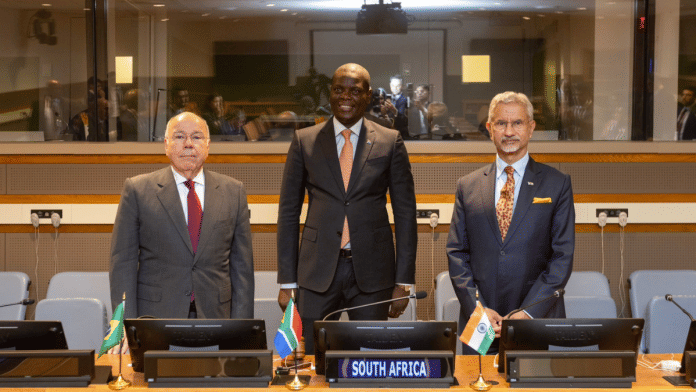
New Delhi: In a strong statement on recent geopolitical events, India, Brazil and South Africa rejected the use of force against, “territorial integrity or the political independence of any State,” while also repudiating the imposition of unilateral sanctions and other “coercive measures”.
The media statement of the IBSA (India, Brazil, South Africa) trilateral ministerial commission meeting on the margins of the United Nations General Assembly (UNGA), published Monday, called on developing countries and the “Global South” to expand the opportunities provided by the “contemporary” multipolar world to drive global change.
The foreign ministers of the three countries—S. Jaishankar of India, Mauro Vieira of Brazil and Ronald Lamola of South Africa—met last Thursday on the margins of the UNGA. The full statement of their deliberations was published Monday by the Ministry of External Affairs (MEA).
“The Ministers expressed a growing concern over the persistent attacks on multilateralism and grave violations of the United Nations (UN) Charter and international law, they reiterated their firm rejection of the use, or threat of use of force, against the territorial integrity or the political independence of any State, as well as the repudiation of the unlawful and illegitimate imposition of unilateral coercive measures that are contrary to international law which have had, amongst others, a negative impact on socio-economic development,” the media statement said.
“The Ministers agreed that, in the context of the contemporary realities of the multipolar world, it is crucial that developing countries strengthen their efforts to promote dialogue and consultations…They acknowledged that multipolarity can expand opportunities for Emerging Markets and Developing Countries (EMDCs) to develop their potential and enjoy universally beneficial, inclusive, sustainable and equitable economic globalisation and cooperation,” it added.
The call for greater cooperation among the developing countries comes as tensions have risen sharply in the last few months. The US-Israel war on Iran has impacted fuel prices, while navigation through the Strait of Hormuz remains a challenge. While not naming any specific country, the IBSA foreign ministers also pushed for ensuring the “unimpeded flow of global trade, supply chains and energy, safety and security of seafarers and merchant vessels”.
The continuing US-Iran war, with reports indicating potential for further escalation, has raised the cost of crude to roughly $100 a barrel. While oil prices have fluctuated as the two sides announced a ceasefire in June. However, the recent continued attacks, along with the renewed hostilities in Yemen, near the Red Sea between the Ansarallah and the Saudi-backed government forces have led to the recent surge in oil prices.
The US has also passed legislation, which would allow President Donald Trump to impose higher tariffs on countries continuing to trade with Russia and Iran—a unilateral measure which India has strongly pushed back against.
The three foreign ministers also sharpened the language on the situation in Palestine, calling for the “halting” of any “policies aimed at the forced displacement of Palestinians from the Gaza Strip and expressed concern regarding arrangements that may prejudice the inalienable rights of the Palestinian people”.
The three countries also cooperate in other platforms such as BRICS, and the recent joint leaders’ declaration had roughly five paragraphs on the situation in Palestine. However, the latest language is one of the stronger languages coordinated by the three countries.
South Africa has taken Israel to the International Court of Justice over its conduct of the war in Gaza, accusing Tel Aviv of potential war crimes. India has a strong relationship with Israel, while being one of the longest supporters of the Palestinian state.
For India, the key parts of the final media statement lies in the paragraphs on artificial intelligence, climate change and security council reform, according to a readout of the meeting published by South Africa last week.
The IBSA Foreign Ministers called for hastening the reform of the UN Security Council (UNSC), to include the country from Africa—a continent which has no representation amongst the permanent five members —as well the “legitimate aspirations” of India and Brazil to have a permanent seat in the Council.
(Edited by Tony Rai)