



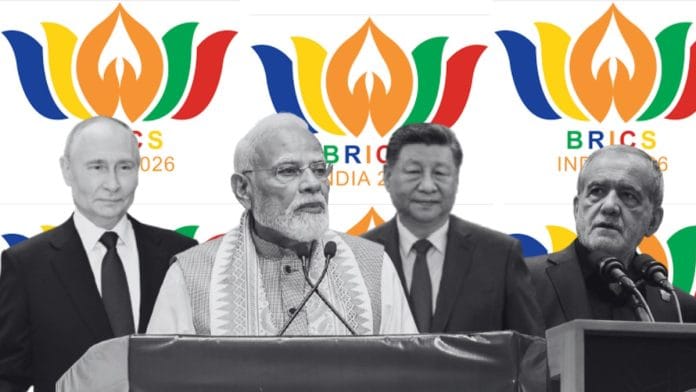
New Delhi: India and other BRICS members have been holding candid discussions on territorial integrity, free flow of maritime commerce and protection of civilians and civilian infrastructure in an attempt to find consensus for a joint statement, ThePrint has learnt.
The aim is to find “landing zones” which could allow the 11 members to agree to a joint statement when they meet in New Delhi on 12-13 September. The West Asia war has continued to split the organisation, as both Iran and the United Arab Emirates—both members of BRICS—are on opposing sides of the conflict.
A senior government official said, “India has always pushed for dialogue, diplomacy and de-escalation. Under its chairship, candid conversations amongst the 11 member-states has led to discussions on the need for free flow of maritime commerce, protection of territorial integrity and sovereignty and the protection of civilians during the conflict.”
“Discussions on the final leaders’ joint statement are ongoing through the Sherpa track. Another Sherpa meeting will be held before the leaders’ summit next month. We are focusing on finding landing zones where consensus can be found,” the official added.
India, chair of the organisation since 1 January, will be holding the BRICS leaders summit on 12 and 13 September in the national capital. The summit is expected to see the Presidents of China, Russia and Iran in attendance, as reported by ThePrint.
As a part of its efforts, India has attempted to be a “transparent” arbiter of discussions engaging with all members of the grouping, allowing for deeper discussions on the West Asia war. India’s previous efforts at finding a consensus on this issue did not lead to a joint statement at any of the ministerial meetings till date.
At a meeting of the representatives of the Middle East and North Africa earlier this year, the delegations had major disagreements on two topics—India’s proposed language on the conflict between Israel and Palestine, and differences between Iran and the UAE on the conflict in West Asia.
A following meeting of foreign ministers’ chaired by New Delhi saw consensus on the language regarding Palestine and Israel, but Tehran and Abu Dhabi continued to spar over the language regarding the US-Israel war with Iran.
India has in the past been able to achieve consensus on extremely difficult topics when it chaired the G20, especially with regards to the Russia-Ukraine war. However, Ukraine was not part of the deliberations of the grouping as it is not a member.
No proposal for de-dollarisation
The senior official quoted earlier underlined that there is no proposal within the organisation to create a separate reserve currency to compete with the US dollar. The focus remains on more technical measures to reduce the transaction costs for bilateral trade. “There have been discussions on practical mechanisms to reduce transaction costs for bilateral trade, which is not aimed at any third country.”
The eleven-member grouping has come under criticism from US President Donald Trump, who has threatened to penalise BRICS members with tariffs in the event they move to de-dollarise the global economy and trade in a different currency.
The official added that BRICS has no plans on expansion at the moment, with the focus on consolidating and bringing the six new members into the overall processes of the organisation.
While BRICS originally was a grouping of Brazil, Russia, India, China and South Africa, it expanded in 2024 to include Egypt, Ethiopia, the UAE, Saudi Arabia and Iran. Indonesia joined the organisation in 2025.
While Saudi Arabia has remained mum on its official acceptance, the senior official said Riyadh has been invited to attend the New Delhi summit as a member of BRICS.
The BRICS summit has also seen heads of a number of regional organisations including the African Union, Community for Latin American and Caribbean States, the Gulf Cooperation Council and the Bay of Bengal Initiative for Multi-Sectoral Technical and Economic Cooperation invited.
This is India’s fourth time chairing the BRICS after the 2012, 2016 and 2021 summits.
(Edited by Gitanjali Das)
Also Read: NSA Doval in China for border talks amid Arunachal tensions and ahead of SCO, BRICS summits
Is resistance, opposition to the West embedded in the DNA of BRICS. Perhaps not. It started out as an economic grouping of promise, commodities – either producing or importing – a part of it. The presence of China and Russia did create a latent tension with USA and Europe. Whereas India’s conscious choice of the West as economic / strategic partner provided a sense of balance. 2. The exceptionalism of Trump 2.0 is creating a new dynamic. It is reducing space for international cooperation. Even in the sphere of globalisation, which has benefited almost everyone. Unsurprisingly, President Trump is resolutely opposed to BRICS. Kept Argentina out, trying to do so with Saudi Arabia as well. De dollarisation gets his goat. Not even comfortable with member states using their currencies while dealing with each other. 3. India has long talked of Strategic autonomy. BRICS is the ideal forum to put it into practice.
India is an expert for issuing statements and doing zero work later.
With President Putin and – likely – President Xi in attendance, a unanimous communique is imperative. A statement from the Chair will simply not suffice.