



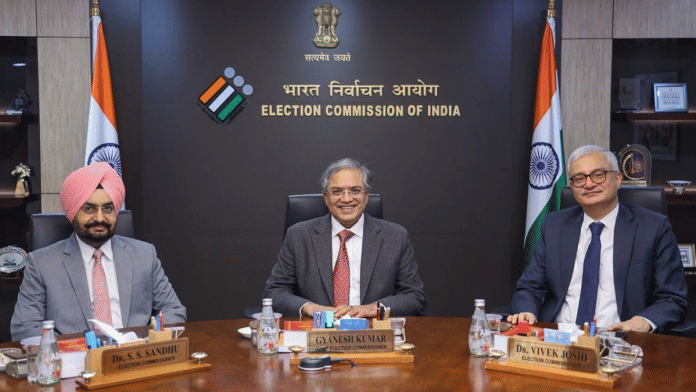

At the outset, let me clarify that this is not a column for or against Chief Election Commissioner Gyanesh Kumar and his fellow Election Commissioners, Sukhbir Sandhu and Vivek Joshi, all of whom have been my colleagues in the IAS. The point to note is that the Election Commission’s efforts to ‘clean up’ the electoral rolls through SIR have divided political opinion in the country like never before. Adding to the controversy are newspaper reports that the three commissioners have not been unanimous on critical matters, and the challenge to the 2023 ECI Appointments Act itself.
The ruling party and its many supporters in the media have defended the actions of the CEC, while the Opposition and many other newspapers have been equally, if not more, vehement in their critique. The CEC’s selection, too, is now in the middle of a storm. Well, the media has always given us different, and often opposing, perspectives—which is what makes it the fourth pillar of democracy. But what is disconcerting is that this matter has put former members of the bureaucracy, the higher judiciary, legal experts and jurists in different camps.
While a former Solicitor General has said that the Supreme Court has taken cognisance of the matter and one must await the outcome, other equally prominent judicial minds have asked for action against the CEC even before adjudication. My cadre, batch, school, college, JNU, civil services veterans’ group and walking partners are all equally divided. I have read with interest the defence of the Commission by former civil servants such as Madan Gopal and Bhaswati Mookerjee in an open letter, and the equally powerful riposte by KBS Sidhu.
During the past few days, I have been inundated with material on how Gyanesh Kumar was certainly less controversial (at the time of his appointment) than Navin Chawla, who was appointed CEC despite his indictment by the Shah Commission in 1979 and the very specific recommendation by the outgoing CEC, N Gopalaswami for his removal as an EC on grounds of alleged political bias just before the general elections. On the advice of the UPA government at the time, President Pratibha Patil rejected the recommendation.
Also, infighting among members of the Election Commission is neither unprecedented nor unique. TN Seshan had a running battle with his colleagues MS Gill and GVG Krishnamurthy. Controversy also surrounds the enigmatic (overnight) appointment of Arun Goel as an Election Commissioner immediately after his voluntary retirement from service, his rather dramatic resignation a matter of weeks before the 2024 general elections and his equally inexplicable appointment as our Ambassador to Croatia!
Also Read: Has 6th Schedule outlived its use? Political deals do the work now, Darjeeling to Nagaland
Split verdict
On 23 September 2026, a two-judge Supreme Court bench of Justices Dipankar Datta and Satish Chandra Sharma delivered a split verdict on the challenge to the Chief Election Commissioner and Other Election Commissioners (Appointment, Conditions of Service and Term of Office) Act, 2023. The matter was referred to the Chief Justice for consideration by a five-judge Constitution Bench.
For the record, the 2023 Act was passed—perhaps in undue haste—by the Rajya Sabha on 12 December and the Lok Sabha on 21 December 2023, without the benefit of a proper debate, as most Opposition leaders were not present in the House. The President accorded her assent on 28 December, and it became the law of the land from 2 January 2024. Prior to this, for over seven decades, Article 324(2) left the appointment of the Chief Election Commissioner and Election Commissioners to the President, “subject to the provisions of any law made by Parliament.”
Parliament made no such law, so in practice, the government of the day chose the people who would referee its own re-election. In March 2023, a five-judge Constitution Bench of the Supreme Court, in Anoop Baranwal v. Union of India, directed that until Parliament legislated, appointments would be made on the advice of a three-member committee comprising the Prime Minister, the Leader of the Opposition (or leader of the largest Opposition party) in the Lok Sabha, and the Chief Justice of India (CJI).
However, under the new Act, the CJI is not part of the selection panel, which now includes the PM, a Cabinet colleague chosen by him and the LoP in the Lok Sabha. Therefore, in effect, it gives overriding powers to the Prime Minister to select the Election Commissioners from a panel proposed by a search committee headed by the Law Minister; the Bill had earlier proposed a search committee headed by the Cabinet Secretary, but this was changed.
CJI’s role in top selection committees
With regard to the recent controversy over the CJI’s non-inclusion in the selection process for Election Commissioners, let us consider his role in other appointments. While the CJI is part of the selection panels for the CBI chief, the Lokpal and Lokayukta, he is not part of the selection panel for the CAG, CVC, CIC or NHRC. As such, there never was any constitutional mandate for including the CJI in the CEC selection process.
However, in terms of perception, the famous dictum from the Roman Empire—that Caesar’s wife must be above suspicion—must always be borne in mind, especially in a democratic polity. Therefore, while no law has been breached, questions about neutrality have certainly been raised in several quarters.
Impeachment is just a theoretical option
Let us also understand that impeachment of the CEC is only a theoretical option. The numbers required for the same will never work, except in the rarest of cases when a fragile coalition is at the helm of governance.
In the case of Supreme Court and High Court judges, while several impeachment motions have been introduced—such as those against Justice V Ramaswami in 1993 and Justice Dipak Misra in 2018—or judges have resigned midway, like Justice Soumitra Sen and Justice Yashwant Varma, none have resulted in an actual parliamentary removal.
The circle of choice
The next point that I wish to make is that, per the extant rules, the circle of choice for the selection of ECI members is rather limited. Only those who have served or are currently serving as Secretaries to the Government of India, or in equivalent positions, are eligible for appointment. The fact is that less than one-third of the members of any batch will fit this criterion on account of the stringent empanelment process.
Each one of them would have had experience conducting elections and serving as Observers under the auspices of the ECI and the State Election Commission (SEC). All of them would also have put in at least three decades of service and, invariably, worked under different political dispensations in their careers across the state and central governments. Thus, theoretically, there should not be much difference in their understanding of the general principles of governance as well as election-related processes.
A decision and a note of dissent
However, as things stand today, the three-member committee headed by the PM, along with his nominee minister, has an arithmetic advantage of 2:1. What this means, in effect, is that the outcome is settled even before the committee meets. The Leader of the Opposition attends a meeting whose conclusion is already known, and his only available options are compliance or a dissent note.
Thus, it would not be unreasonable to presume that every such meeting will end with a decision and a dissenting note. When the first Chief Election Commissioner was appointed under this new law in February 2025, that is precisely what happened.
Also Read: What’s the counterweight to ECI? A Supreme Court of not-yets, not-nows, not-heres
Merit, seniority and transparency
Therefore, here is a suggestion that prevents ‘capture by rules’. Can we design something that makes neutrality and fair play a matter of rational choice? Independent institutions cannot rest on the goodwill of whoever holds a majority. They must rest on rules under which even a self-interested government finds it rational to appoint someone neutral.
Could we not prescribe a method that incorporates the elements of merit, seniority and transparency in the final selection? Let the Cabinet Secretariat and the Law Ministry prepare a collegium of the twelve seniormost Secretaries to the Government of India who are expected to superannuate over the next six months. From this list, let the Prime Minister and the LoP have the option of knocking out up to two members, or refrain from exercising this option.
For those who are still in the fray, the selection can be based on transparent criteria relating to experience in the conduct of elections—the number of tenures as a Returning Officer (RO) or Assistant Returning Officer (ARO), as well as time spent on Observer duty under the ECI/SEC.
Perhaps this will lead to greater acceptance of a neutral commission that conducts the largest democratic exercise on the planet.
Sanjeev Chopra is a Senior Fellow at the Centre for Contemporary Studies, Prime Ministers Museum and Library (PMML), New Delhi, where his Fellowship topic is Borders, Boundaries and Bluewaters of Bharat. He tweets @ChopraSanjeev. Views are personal.
(Edited by Asavari Singh)