



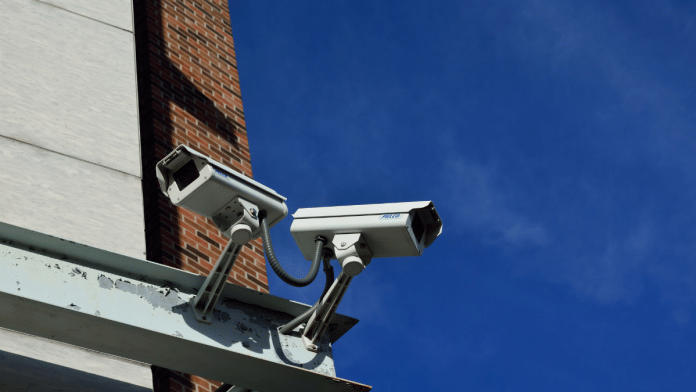
New Delhi: From Israel to Ukraine, wars around the world have a new surveillance weapon: hacked civilian security cameras. According to a report in the Wall Street Journal, devices installed to protect homes, businesses and public spaces are being turned into espionage tools to monitor troop movements, identify targets and assess damage from attacks.
The Wall Street Journal investigation published Saturday reported that an estimated 1.2 billion internet-connected cameras worldwide—as per cybersecurity consultancy firms—have become fixtures of everyday life in the form of security systems, doorbells, traffic monitors and baby monitors.
Their widespread use allows hackers to exploit devices that may have little or no protection against the intrusion. The report mentions the case of a farm owner in northern Israel, who discovered this when his camera was compromised and used to monitor movements of Israeli forces along the Lebanon border.
Analysts quoted in the report described the trend as a shift of “civilian surveillance into wartime intelligence collection”, with the proliferation of connected cameras creating a global “soft underbelly” of digital surveillance.
Based on interviews with intelligence agencies, cybersecurity experts, military officials and hackers, the investigation examined the scale and consequences of the practice. It found that intelligence agencies worldwide routinely scan the internet for vulnerable cameras, systematically testing millions of passwords to gain access.
Artificial intelligence (AI) has made the process easier by allowing algorithms to analyse vast amounts of footage, identify patterns and detect details that might escape the human eye. Hacked cameras are then used for aerial reconnaissance and human intelligence operatives like identifying targets, tracking military movements and assessing the effects of attacks.
According to the WSJ report, in 2022, Team OneFist, an international hacker group supporting Ukraine, gained control of a camera in Sevastopol, which has been under Russian control since 2014. The group used it to track a Russian military helicopter to a site near a local airport, where it identified a previously unknown Russian air base. It passed the intelligence to Ukrainian forces, which subsequently attacked the base, damaging Russian aircraft and air-defence systems, the report said.
Russia has also exploited compromised cameras to gather intelligence in Ukraine. In 2024, Russian hackers took control of residential webcams in Kyiv to identify targets and adjust missile strikes, improving their accuracy. Since Russia launched its full-scale invasion in 2022, Ukraine’s security service has identified, repositioned or blocked roughly 40,000 cameras that posed potential security risks.
Psyop tools
Hacked cameras are being used not only for military operations but also for information warfare. According to analysts cited in the report, anti-Israeli groups have used footage from compromised cameras in propaganda videos to project an image of intelligence superiority.
The Iran-linked group Handala has reportedly taunted Israelis by claiming it can see and hear them in their own neighbourhoods. “Have a message? Find the nearest traffic camera and talk,” the group wrote last year on one of its websites, which has since been taken down.
In Russia, hackers have also used unauthorised access to disrupt official communications.
Earlier this year, Russian officials from the Ministry of Industry and Trade were discussing their dependence on Chinese drone components during a videoconference when an unexpected voice joined the call.
“Colleagues, can you hear me?” the intruder asked.
The meeting leader confirmed that he could.
The intruder then posed what appeared to be a technical question before turning to obscene remarks. “Turn it off,” the leader instructed his colleagues, according to a video later posted online by Ukrainian hackers.
Days later, Ukrainian hackers released footage showing how they had disrupted a streamed Russian army recruitment presentation for students at a university in southern Russia. The intruders threatened to kill students if they joined the military.
The threat extends beyond battlefields and government offices to ordinary households.
In Prague, Ondrej Svoboda was reading to his young children one evening in 2023 when their baby monitor began playing strange sounds of people talking and background music resembling the noise of a bar.
Initially, he thought his wife was using the monitor’s two-way communication function. He soon realised, however, that the device had been hacked.“I didn’t think this was something that could happen to me,” Svoboda, who worked at a cybersecurity company, told the WSJ. “I was really scared—my heart was racing.”
He then stared silently into the camera to signal to the intruders that he knew they were there. Then he unplugged the device.
(Edited by Chingkheinganbi Mayengbam)