




I started my professional career in the IAS as the sub-divisional magistrate in Kalimpong in 1987, then a part of Darjeeling and now a full-fledged district. This was the time when the Gorkha National Liberation Front (GNLF) agitation for a separate state of Gorkhaland was at its peak. Normal life had been disrupted by a spate of violence in which 1,200-1,500 people lost their lives within a span of two years — from mid-1986 to the signing of the Darjeeling Accord on 22 August 1988. The functioning of West Bengal government offices, including treasuries, had come to a virtual halt, and all personnel with Bengali surnames were forced to quit their hearths and homes in the hill subdivisions.
When I took charge of the subdivision in August 1987, the only other functional offices were the sub-jail and the subdivisional hospital, as doctors and nurses had been exempted from the GNLF diktat to quit Darjeeling by 15 August that year. Needless to say, these were tough times, and we had to keep essential services running during intermittent strikes, closures, and complete bandhs. As the CBSE and ICSE examinations could not be postponed, convoys of army trucks were pressed into service to transport children to Siliguri from eight to 10 important centres. Many students, accompanied by their teachers and parents, were put up in dharamshalas (rest houses) in Siliguri for the duration of the exams. Things started settling down after the accord, and I remained in touch with friends, colleagues and former adversaries from the region for four decades.
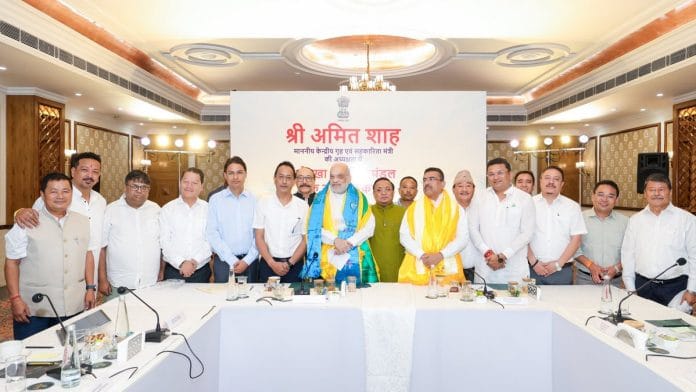
As such, I am “entitled” to reflect on the genesis of, and prognosis regarding the lingering issues and concerns in the context of the “permanent political solution” process initiated by Home Minister Amit Shah on 22 August 2026, the 38th anniversary of the GNLF accord, at Sukna in the foothills of Darjeeling.
I will also use this opportunity to draw parallels with the Frontier Nagaland Territorial Authority (FNTA) agreement signed on 5 February 2026 by the Ministry of Home Affairs (MHA), the Government of Nagaland, and the Eastern Nagaland Peoples’ Organisation (ENPO). The agreement grants financial autonomy, a mini-secretariat and devolved legislative powers across 46 subjects for the six eastern districts of Tuensang, Mon, Kiphire, Longleng, Noklak and Shamator—with Tuensang being the headquarters for the authority. At the time, Shah noted that the Modi government had signed 12 agreements to address long-pending issues in the Northeast, starting with the memorandum of settlement with the NLFT of Tripura. The column will also examine the track record of these settlements, for it is generally agreed that, with the exception of the internecine violence in Manipur, the other attempts have borne fruit.
These negotiated settlements also have to be juxtaposed against the theory and practice of the Sixth Schedule, which was incorporated in the Constitution precisely to address questions of autonomy and self-governance in tribal areas. Is it therefore time to reshape or rescind this very important Schedule, which seems to have outlived its original purpose? In fact, when Subhash Ghising, founder of the GNLF, sought Sixth Schedule status for the Darjeeling hill areas in 2004, his efforts did not capture the public imagination. On the contrary, this marked the beginning of the end of his sway over the hills.
Also Read: Why Siliguri Corridor is top priority for Suvendu Adhikari govt. New border nexus brewing
A question of identity before autonomy
Let me begin with the two major concerns of the majority hill population in Darjeeling and Kalimpong — their identity as Gorkhas and the inclusion of Nepali as a language under the Eighth Schedule. In pressing their identity as Gorkhas, as distinct from Nepal, Ghising and many other hill leaders from Darjeeling were making an important point.
By some accounts, the term Gorkha comes from “Go-Rakha”, or “protectors of the cow”. Indian Gorkhas were soldiers whose forebears had been part of the Indian Army: they had fought wars and shed blood with other Indian soldiers. They were different from other Nepalis, such as those who settled in Sikkim from the 1870s to cultivate the fields around the monasteries. Ghising, an ex-serviceman himself, argued that his community had every right to be treated as Indian citizens and also to have a separate area, preferably a state of their own, where they could exercise effective political power.
These demands received a fillip when neighbouring Sikkim’s status changed from that of a protectorate to an associate state before it was incorporated as an integral part of India in 1975 by the 36th Constitutional Amendment Act, which altered the First Schedule attached to Article 1 of the Constitution.
One immediate fallout of Sikkim’s merger with India was the recognition of Nepali as an official language in the state. With the passage of the Sikkim Official Languages Act, 1977, Nepali entered the official linguistic register of the country.
Even six years earlier, on 19 March 1971, the MP from Darjeeling, Rattanlal Brahman, had insisted upon taking his oath in the Lok Sabha in Nepali, which was allowed by Speaker GS Dhillon.
However, when Morarji Desai became Prime Minister, he not only criticised the merger of Sikkim, but also offended proponents of Nepali by calling it a foreign language.
Also Read: From Nehru to Modi, Parliament has often rewritten what the Supreme Court decided
Rise of the Gorkhaland movement
In the late 1970s, Darjeeling became a focal point for intense demonstrations, strikes and literary protests. Local organisations, students and political groups mobilised massive rallies denouncing the “foreign” tag. Writers and poets expressed collective outrage through resistance poetry and publications such as Haamro Bhasha, intensifying the long-standing Bhasha Andolan (Language Movement).
While mainstream organisations such as the All-India Nepali Bhasha Samiti (AINBS) focused heavily on the Bhasha Andolan — the linguistic demand for inclusion in the Eighth Schedule — Ghising galvanised the masses toward a political movement. On 22 April 1979, he formally raised the demand for a separate state for the Nepali-speaking people, eventually founding the GNLF to spearhead the Gorkhaland movement.
By the early 1980s, he had built up his support base, especially among ex-servicemen and tea garden workers, who now shifted their allegiance from the Centre of Indian Trade Unions (CITU) to the Himalayan Plantation Workers’ Union (HPWU). This was a real setback for the CPM, which had held complete sway in the district until then.
Meanwhile, the GNLF called for a complete boycott of the 1984 parliamentary elections in the Darjeeling constituency, marking one of its earliest major moves to disrupt state machinery and signal local alienation from New Delhi and Kolkata. The three hill subdivisions recorded less than 30 per cent turnout. Though the overall turnout was 68 per cent, this can be attributed to the much larger share of the electorate in Siliguri and the Islampur and Chopra blocks of the neighbouring district of West Dinajpur.
In the 1987 West Bengal Assembly elections, the GNLF was successful in enforcing a total shutdown of polling booths and social boycotts of anyone attempting to vote or run as a candidate.
After two years, Ghising agreed to lay down arms and come to an understanding. However, even when the principle of autonomy within West Bengal was accepted, the talks nearly broke down over nomenclature. The Left Front government wanted to call the new body the Darjeeling Hill Council, while the GNLF wanted to call it the Gorkha Council, to the exclusion of Darjeeling. Finally, a compromise of sorts was struck, and the new body was called the Darjeeling Gorkha Hill Council. Ghising became its first chairman and chief executive councillor in January 1989 and held the position for three successive terms.
(To be continued)
This is the first part of a four-column series on political settlements in the Himalayan region of Darjeeling-Kalimpong and the eight northeastern states, now referred to as Ashtalakshmi — the eight sisters of wealth and prosperity.
Sanjeev Chopra is a Senior Fellow at the Centre for Contemporary Studies, Prime Ministers Museum and Library (PMML), New Delhi, where his Fellowship topic is Borders, Boundaries and Bluewaters of Bharat. Views are personal.
(Edited by Asavari Singh)