








Hoardings change with every political transition, and it is understandable that Suvendu Adhikari’s billboards and posters will now dominate public spaces in West Bengal. However, this time, there is a change with a far deeper strategic impact: the strengthening of the Siliguri Corridor, and topmost priority being given to the acquisition of land for border roads and fencing.
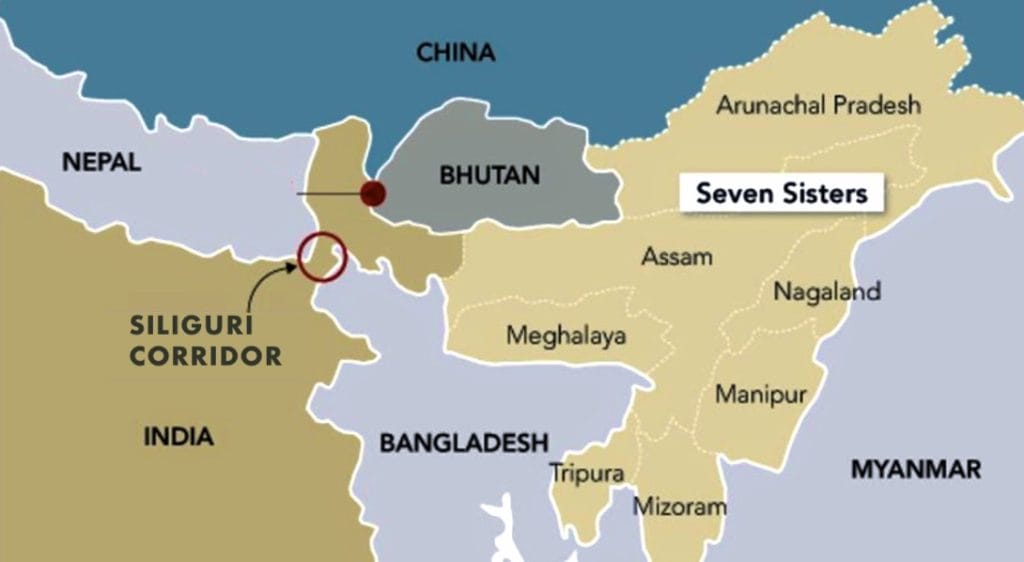
In this column, we shall examine the steps being taken to strengthen the 60-kilometre-long and 22-kilometre-wide Siliguri Corridor, which connects India’s eight North East states with the rest of the country. Colloquially called the ‘Chicken’s Neck’, this narrow passage has always posed a serious challenge.
Wedged between Bangladesh to the south and the west, and Tibet (China) to the north, the Siliguri Corridor also links India to neighbouring Nepal, Bangladesh, and Bhutan, as well as to the Chumbi Valley, the highly strategic and contested territory located at the tri-junction of India (Sikkim), China (Tibet), and Bhutan. The corridor shares borders with Nepal, Bhutan, and Bangladesh, and is only 130 km away from the Chumbi Valley.
Also Read: Will Suvendu Adhikari’s massive welfare schemes outdo Mamata’s doles? It’s a clash of legacies
Highways, high-speed railways & an underground rail link to Assam
In recent weeks, three important decisions connected to the corridor have been taken.
Last month, the West Bengal government gave ‘in-principle’ approval for handing over seven stretches of national highways to the National Highways Authority of India (NHAI) and the National Highways and Infrastructure Development Corporation Ltd (NHIDCL), paving the way for long-pending infrastructure works on key road corridors in the state.
These stretches were under the national highway wing of the state’s Public Works Department (PWD), and the transfer proposals had been pending for nearly a year despite repeated requests from the Union Ministry of Road Transport and Highways.
These include the 329.6-km stretch of NH-312 connecting Jangipur, Omarpur, Krishnagar, Bongaon, and Basirhat up to Ghojadanga along the India-Bangladesh border, besides NH-31 from the Bihar-West Bengal border to Gazole, and NH-33 up to Farakka. Four other stretches, including the Sevoke Army Cantonment-Coronation Bridge-Kalimpong-West Bengal-Sikkim border route under the new NH-10, have been handed over to NHIDCL, a Central government PSU. The Hasimara-Jaigaon stretch up to the India-Bhutan border, the Baradighi-Mainaguri-Changrabandha route up to the Bangladesh border, and the Siliguri-Kurseong-Darjeeling hill road are also under the direct supervision of the Union government. The WB government press note has confirmed that infrastructure works on these seven stretches would strengthen connectivity to Sikkim, Bhutan, and Bangladesh, while improving links between north Bengal and the Dooars.
Meanwhile, Railways Minister Ashwini Vaishnaw has also announced a bullet train between New Delhi and New Jalpaiguri (Siliguri). This will cut down travel time by more than two-thirds, from twenty hours to six, thereby bridging both the physical and the psychological distance.
The minister has also promised to expedite work on an underground rail link along the strategic ‘Chicken’s Neck’, from Tinmile Hat in Uttar Dinajpur district to Rangapani, and then onward to Bagdogra. The proposed project falls under the Katihar Division of the Northeast Frontier Railway, and spans parts of Darjeeling and Uttar Dinajpur districts in West Bengal, and Kishanganj district in Bihar. It is aimed at ensuring secure, reliable, and uninterrupted rail connectivity in this strategically sensitive corridor. Assam Chief Minister Himanta Biswa Sarma has called the proposed underground rail link a major strategic breakthrough, creating a secure and foolproof transportation corridor between the North East and the rest of the country.
Different strokes: Borders with Nepal, Bhutan, and Bangladesh
Let us now examine the strengths and challenges India faces vis-à-vis its neighbours along this border. Our relationship with Bhutan and Nepal is on a different footing compared to that with Bangladesh. Indian citizens can travel to Nepal and Bhutan without an entry visa, and a valid passport is sufficient for entry. This visa-free movement is reciprocated by India for citizens of these two countries.
Travelling to Bangladesh, however, requires a visa as well. Earlier, residents of West Bengal and the North Eastern states could travel on limited India-Bangladesh Passports issued by District Magistrates, but these were discontinued in 2013.
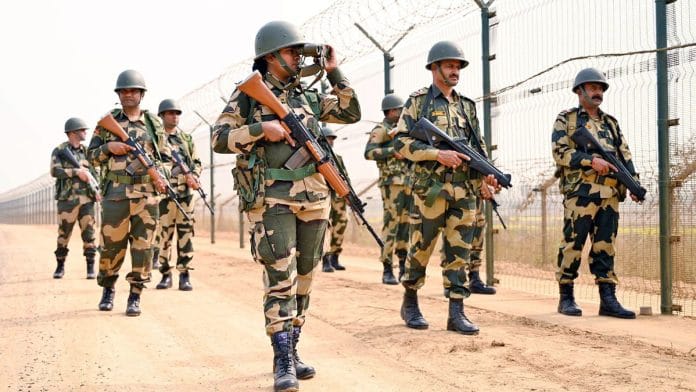
Unlike the India-Nepal and India-Bhutan borders, the 2,216.7-km-long India-Bangladesh border is heavily guarded. Of this, 1,647.7 km has been covered by fencing, and the Adhikari government has moved to expedite land transfer to complete the remaining gaps.
Two other initiatives of the NHAI will also help integrate the Siliguri Corridor within the logistics framework of Bharatmala Pariyojana, the Centre’s flagship highway programme. These include the Gorakhpur-Siliguri Expressway, a 519-km access-controlled greenfield expressway from Gorakhpur in Uttar Pradesh to Siliguri, running almost parallel to the India-Nepal border. It will significantly reduce travel time between the two nodes, besides boosting trade and people’s movement along the India-Nepal border.
Then there is the 506-km Kharagpur-Siliguri Economic Corridor to link North Bengal with the port city of Kharagpur, via Bardhaman, Morgram, Malda, and Raiganj. It will improve freight mobility, increase regional economic integration, and provide logistical support to the tea, jute, and agro-commodities trading centres along the route.
Bangladesh-Pakistan-China nexus at Lalmonirhat
While India is strengthening its infrastructure, another challenge comes from the involvement of China and Pakistan in reviving the World War II-era Lalmonirhat Airbase in northern Bangladesh.
Built by the British during World War II and heavily utilised during the Burma Campaign, the 1,166-acre aerodrome features a 4-km runway (making it historically one of the largest in Asia). It is reliably learnt that Bangladesh wants to upgrade this airfield into an operational dual-use base, with Chinese funding and technical assistance, and a Pakistani defence contractor undertaking on-ground construction.
This carries serious strategic implications for India’s defence architecture in the eastern theatre, for the airfield lies only 12 to 20 km from the Indian border, adjacent to West Bengal’s Cooch Behar and Jalpaiguri districts, and roughly 135 km from the Siliguri Corridor.
Until 1971, the Lalmonirhat Airbase was used by the Pakistan Air Force primarily as a satellite and forward airbase rather than a permanent fighter station, and later, remained largely dormant for decades under the Bangladesh Air Force. Its potential new life, though, is cause for concern.
Till the ouster of the Sheikh Hasina-led Awami League government, India viewed its border with Bangladesh as a friendly, low-militarised boundary requiring border guarding rather than heavy air defence deployment. But with this development, India will have to strengthen its air defence, surveillance, and counter-interdiction capabilities over North Bengal.
Also Read: How did West Bengal fare during 34 years of Left rule? Here’s the good and the bad
Eternal vigilance for safe and secure borders
This is a corridor that India will have to watch very closely. It has the potential to make Siliguri a trade and logistics hub under our Act East Policy, but it is also vulnerable to Chinese salami-slicing tactics, against which we have to be on the alert. Eternal vigilance is the price of keeping our borders secure and safe.
Sanjeev Chopra is a Senior Fellow at the Centre for Contemporary Studies, Prime Ministers Museum and Library (PMML), New Delhi, where his Fellowship topic is Borders, Boundaries and Bluewaters of Bharat. Views are personal.
(Edited by Asavari Singh)