





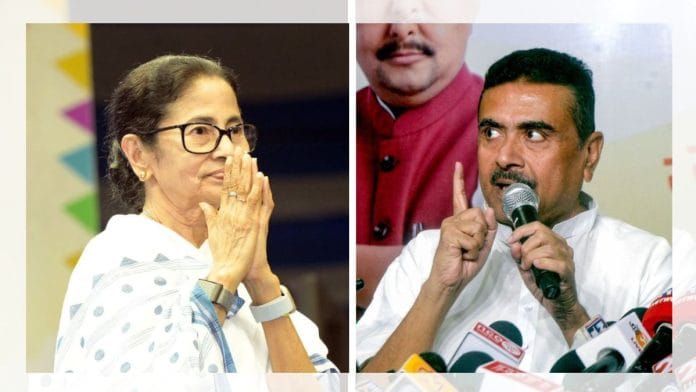


The first five years of Mamata Banerjee were reminiscent of the fresh energy and enthusiasm of the Left Front. From the Global Investors Meet to Biswa Bangla to the Agribusiness Marts and Utkarsh Bangla, the skilling mission, Banerjee took advice not just from her bureaucrats but from a cross section of society—from artists and thespians to captains of industry, serving and retired politicians. She consulted a range of artists such as Siva Prasanna, Bratya Basu, Shaoli Mitra, Jogen Chowdhury, Parambrata Chattopadhyay, Arindam Sil, and Soham Chakraborty. Banerjee even had economist Amit Mitra as her finance minister. Business tycoons such as ITC’s Y Deveshwar, Sanjiv Goenka of the RPSG Group, Harshavardhan Neotia, as well as, Sanjay Budhia were helping her shape the industrial landscape.
In 2015, Banerjee hosted the country’s leading corporates, from Mukesh Ambani to Gautam Adani, at the Bengal Global Business Summit (BGBS), which also saw ministers and high commissioners from across the world commit to investments in West Bengal. D Bandyopadhyay, the architect of Operation Barga, was on hand to advise the chief minister on agriculture and rural development. Populist schemes such as Khadya Saathi (subsidised food grains), Kanya Shree (conditional cash transfers for girl education) and Sabuj Saathi (bicycles for students) resonated deeply with rural and lower-income voters.
Another visible change from the LF was her direct integration with the officers. Under the LF, the departmental ministers and the district zilla parishad heads, except in Congress-dominated districts like Malda, Mushidabad and Darjeeling, held the reins of power. Jyoti Basu and Buddhadeb Bhattacharjee’s interaction was never direct, except in the last few years of the Bhattacharjee regime in 2011, by which time the decline had already begun.
Secretaries found that Banerjee preferred to discuss critical issues with them rather than her cabinet ministers. This was good for the bureaucracy in the short run, but in the long run, it was detrimental for political insights and inputs, which are equally important in policy communication and implementation. Although the DMs were happy to receive instructions directly from the head honcho, they all vied with each other to project an ever-positive image of whatever was being measured. When Banerjee started her district tours accompanied by her secretaries, it was a brilliant feedback exercise, but soon the distinction between the state and party vanished—even more than in the LF times. In review meetings, opposition MLAs and panchayat members were not invited; in fact, they were barred from attending altogether. As ministers lost their importance, MLAs started losing their relevance, and it soon became a Bonapartist regime. Everything was in Banerjee’s name, and she became the patron goddess for everything.
The Banerjee syndicate
The best example of Banerjee’s consolidation of power was perhaps her 2016 win, when she won 211 of the 294 seats. But the win was also because the opposition vote was split between the Left and Congress, the former getting 33 seats and the latter 44 seats, besides three each for the BJP and the Gorkha Janmukti Morcha. One Independent appeared to be political invincible. Nothing seemed to affect her victory juggernaut—not the Saradha scam of 2014, in which her transport minister Madan Mitra and TMC MP Kunal Ghosh were arrested nor the Narada sting operation videos made public on 14 March 2016, nor even the collapse of Vivekananda Road Flyover, which resulted in 27 deaths and left over 80 people injured.
From her second term, the hubris grew and became visible. In the first term, Banerjee dispensed with advice from her ministers. Now it was the turn of the senior additional chief secretaries and principal secretaries. Banerjee found it more comfortable to assign departments with large budgets like PWD, health and education to relatively junior officers, while senior officers were sent to mass education, science, and technology gazetteer units and the ATI. She now began developing a direct rapport with the directorate heads. Thereby breaking the established administrative triad of the minister rendering political advice, the secretary offering his administrative, legal and financial insights, and the directorate providing the technical inputs. Cabinet meetings were held rather cursorily—no minister voiced their concerns, and officers, in any case, were not part of the deliberations, even if they were supposed to be in attendance.
But the fate of the legislature was worse than that of the cabinet. During Banerjee’s first term, the Assembly met for an average of 42 days a year, in the second it dipped to 29 days, while in the third term it met for merely 33 days. This lacklustre was even visible in the time spent by legislators; by the third term, the average transaction time for each day of work had come down to two-and-a-half hours.
In the 2021 elections, the TMC secured another two seats and also increased its vote share from 44.9 to 47.9 per cent, but the main political upset was the BJP’s vote of 38 per cent with 77 seats and the complete decimation of the Left and the Congress. This marked Banerjee’s transition from governance to vote capture. And all semblance of running a neutral state election ended. You were either with her or against her. But to be with Banerjee, you had to be an absolute loyalist, regardless of rank, cadre, or position. She was liberal when it came to rewarding her favourite superannuating IAS and IPS officers with sinecures and, in the case of the controversial Rajiv Kumar, a seat in the Rajya Sabha. The recruitment scams, the RG Kar rape and murder, the terror in Sandeshkhali and even the messy Messi visit were all leading to a resentment of an order she was unwilling to listen. There was no one to tell Banerjee that the jig was up; senior ministers came up against the dynastic wall of Abhishek Banerjee.
Meanwhile, the BJP ran up a polarising campaign—raising the issue of the visible demographic changes in the state as well as the challenges faced by the BSF along the Bangladesh border. The SIR and the granular superintendence of the Election Commission and the transfer of the director-general of police, along with a majority of DMs and SPs and the overwhelming presence of the CAPFs certainly made it very difficult for the TMC cadres to exercise the kind of street power they were infamous for.
Also Read: How did West Bengal fare during 34 years of Left rule? Here’s the good and the bad
A new dawn…?
Suvendu Adhikari has started action on predictable, safe lines. The first few decisions by the newly elected CM include transferring land to the BSF to erect fences along the Bangladesh border within 45 days, a statewide implementation of the Bharatiya Nyaya Sanhita (BNS), the immediate rollout of the Ayushman Bharat healthcare program, wrapping up pending central welfare and census exercises and a discontinuation all religion-based assistance schemes previously operated through the Madrasa and Information & Cultural Affairs departments.
Adhikari has also initiated a review of the Other Backwards Class (OBC) certificates issued under the previous administration in accordance with the Calcutta High Court judgments and banned new liquor shops and licenses within a kilometre of schools, colleges, and temples to maintain a disciplined social environment.
However, the one real cause of concern for the state, which is facing a major fiscal crisis, is the transition from the Lakshmi Bhandar to the Annapurna Yojana. The allowance has been raised from Rs 1700 to Rs 3000 and will cover all women between the ages of 21 and 60 whose family income is less than Rs 8 lakh per annum, land holding of less than five acres and a tenement of less than 1000 square feet. The total projected cost of the new scheme is roughly Rs 72,000 crore to Rs 85,000 crore annually, consuming nearly 18 per cent of West Bengal’s overall state budget.
Also Read: West Bengal has only had 9 CMs since Independence—and 5 phases of politics
What is the way out
Asking the Centre for special financial assistance is one way, but perhaps a better, long-term and more sustainable alternative is to look at the extant MoUs which have not been implemented in the last decade.
What Mr Adhikari can do immediately is to review the follow-up on the Rs 23.4 lakh crore worth of MoUs that have been signed in the BGBS over the past decade. Those that cannot be revived must be scrapped, but those which show some possibility, for example the stalled Tajpur deep-sea project should be examined afresh.
Unless the state can transform its political economy to reverse the steady decline of its industrial potential, the downward trajectory of share in national and per capita GDP, which started with BC Roy, will continue as before.
Sanjeev Chopra is a Senior Fellow, Centre for Contemporary Studies, PMML, New Delhi, a Trustee of the Lal Bahadur Shastri Memorial, and the festival director of Valley of Words, a pan-India literature and arts festival based out of Dehradun. He tweets @ChopraSanjeev. Views are personal.
(Edited by Insha Jalil Waziri)