







India has had fifteen Prime Ministers, but West Bengal just welcomed their ninth Chief Minister, Suvendu Adhikari. This long cycle is why regime changes in West Bengal are more significant than in other states.
The neighbouring states of Bihar, Assam and Odisha have had 24, 15 and 15 incumbents at the helm. Maharashtra has had 20 CMs, while UP has had 21. Even the small state of Uttarakhand, which was carved out of UP in 2000, had had ten CMs in the last quarter century.
What then does fate have in store for Suvendu Adhikari, who was once a trusted lieutenant of former CM Mamta Banerjee. In fact, he was the face of the Nandigram agitation in 2006 against the proposed Rs 40,000 crore Special Economic Zone (SEZ) for a chemical hub by Indonesia’s Salim Group. This decision, as well as the exit of Tata from the Nano project at Singur marked the end of Buddhadeb Bhattacharya’s efforts to transform the agrarian state into a modern industrial manufacturing hub. He was the last CPI(M) CM of the state, with a tenure running from 2000 to 2011.
However, it must be placed on record that even though the CPI(M)’s new-found love for industry was echoed by Bhattacharya, Somnath Chatterjee and Nirupam Sengupta (the industries minister of Bengal), many within his own party, including the Jyoti Basu-loyalist Asim Dasgupta never gave their full support. Dasgupta was miffed that he had not been chosen as CM.
This was the background which led to Mamata Banerjee’s massive victory in 2011. It was dubbed Poriborton—transformation. But after three continuous terms of TMC—from 2011-2026 one is compelled to confront the fact that the more things change, the more they stay the same.
Banerjee followed the template of the Left Front to the tee—populism, street power, suppression of all dissent, and the ritualisation of procedure. She went a step further and personalised state power. The Left Front had to contend with recalcitrant partners like the Forward Bloc and RSP, which threw a spanner in every reform effort, and looked to extract their pound of flesh in the state apparatus.
However, the tragedy of the state—which accounted for over 27 per cent of India’s industrial production in 1947 and was the hub of commercial activity with India’s most active port and a stock exchange—is that it has lost its economic might with every successive regime. As of today, it contributes less than 6 per cent of the national GDP, and is ranked 24th in per capita GDP.
How did this happen across the five phases of the state’s political trajectory?
Also read: BJP Bengal win dissolves the old Bhadralok order. It kept Dalits and their issues out
The BC Roy phase
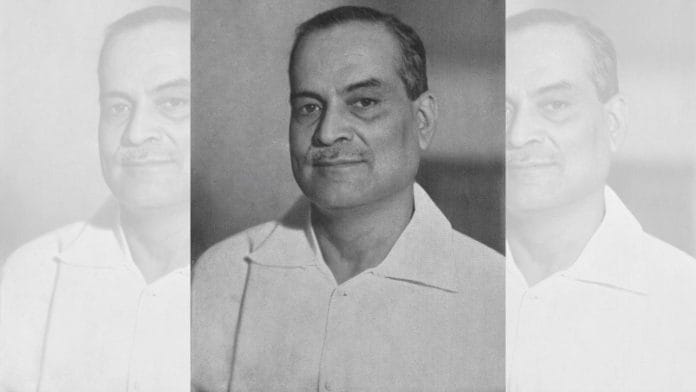
The first Chief Minister of West Bengal was Dr Bidhan Chandra Roy. He led the state for fourteen years, from 1948 till his death in 1962. During the first two years of his rule his title was Premier. This period was marked by the challenge of rehabilitating Partition refugees. Still, many new industrial projects, institutions of learning—IIT-Kharagpur, the Agriculture University at Bidhan Nagar—townships of Durgapur, Kalyani, Ashoke Nagar and Salt Lake (now called Bidhan Chandra Roy Nagar) came up during this period. The West Bengal Land Reforms Act was also passed during his tenure. Though the implementation was done by the Left Front regime two decades later.
Dr Roy did make sincere attempts at rehabilitation of the displaced persons from East Pakistan. However, unlike their Punjab counterparts, they could not be accommodated in the limited land available within the state. So he sent some of them to Andamans, others to Dandakaranya and some to the Terai belt of UP.
In 1956, Dr Roy made a very bold and innovative suggestion: Merging West Bengal and Bihar into a single state. For the record, both the state assemblies passed a resolution favouring the merger. This would have had many advantages—the new state could have leveraged the land and water resources for new migrants, the mineral resources of Bihar could have fuelled the industrial production, the combined state would have access to the port, and large river valley projects like Damodar Valley Corporation could have come under one roof. However, this was not to be. Both the CMs had to face severe internal opposition—from within the Congress, as well as from the Communists, the Bangla Congress and the regional press.
This was indeed a missed opportunity—for the combined bilingual state would have also challenged the discourse of the reorganisation of India on linguistic lines.
This was also the time when West Bengal, like the rest of the country, faced a major food crisis. But the situation in Bengal was alarming: Rice prices soared—from Rs 382 per ton in 1955 to Rs 532 per ton by the end of 1956. It led to massive protests by the Price Increase and Famine Resistance Committee (PIFRC), backed by the Communist Party of India (CPI) and other Left-wing groups demanding affordable food, fair rationing, and land redistribution.
While the state was grappling with this situation, the freight equalisation policy hampered growth. As Roy noted, “The railways own internal rates, calculated per tonne-kilometer, are Rs 30 for a tonne of steel from Jamshedpur to Howrah. And Rs 120 for a tonne from Jamshedpur to Bombay, that is, Rs 150 for these two tonnes of steel. Under the Centre’s new policy, the Calcutta user is made to pay Rs 75 and the Bombay user also Rs 75.” Since the formula was nearly the same while calculating coal tariff, coal-producing states such as Bihar and Bengal lost their competitive advantage. The impact of these policy changes was seen within Roy’s tenure—industrial output had dropped to 17.20 per cent in 1960-61.
Period of political instability
West Bengal’s second phase—from BC Roy’s death in 1962 to the advent of SS Ray’s tenure—was a period of political instability, economic decline, flight of capital, rise of Naxalism and three spells of President’s rule. This period saw a rapid turnover of CMs—Prafulla Chandra Sen, Ajoy Mukherjee with Jyoti Basu as the Deputy CM (thrice) and Prafulla Chandra Ghosh. The extreme agrarian distress, deep-rooted socio-economic inequalities, and the perceived betrayal of landless peasants by the political establishment—which now included both the Communist parties, which were part of the United Front coalition government—saw the urban youth and academics gravitating toward revolutionary cult figures like Che Guevara, Fidel Castro, Mao Tse Dong and Ho Chi Minh. The filmmakers Ritwik Ghatak and Mrinal Sen and litterateurs such as Mahasweta Devi, Saroj Dutta, Shankha Ghosh created the intellectual ferment in favour of the revolution.
Also read: Bengal is notoriously prone to political violence. It didn’t start with TMC-BJP rivalry
Enter SS Ray
Just when the state was on the verge of withering away, and facing the strain of nine million refugees, SS Ray came to power as the congress Chief minister. He was riding the wave of Indira Gandhi’s spectacular victory in the 1971 war, which saw the creation of Bangladesh.
A million refugees crossed over to West Bengal and Ray took steps for their resettlement. Soon thereafter, he started the crackdown on Maoist insurgents in the state. The methods were brutal, but effective, which is perhaps why he was also chosen as the Governor of Punjab when insurgency was at its peak in this state. Jhumpa Lahiri’s Lowlands gives an avid description of the senselessness of both the Naxal violence as well as brutal state repression. He was instrumental in passing the West Bengal Panchayat Act of 1973, which changed the pre-existing 4-tier panchayat system into the current 3-tier panchayat system, which was later implemented nationally as the 73rd Amendment to the Constitution of India in 1992.
His most celebrated achievement was the commencement of construction for the Kolkata Metro during his tenure—making Kolkata the first Indian city to have an underground rail system.
It wasn’t all good, though. The Calcutta Stock Exchange (CSE) went on a definitive downward trajectory due to the culture of political violence. It led to the departure of major India-British conglomerates from the city. International capital and business now preferred Hong Kong and Singapore to Lyons Range—the informal name for the CSE.
One may therefore say, that while he tried to arrest the decline of the state’s industrial and commercial growth, the overall ecosystem of the state was still not still not conducive for entrepreneurship.
This is the first in a three-part series mapping West Bengal’s political economy.
Sanjeev Chopra is a Senior Fellow, Centre for Contemporary Studies, PMML, New Delhi, a Trustee of the Lal Bahadur Shastri Memorial, and the festival director of Valley of Words, a pan-India literature and arts festival based out of Dehradun. He tweets @ChopraSanjeev. Views are personal.
(Edited by Theres Sudeep)