





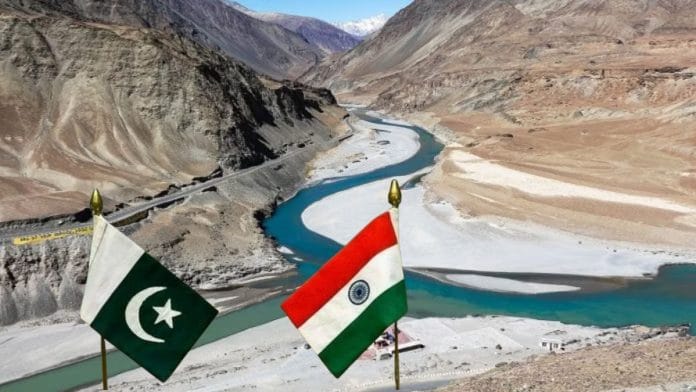


New Delhi: India Saturday rejected an award from a Court of Arbitration in The Hague concerning “maximum pondage”—the storage capacity of a reservoir. This comes while India continues work on hydropower projects on the Kishenganga and Chenab rivers amid its dispute with Pakistan over the Indus Water Treaty and its dispute-resolution mechanism.
Two days earlier, the CoA ruling on the “maximum pondage” effectively stated that India could store less “live water” in the upcoming reservoirs than its engineers had planned. It added that certain existing or proposed designs needed alteration for the projects to be within treaty-compliant “pondage”.
However, emphasising the continuance of India’s 2025 decision to keep the Indus Waters Treaty (IWT) in abeyance, Ministry of External Affairs (MEA) spokesperson Randhir Jaiswal said, “The illegally constituted so-called Court of Arbitration (CoA) has, on 15 May 2026, issued what it termed an award concerning maximum pondage supplemental to the award on issues of general interpretation of the Indus Waters Treaty.”
“India categorically rejects the present so-called award, just as it has firmly rejected all prior pronouncements of the illegally constituted CoA. India has never recognised the establishment of this so-called CoA. Any proceeding, award, or decision issued by it is null and void.”
Also Read: With Indus Waters Treaty on hold, India working to revive Tulbul project on Kashmir’s Wular Lake
The controversy
India’s hydropower projects—the 330 MW Kishenganga Hydroelectric Project on a Jhelum tributary and the 850 MW Ratle Hydroelectric Project on the Chenab—have long been central to a water-sharing dispute with Pakistan.
Pakistan’s objections to both projects relate to specific design features, including pondage and gate operation. Hence, when Pakistan filed a request for arbitration under the IWT in 2016, India responded that the appropriate forum for the dispute was before a neutral expert, as stipulated in the treaty’s dispute resolution mechanism.
The treaty’s foundational design is such that any disputes are resolved through escalating layers of engagement, with formal arbitration as the last resort. The first step involves the Permanent Indus Commission (PIC)—a bilateral body with one commissioner from each country. If the PIC cannot resolve a matter, disputes over specific technical differences go to a neutral expert—a single independent technical authority. Either country can initiate arbitration only if both mechanisms are exhausted or if a dispute is too legally complex for a neutral expert.
After the World Bank appointed French engineer Michel Lino as the neutral expert in 2022, India continued to insist on this being the correct dispute resolution route. Moreover, India emphasised that the treaty’s mechanisms are sequential, not parallel.
The Permanent Court of Arbitration (PCA) in The Hague—administering the current CoA proceedings—is itself not a court but a dispute resolution organisation that facilitates inter-State arbitrations under various treaty frameworks. Its awards carry the weight of international legal obligations, but enforcement depends entirely on political will and peer pressure. There is no global authority to compel compliance.
India objected to the ruling on the ground that the treaty never identified the PCA as a forum for arbitration. New Delhi argued that the PCA had engaged in ‘jurisdictional creep’, transforming itself from facilitator to adjudicator, granting authority through institutional reputation rather than through the explicit consent of the parties.
Despite India’s objections, the World Bank constituted the arbitration tribunal in 2022. As the treaty’s signatory, the bank, in a defined institutional capacity, can facilitate appointments when the parties cannot agree on the relevant neutral figures. That role became central once India and Pakistan disagreed not only on the substance of their objections but also on the correct forum.
The World Bank paused proceedings in 2016 while urging the parties to find an amicable way forward. It later decided in 2022 to resume both the neutral expert process and the CoA process. The present CoA was established through the treaty’s back‑up appointment mechanisms, which involved neutral appointments when the parties could not agree.
India’s position has been consistent—the “so-called” arbitral body’s very constitution was “in itself a serious breach of the Indus Waters Treaty”. It has held that any awards the CoA issued were “illegal and per se void.”
In 2025, after the Pahalgam terror attacks, India announced that the IWT would be kept “in abeyance”.
The CoA, however, said that the treaty could not be unilaterally set aside, and that it still had jurisdiction to decide on Pakistan’s issues.
Responding, the MEA stated, “Until Pakistan credibly and irrevocably abjures its support for cross-border terrorism, India is no longer bound to perform any of its obligations under the Treaty.”
“No court of arbitration, much less this illegally constituted arbitral body, which has no existence in the eye of law, has the jurisdiction to examine the legality of India’s actions in exercise of its rights as a sovereign.”
Can the CoA proceed without India
The CoA claimed that its ability to proceed despite India’s absence was a feature of the treaty India itself signed in 1960.
By ratifying the IWT, India expressly agreed that “the court shall decide all questions relating to its competence” under Annexure G—meaning the tribunal decides whether it has the power to rule, not the party objecting to it.
Further, while India refused to appoint two of the required seven arbitrators, Annexure G of the IWT provides that the court is competent to transact business when all three neutral umpires and at least two arbitrators are present. Pakistan’s two arbitrators and the three umpires meet this threshold.
When India placed the treaty in abeyance in April 2025, the CoA referred to a rule of customary international law that events occurring after the initiation of proceedings could have no effect on the jurisdiction of the relevant tribunal. It found it was not open to India to unilaterally suspend the proceedings.
While the CoA stated that India could not unilaterally put the treaty in abeyance, it has been silent on Pakistan’s unilateral initiation of arbitration proceedings. That asymmetry is central to India’s grievance of distortion of process.
A major limitation of such ex parte proceedings is that there’s no formal enforcement mechanism. The tribunal may declare any number of awards, but it cannot compel India—with its significant upstream leverage—to redesign, pause or alter any project.
There is also a practical consequence of India’s total absence from the proceedings—only the neutral expert, not the court of arbitration, has had the opportunity to physically access and inspect the projects in India. The panel in The Hague is, in effect, ruling on the design of dams it has never even seen.
Treaty history
The IWT was signed on 19 September 1960 by Indian Prime Minister Jawaharlal Nehru and Pakistani President Ayub Khan, with the World Bank as a facilitator and signatory. Since then, the IWT has been one of the few stable aspects of India-Pakistan relations, surviving multiple wars and diplomatic breakdowns.
The Indus river—one of the world’s longest rivers—rises in Southern Tibet and flows through Ladakh before veering into Pakistan. The word ‘India’ is derived from Indus—first as Sindhu in Sanskrit (meaning river), then Hindu in Persian, then Indos in Greek, and finally India in Latin.
The IWT divided the six rivers of the Indus basin between the two nations, assigning the three eastern rivers—Ravi, Beas and Sutlej—to India.
Meanwhile, the three western rivers—Indus, Jhelum and Chenab—were largely reserved for Pakistan, subject to India’s limited rights of use, including hydropower generation, under detailed design restrictions.
What happens next
P.K. Saxena, former Indian Commissioner for Indus Waters, writing in Nat Strat in July 2023, in response to the CoA’s previous award, said, “It is a welcome step by India to reject the Award of the illegally constituted Kangaroo Court and call for renegotiations of the Treaty. The dispute resolution mechanism in the present Treaty is a relic of the colonial era which heavily relies on the West and allows them to meddle in bilateral affairs. It is time for India to assert her right to exploit her resources for the benefit of our people, and take all necessary steps to secure this right”.
For Pakistan, the CoA’s accumulating awards represent growing legal capital, irrespective of India’s non-compliance and the lack of enforcement mechanisms. As the tribunal issues further rulings on the specific design elements of Kishenganga and Ratle, Pakistan builds a formal international legal record that can be cited in multilateral forums and in any future renegotiation of the IWT.
Alongside the CoA process, Pakistan has also taken its case to the United Nations. Whether the UN Security Council acts is another matter; the body is ill-suited to adjudicate technical water disputes, and its intervention requires navigating significant geopolitical calculations.
The most likely scenario is a stalemate—the CoA issues further awards; India rejects them; and the legal record remains without enforcement.
If and when India-Pakistan relations stabilise—a prospect that appears distant in the wake of Pahalgam and Operation Sindoor—the treaty’s future will become one of the central topics of any diplomatic talks.
A river that has been flowing for millennia will continue to shape the identity and security of the Subcontinent. The question is not whether the Indus flows, but who gets to direct, store, and use that flow—and on whose terms.
Saumya Sharma is an alum of ThePrint School of Journalism, currently interning with ThePrint.