








Last week was all about spectacles. Prime Minister Narendra Modi cut down the size of his convoy to two cars. Maharashtra chief minister Devendra Fadnavis rode a bike to office. Lest the target audience in the national capital missed it, Madhya Pradesh CM Mohan Yadav chose to ride the Delhi Metro.
CMs, Union Ministers, and BJP leaders were all scrambling to follow the PM’s lead—allowing nothing between them and the cameras. Bihar CM Samrat Choudhary outdid them all, walking from his official residence to the state Secretariat—all of 300-400 metres. It was an ostentatious display of austerity.
Why not continue it even after the camerapersons are gone? If our leaders can get by without those symbols of power for a day or so ostensibly to inspire the nation, they can surely do it every day. Who knows, the thought might have crossed PM Modi’s mind during his weekend visit to the Netherlands. Former Netherlands PM Mark Rutte used to cycle to the office. When he left office in 2024, he just cycled away.
During PM Modi’s visit to the Netherlands in 2017, Rutte had gifted him a cycle. Modi couldn’t use it. It’s not just about his age. It’s about the distance in India. And the Prime Minister of a vast and complex country like India needs large security details and other facilities, necessitating a big convoy.
BJP’s awkward defence
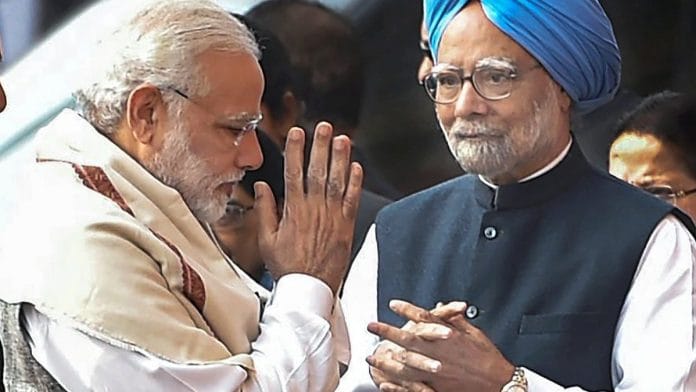
The display of austerity by India’s VIPs last week didn’t dissuade the Opposition from criticising the Rs 3 per litre hike in petrol and diesel prices and Rs 2 in CNG. The BJP’s response to the Congress criticism is rather befuddling, if not amusing. Look at the party’s long ‘X’ thread on 13 May. In trying to attack the previous Manmohan Singh government, the BJP’s ‘X’ posts ended up placing the Modi government in the same bracket in terms of their responses to the economic challenges.
One of the posts read: “Congress attacking PM Modi on gold policy is peak hypocrisy. In 2013, after years of UPA economic mismanagement weakened the rupee and pushed the economy into crisis, then Union Finance Minister P. Chidambaram literally urged Indians to ‘reduce appetite for gold’….” You may want to read it again. The ruling party is saying that the rupee weakened because of economic mismanagement.
In 2013, the US dollar-rupee exchange rate hit a record low in August when it breached the 68-mark briefly. On Sunday, as I was writing this, the rupee was almost touching 96 per dollar, having breached this mark for the first time on Friday. In July 2013, when the rupee had crossed the 60-mark, then Gujarat chief minister Narendra Modi had drawn a parallel between a falling rupee and the then government’s credibility.
“During Independence, the value of a rupee was equivalent to a dollar…. When Atalji left office, it was Rs 44 to a dollar… since our economist PM (Manmohan Singh) has taken charge, the rupee has sunk to Rs 60 a dollar. There seems to be a competition between the rupee and our government in Delhi,” Modi had reportedly said.
In the run-up to the 2014 parliamentary election, the BJP’s prime ministerial candidate kept making jibes at the Manmohan Singh government for the falling rupee. Given that the rupee has now fallen to a historic low under the Modi government, it’s really strange that the BJP has chosen to link the exchange rate with ‘economic mismanagement’.
The ’X’ post further reads: “The UPA officially pushed ‘compression’ of gold imports and other ‘non-essential imports’ because of the economic mess they had created.” Really? The Modi government is doing the same today. Is it because of the ‘economic mess’ it has created? Is the BJP defending or castigating its government at the Centre?
Read another post by the BJP from its long ‘X’ thread on May 13: “In August 2013, the-then PM Dr. Manmohan Singh publicly appealed to Indians: ‘We need to reduce our appetite for gold. We also need to economize in the use of petroleum products.’ This was not symbolic rhetoric. The UPA government simultaneously raised gold import duties, restricted bullion imports, increased diesel prices, and pushed fuel conservation messaging because India’s forex reserves were under severe pressure.”
What’s the BJP trying to do here? In 2013-14, the then-Gujarat CM had built his prime ministerial campaign to a great degree on the then-Manmohan Singh government’s policy paralysis and economic mismanagement. It’s bizarre that the BJP now suggests that the Modi government is doing the same as the Manmohan Singh government did in 2013.
Also read: Modi’s austerity call revives India’s forgotten culture of sacrifice and survival
Then vs now
Now that the ruling party itself is comparing the two governments, let’s also look at how they reacted to international crude oil price hikes. According to a report by The Indian Express, the crude oil prices (per barrel that India procured at) in 2011-12, 2012-13 and 2013-14—the last three years of Manmohan Singh government—were $113.5, $108.1 and $105.5, respectively. The prices of petrol per litre in Delhi in those three years respectively were: Rs 64.4, Rs 68.1 and Rs 70.3.
Now let’s look at the crude oil prices (per barrel) in the last three years of the Modi government: $82.5 per barrel in 2023-24, $78.6 in 2024-25 and $71.7 in 2025-26. The per litre petrol prices in Delhi in these three years respectively were Rs 96.7, Rs 94.8 and Rs 94.8. In a nutshell, compared to the Manmohan Singh government, the Modi government was buying crude oil at a much lower price until now, but the consumers in India were paying much more than they paid during the previous regime.
In 2014-15, when the Congress-led government was buying crude oil at $84.1 per barrel, the petrol price in Delhi was Rs. 66.6 per litre. In 2020-21, when the Modi government was buying crude oil at $ 44.6 per barrel, almost half of what the previous government paid six years earlier, people in Delhi were buying petrol at Rs. 80.9 per litre, Rs. 14 more than what they were paying six years back.
Of course, the crude oil has touched $107 per barrel today. It’s nobody’s case that state-run oil marketing companies (OMCs) should be running in losses to keep the prices low for consumers. But the prices should not be a matter of political convenience and expediency. Because the ruling BJP had big stakes in the last round of Assembly elections, the oil prices had to be kept low despite the crude price surge.
The government chose to offset the OMCs’ losses by reducing excise duty on petrol and diesel by Rs 10 per litre. Once the elections were over, the retail prices had to be increased. There came PM Modi’s austerity push, followed by a Rs 3 per litre hike in petrol and diesel prices. It’s too little. It is estimated to yield barely 150 crore a day to the OMCs, which, the government says, are running a loss of Rs 1,000 crore a day from petrol, diesel and LPG.
The Manmohan Singh government had deregulated petrol pricing in 2010, and the Modi government deregulated diesel pricing in 2014, essentially letting the market determine their prices on a dynamic basis. Electoral considerations have stalled its implementation in practice, though. Now that the BJP is seeking to justify PM Modi’s austerity call today by citing Manmohan Singh’s policy measures in 2013, it’s worthwhile to remember how the latter had shown a greater political will and allowed the OMCs to increase petrol price by Rs 10 per litre in 2012.
Also read: Modi’s call to cut fuel use wasn’t just about oil—it was about saving the rupee
All in the name of Modi
The OMCs have all the more reasons today to go for a stiff retail price hike, but the government is ostensibly hesitant. PM Modi’s diffidence in taking tough decisions is inexplicable. After a slight setback in the 2024 Lok Sabha election, the people have repeatedly reposed faith in the BJP in Assembly elections—Haryana, Maharashtra, Delhi, Bihar, Assam and West Bengal.
It’s a decisive Modi that they all vote for. They had stood by him and his party even after the disastrous demonetisation move. He had asked the people to give him just 50 days and bear the hardships caused by this move. They bore all the pain and went on to give a decisive mandate to his party three months later in Uttar Pradesh and Uttarakhand.
So, if PM Modi were to tell them that fuel price hike—say, by Rs 10 per litre—is essential due to the crude price surge amid the West Asia crisis, the people won’t mind. But the BJP needs to be honest with them. If they ask why they didn’t get any price relief when crude prices were very low all these years, the ruling party can tell them that the free foodgrains and direct cash transfers that they get and vote for were funded by the oil money. The middle class may not be very happy with this answer, but who cares? They have nowhere else to go.
Talking about honesty, the BJP adopting the same yardstick to judge both the Manmohan Singh and the Modi governments—economic mismanagement behind falling rupee—is quite a bold start. Next, it should seek the reasons for the capital account and the current account deficits.
DK Singh is Political Editor at ThePrint. He tweets @dksingh73. Views are personal.
(Edited by Saptak Datta)
Apples with apples. Over a decade, UPA delivered roughly two percentage points higher growth than its successor. If the incumbent dealt with Covid, its predecessor was hit squarely by the 2008 global financial crisis. Over such a long span, meaningful comparisons become possible. Note too that this government has had its full parliamentary majority, no coalition compulsions. Not even now. A complete domination over the landscape, including full institutional support.