








This is an ancient mantra from our vedas: आपदर्थे धनं रक्षेद् दारान् रक्षेद् धनैरपि। आत्मानं सततं रक्षेद् दारैरपिधनैरपि॥ It is also known as aapaddamantra—a maxim for tough times, times of emergency, times when we need to tighten our belt and prepare for an unpleasant period.
Sometimes the nation asks not for grand heroism but for small acts of discipline. Postponing non-essential consumption and moderating consumption. Even our scriptures suggest saving and using these scarce resources to protect the family or the nation.
The meaning is simple. During times of Emergency, save your wealth; with your wealth, save the family. And in acute times of crisis, save yourself before wealth and family. This is a motto that they make you revise during those take-off safety instructions in aircraft, where it is suggested you save yourself before helping others. The logic behind this: if you yourself are incapacitated, you will be unable to help anyone else and, rather, will become a burden on others.
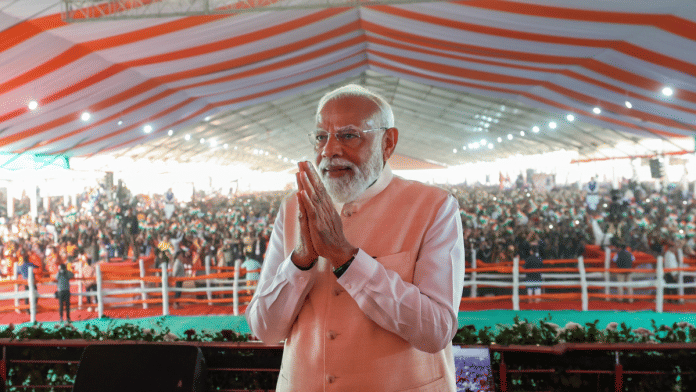
And this is exactly what is behind Prime Minister Narendra Modi’s call to action to Indian citizens. With a view to protecting and preserving our foreign exchange reserves, Modi has called for a slew of measures such as restricting the purchase of gold, curtailing non-essential foreign travel and being mindful of fuel conservation.
“The government,” Modi said, “over the past five to six years, has been working to overcome challenges arising from disruption of world supply chains.” India successfully navigated the crisis created by the Covid pandemic, and the disruption thus caused was tided over, with India emerging at the forefront of the global fight. Through schemes such as Vaccine Maitri and timely lockdown measures, India was able to mitigate the domestic crisis and emerged relatively unscathed from this ginormous disruption.
Nobody’s war
The current global crisis, originating from a war that belongs to nobody (read nobody’s war), is causing enormous strain on India’s fledgling ride as one of the world’s emerging large economies. As we approach the 90-day mark, the Hormuz Straight remains largely blocked, and Brent crude prices have shot through the roof.
West Asia is critical to the world’s energy security, and with India being literally in their backyard, any geopolitical tensions in the region are reflected immediately in India. Supply risk premiums have skyrocketed, and the uncertainty surrounding the resolution of the conflict has impacted oil price volatility and driven up prices dramatically.
In India, however, thus far, we have been able to contain the impact as the public-sector oil companies have absorbed the effect of the war, and only on Friday have petrol and diesel prices gone up by Rs 3 per litre. Domestic LPG prices have increased only once this year, in March, by Rs 60. However, should the war continue, then all the progress the government has made in ensuring the poor have access to clean energy through the Pradhan Mantri Ujwala Yojana will have been negated. “Domestic LPG remains insulated. A 14.2-kg household cylinder in Delhi continues to retail at Rs 913 after the March hike, with no further revisions despite persistent global volatility,” according to DowntoEarth.
Traditionally, we Indians have been a society that preserves, saves and restores. And our Vedic principles are also based on austerity and sacrifice. Gandhian philosophy during the freedom struggle and the ‘Swadeshi’movement involved eschewing foreign-manufactured textiles in favour of locally spun khadi. I have been on this planet long enough to recollect the blackouts during the 1971 war; as sirens went off overhead, our mother would switch off all the lights and cook dinner in the light of a candle, with all the windows covered with paper, so that a mere sliver of light could not peep through.
The ‘blackouts’ became more of a game than a sense of foregoing a well-lit family meal. I also recall how the neighbourhood bhaiyas would form night patrol groups to ensure that no one switched on the lights.
The sacrifices made during the Emergency hit much closer to home as the citizens of this country forfeited their civil rights, democratic liberties and autonomy. Thousands of opposition leaders, including PN Lekhi, Jayaprakash Narayan and Atal Bihari Vajpayee, were incarcerated without trial.
Supreme Court’s controversial ruling in the ADM Jabalpur case effectively extinguished basic civil rights through the Habeas Corpus.
The free press was muzzled, and the readers sacrificed their daily dose of news as many leading editors were behind bars. Trade Unions were illegal during the emergency, and workers forfeited their rights to protest.
And the piece de resistance, the current LoP’s grandmother presided over the Emergency as Sanjay Gandhi drove the infamous “Five-Point Programme”, mandatory, state-sponsored mass sterilisation drives.
Also read: Modi’s call to cut fuel use wasn’t just about oil—it was about saving the rupee
Rationing the Ration Card
The Ration Card was a discrete little book that contained the names of all the family members through multiple generations. Ubiquitous as a national identity card until the late 1990s, it represented a lifeline that got families everything from food on the table to their passports. A copy of the ration card had to be attached to every government-related event—purchase of property, birth registration, buying a car, which was one of the rarest of the rare occasions.
In fact, even the Maruti 800 — widely regarded as India’s first modern car — was effectively rationed, with buyers depending on a lucky draw for allotment. It’s a different story that enterprising Indians managed an innovative way to jump the queue by paying a premium.
So the Ration Card got families their monthly supply of essentials such as rice, wheat, sugar, kerosene and even edible oils during the edible oil crisis. Periods of scarcity caused by droughts, wars, oil shocks and food shortages, and India’s closed economy had taught the citizens to eat and live frugally, and austerity was an accepted way of life.
Even a ration card could be hard to come by, and for many families, monthly life revolved around the arrival of rationed grain, sugar and kerosene. This taught an entire generation of people like me the value of thrift, patience and collective endurance during national hardship. Quite the reverse of today’s Blinkit Era.
Before the economic liberalisation of 1991, the dollar was rationed, and India fiercely guarded her Forex reserves. Under the Foreign Exchange Regulation Act, ordinary citizens could not possess, purchase or acquire foreign exchange without the explicit permission of the RBI. For Foreign travel, you could purchase a princely amount of approximately $751, and the amount would be stamped on your passport. Leisure foreign travel was restricted due to a paucity of dollars, and Indian businesses faced bureaucratic hurdles to import goods.
This led to the 1991 crisis when India’s foreign exchange reserves fell to an all-time low, covering a bare two weeks of essential imports. This led to the devaluation of the Indian Rupee and the pawn of Indian gold from the treasury to balance the foreign exchange reserves.
And that’s when foreign investment, foreign goods and aspiration came flooding in. The country changed dramatically. Waiting lists were replaced with instant consumption, and a generation got hooked on instant noodles. A rising middle class embraced a culture of convenience and global lifestyles.
Liberalisation transformed the country. Coca-Cola, which exited India during the Janata era, returned after 1991 as indigenous Campa Cola faded. Kurkure and Lays Potato Chips became household consumption. Along with it, the culture of restraint and sacrifice that formed the backbone of the freedom struggle gradually eroded, and a generation used to Amazon and Zepto sometimes needs to be gently nudged to remember the history of sacrifice that forms the ethos that is Bharat. ‘Have passport, will travel’ is the mantra of the middle class. Austerity and sacrifice are now outdated concepts, and not what we are used to anymore.
Also read: PM Modi’s austerity push isn’t economic Emergency. He is preparing India for a global crisis
Austerity as strategic preparedness
As of now, there seems to be no end in sight to the global crisis caused by the US-Iran War. Ukraine was already in conflict with Russia. Trump’s visit to China may have changed some equations there, and as I write, India is participating in the BRICS conclave. But, despite this, supply chains remain vulnerable. Energy markets are volatile. Geopolitical tensions abound, as do resource conflicts.
The world today is deeply unstable. Wars continue across regions. Supply chains remain vulnerable. Energy markets fluctuate unpredictably. Cyber warfare, economic sanctions, resource conflicts, and geopolitical tensions have redefined modern warfare itself. So whilst we cannot curtail our investment in tanks, missiles and physical defence systems at our borders, we also need to manage and secure our borders. And one way for our nation to prepare is through economic resilience, which can be achieved by civilian discipline.
Moderation has always been respected in our civilisational ethos. Gandhian simplicity petered down the generations, and traditional household frugality came from the Indian culture that viewed unnecessary excess with caution. Reuse, recycle, and repair were part of our practices long before the three R’s became famous. Wastefulness has always been discouraged by our nani’s and dadi’s. Indian practices were not mere economic compulsions. They reflected a deeper understanding that resources are finite.
It is not in the interest of the nation to politicise Modi’s call for austerity. If the Covid-19 pandemic template is anything to go by, working together is good politics, and disruptors lose their image and credibility in the eyes of the people. Rather, all the political parties should rally together in the nation’s hour of need and show the world that the government’s appeal for restraint is not merely rhetorical. Yes, young India deserves prosperity, mobility and opportunity. But along with growth must come preparedness.
And discipline!
Remember, national interest always comes first.
Meenakshi Lekhi is a BJP leader, lawyer and social activist. Her X handle is @M_Lekhi. Views are personal.
(Edited by Saptak Datta)
Giving a positive spin to incompetence. The bards and IT cell is out in full force.
Dress it up all you want in the sweet poisons of sacrifice, survival, and ancient culture, the fact is you are in the middle of a crisis no one wants you to see.
Yes madam, while you, your boss and family can do wharever duck you want!
The author has invoked the ” forgotten culture of sacrifice and survival ‘ as advised in our Vedas. We can note however that remembrance of this forgotten culture took place only under the chaos unleashed by Trump and his friends on Feb 28th 2026. Till then , none of our ruling politicians took recourse to our Vedas , even though they contain wisdom for all time to come.