





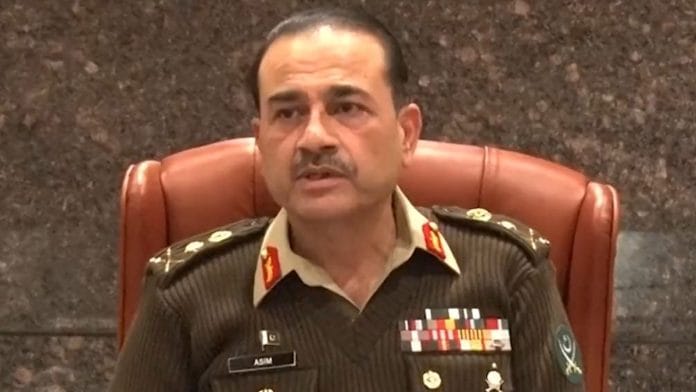


New Delhi: Two years ago, Pakistan had under its Army chief Asim Munir sought China’s help to develop nuclear second-strike capability—the ability to absorb an enemy’s nuclear attack and still launch one in retaliation—in exchange for Beijing being allowed to convert Islamabad’s deep-water port at Gwadar into a permanent Chinese military facility, a Drop Site News report has said.
Such a move would expand China’s footprint in the Arabian Sea and deepen its security presence near the Persian Gulf.
Pakistan’s other two asks were assistance in modernising its military and intelligence services to bring them at par with India’s, and guarantees that Beijing would shield Islamabad from potential American political, economic, or diplomatic pressure arising from the potential Gwadar arrangement.
China, however, declined the request. According to the Drop Site News report, Beijing concluded that direct assistance in establishing a second-strike nuclear capability would amount to overt participation in nuclear proliferation in South Asia. It could violate its own nonproliferation commitments, exposing it to international repercussions.
These moves were part of Pakistan’s strategic recalibration with its “all weather friend” amid frayed ties with the US.
Another part of the report talks about how Washington was unhappy with former Prime Minister Imran Khan’s independent foreign policies, which included his refusal to meet then CIA chief William Burns in June 2021 (when he came to secure Pakistani territory for US drone bases after America’s withdrawal of troops in Afghanistan), and a meeting with Russian President Vladimir Putin the day Russian forces entered Ukraine.
The Pakistani military, sensing things were going downhill between the two countries, sought to make reparations. A leaked classified cable revealed by Drop Site shows how Donald Lu, former US assistant secretary of state for South and Central Asian affairs, told Pakistan’s ambassador in Washington that “all would be forgiven” if Khan is removed in a no-confidence motion, which the Army consequently set out to do in 2022.
The new report also revealed that months after Imran Khan was removed from office through a vote of no-confidence in April 2022, then Army chief General Qamar Javed Bajwa travelled to Washington and reassured the Americans on two fronts. First, that Pakistan’s nuclear and missile capabilities would never reach Israel, addressing US concerns after Pakistan tested its 3,000 km-range Shaheen-III ballistic missile. Second, that a US delegation would be granted access to Pakistan’s sensitive nuclear sites.
According to Drop Site News, Bajwa’s October 2022 US visit and subsequent assurances were a last-ditch effort to repair Pakistan’s strained ties with the US, which had frayed due to Imran Khan’s foreign policy positions.
Bajwa also assured US officials that Pakistan would reconsider elements of its strategic posture towards China, its longtime strategic partner, according to Drop Site News.
The US had sought access to sensitive nuclear sites in Pakistan at the start of 2022, but the Imran Khan administration denied the request, the report said.
The latest news report sheds light on the intricacies of the relationship between Islamabad and Washington that culminated in Pakistan assuming the role of mediator in the West Asia war, and Asim Munir becoming Trump’s “favourite Field Marshal”.
Drop Site News, a Washington-based media website started by journalists, said its investigation was based on leaked diplomatic cables, documents and insider interviews. It did not cite any response from the US officials and administrations in the latest report.
Also Read: Iran war mediator Pakistan deploys thousands of troops, fighter jets to Saudi Arabia—Reuters report
The American influence
Though Pakistan’s missile programme has historically been directed towards India, the Shaheen-III test in April 2022 highlighted that Israel could be within its reach. It set off alarm bells in Washington DC.
In October 2022, General Bajwa, during his final month as Army chief, met with US Defence Secretary Lloyd Austin and then US President Joe Biden’s national security adviser Jake Sullivan. He reportedly signalled to the US that Pakistan was willing to place informal limits on its missile range, and that there was no reason to worry.
On his return to Pakistan, Bajwa contacted the head of the Strategic Plans Division, or the military body responsible for overseeing Pakistan’s nuclear weapons infrastructure. He directed the official to permit an American delegation to access certain sensitive nuclear sites. The SPD chief reportedly declined, saying he only reported to the PM through Joint Chiefs of Staff Committee chairman General Sahir Shamshad Mirza.
Days later, Biden made an unexpected public remark, describing Pakistan as “one of the most dangerous nations in the world”. It puzzled diplomats and analysts. According to Drop Site News, it was actually an expression of frustration within the Biden administration over General Bajwa’s inability to secure the access American officials had sought.
General Bajwa retired in November 2022 and was succeeded by General Asim Munir. Over the following years, Munir steadily consolidated power amid deepening political turmoil while expanding the military’s role in Pakistan’s governance.
By 2025, General Munir had elevated himself to the rank of field marshal, created a new office of Chief of Defence Forces and pushed through constitutional changes that eliminated the role of the Joint Chiefs of Staff Committee. For the first time in Pakistan’s history, authority over the military hierarchy and nuclear command mechanisms was effectively centralised under a single individual.
COAS Field Marshal Asim Munir now exercises complete control over Pakistan’s nuclear command structure.
(Edited by Gitanjali Das)